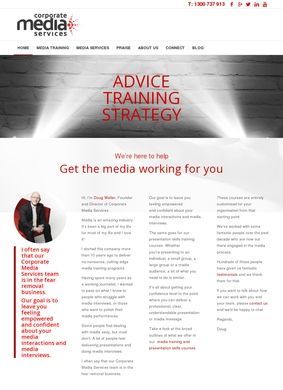
Corporate Media Services is an Australian firm that trains executives and organizations to handle the media, based on the practical mechanics of interviews, spokesperson work, and crisis communication. The site lays out a clear set of courses and pitches them under the line "real world training for real world situations," which is a fair summary of what the material seems built around: getting people through a radio grab, a television camera, a hostile print reporter, or an online story without freezing or saying the wrong thing.
Training courses for executives and spokespeople
The training catalogue is the substance here, and it is easy to see who each piece is for. Executive Media Training and Media Spokesperson Training target the people who end up in front of a microphone on behalf of a company. Crisis Media Communications Training addresses the harder scenario, when the story is already bad and the clock is running. There is also Public Speaking and Presentation Skills Training, which reaches past media work into the broader problem of standing up and being convincing. Webinars sit alongside the in-person courses, a useful option for teams that cannot pull senior people out of the building for a full day. Together the four course lines give Corporate Media Services a spread that runs from routine interview drills to the pressure of a live crisis.
Consulting and media strategy services
Beyond the courses, the offering widens into consulting. Corporate Media Services provides media consulting and media strategy development, aimed at organizations that need a plan before they need a spokesperson. That pairing is sensible. A crisis course teaches you to survive the interview, and a strategy engagement is where you decide what you are trying to say in the first place. The site also keeps a media resources section stocked with articles, videos, and links, which reads as a genuine reference area for people wanting to read up before they book anything.
Who the training reaches
The audience list is specific enough to be useful. The firm names executives, managers, and senior team members as the obvious core, then extends to first responders and subject-matter experts, two groups that end up talking to reporters more often than they expect and usually with far less preparation than a chief executive. A scientist explaining a study or a fire officer briefing on an incident faces the same cameras as a corporate spokesperson, and the fact that the training explicitly reaches for them suggests the people behind it understand where the real demand sits.
National coverage with online delivery
Geographic reach is broad for a training business. The firm lists coverage across Melbourne, Sydney, Brisbane, Canberra, Perth, Adelaide, Hobart, and Darwin, which is effectively the whole country, and it offers online delivery for international clients. For a company whose product depends heavily on in-person coaching and real-time feedback, having both a national footprint and a remote option is a practical answer to a real constraint. A regional manager in Darwin and a client abroad can both get something without waiting for a trainer to fly in.
What verification is available?
One thing worth flagging plainly: no independent reviews or ratings turned up for this particular company. A search on the name mostly surfaced unrelated American businesses with similar names, none of which are this Australian outfit, so there is no Google or Trustpilot picture to lean on either way. That is not a mark against the work, but it does mean a prospective client is judging the offering on the site's own description and on a conversation, without a crowd of past customers to check it against. For a service bought largely on the strength of the trainer, that puts more weight on the initial contact.
Contact options and director visibility
On that front the practical details are refreshingly open. There is a national phone line, 1300 numbers being the usual Australian business standard, and, more unusually, a direct mobile for the director, Doug Weller, listed right there. Naming the person who runs the business and handing over his mobile is a small signal of confidence that a faceless enquiry form does not send. A contact page with a form is there too, along with active profiles on Facebook, Instagram, LinkedIn, and YouTube, so reaching Corporate Media Services can happen through whatever channel suits the enquirer. For a media trainer, keeping a visible presence on video and social platforms is also a quiet demonstration of the skill being sold.
The gap in the picture is verification. Everything Corporate Media Services claims about method and reach is stated by the firm itself, and there is no third-party feedback to confirm how the sessions actually land. A buyer would reasonably want to ask about the trainer's own media background, request a reference or two, and get a clear sense of course length and format before committing. The mobile number makes those questions easy to put directly to the person answering for them.
Weighed against a well-known alternative like the Sydney-based Media Manoeuvres, another Australian media-training specialist with a longer public trail of client testimonials, Corporate Media Services competes more on access than on visible track record. What it has going for it is national coverage, a named and reachable director, and a course list that clearly separates everyday spokesperson work from genuine crisis response. The published material makes a decent case for Corporate Media Services on its own, but it stops short of proof: no client names, no testimonials, no third-party rating to weigh against the pitch. A caller who pushes past the courses to ask about the trainer's own on-air history and past clients gets a much clearer picture than the website alone provides.