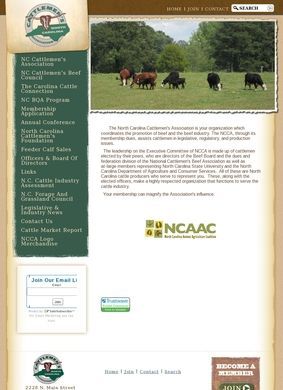
A cattle producer in the eastern part of the state needs hay before the week is out, wants to know whether the feeder calves heading to market will fetch a fair price, and keeps hearing warnings about New World Screwworm moving north. Those three worries land on different desks in most places. The North Carolina Cattlemen's Association tries to put them on one. It is the statewide trade body for beef in North Carolina, built around the people who raise the animals, and most of what it does answers a practical question a working farm is already asking.
Hay and feeder cattle marketplaces
Start with the tools, because they are the part a producer reaches for first. The NC Hay Finder, run by the North Carolina Cattlemen's Association, connects growers who have hay to sell with the operations that need to feed it, which during a dry stretch is the difference between holding a herd together and selling down. NC Feeder Cattle works the same logic on the marketing side, giving buyers and sellers a platform to move feeder cattle. Neither is glamorous. Both solve a real bottleneck, and the fact that the association builds and runs them itself, rather than pointing members off to some third party, says something about how it sees its job.
Beef Quality Assurance certification
Then there is the Beef Quality Assurance program. BQA certification is the kind of credential that increasingly shapes who a producer can sell to and at what grade, covering handling, animal health, and the husbandry practices that buyers down the chain now ask about. Offering it through the North Carolina Cattlemen's Association, an organization that knows North Carolina conditions, keeps producers from having to chase certification somewhere that does not understand their operations. That practical bent runs through the educational material too. "Beef Basics" is aimed squarely at North Carolina producers, and the association keeps current information on issues that can hit a herd fast, the screwworm threat being the live example.
Legislative monitoring and industry assessment
The advocacy is the quiet half of the answer, and arguably the larger one. The North Carolina Cattlemen's Association does legislative and regulatory work on behalf of cattlemen, which means someone is watching the bills and rule changes that can reshape a farm's costs and obligations long before they reach the pasture. A single operation rarely has the time or the standing to track that. A statewide group can, and that pooled attention is a large part of what dues buy. The North Carolina Cattlemen's Association also administers the Cattle Industry Assessment program, the checkoff-style mechanism that funds beef promotion, so it sits at the point where producer money turns into industry marketing. That is a position of real responsibility, and it puts the association close to the financial machinery of the whole state sector, well beyond its own membership.
Publishing membership communications
Information flows through the membership as well. The Carolina Cattle Connection is the association's own periodical, a regular channel for the news, market notes, and program updates that a scattered, rural membership would otherwise struggle to gather on its own. Print and a mailing list still do real work in agriculture, and keeping a publication going is a steadier commitment than posting now and then to social media, though the North Carolina Cattlemen's Association does maintain a presence on Facebook and Twitter for the faster updates.
Scholarships and forage expertise
For the next generation, the North Carolina Cattlemen's Association runs a scholarship program through its Foundation, directed at agriculture students with a genuine interest in the cattle industry. That is a long game, and it tells you the organization is thinking past the current crop of members toward who will be raising cattle in twenty years. The association is also affiliated with the NC Forage and Grasslands Council. Forage is the foundation of any grazing operation, so that link gives producers a path into pasture and grassland expertise alongside the cattle side.
There is a lighter strand too. Branded logo merchandise is available for anyone who wants to wear the affiliation, which is a minor thing, but trade groups that build a bit of identity tend to hold their members better than ones that stay purely transactional. The substance, though, is plainly in the tools, the certification, the advocacy, and the publication. The merchandise is a footnote, not the pitch.
What I appreciate about how the North Carolina Cattlemen's Association presents itself is that the offering reads as coherent. The hay tool, the feeder cattle platform, BQA, the assessment program, the magazine, the scholarships, and the forage council tie-in all orbit the same constituency. Nothing on the page feels bolted on to look busy. A producer can see, fairly quickly, how the pieces connect to the actual rhythm of running cattle through a North Carolina year.
Independent reviews are scarce. A search turns up no substantial volume of them for the North Carolina Cattlemen's Association on general platforms, which is typical of a state trade association rather than a consumer-facing business. What the public record does show is sustained engagement with the North Carolina legislature and regular presence at national Cattlemen's Beef Association events, both of which point to a group that stays active in its field.
If there is a limit worth naming, it is that the value of an organization like this depends heavily on engagement. The North Carolina Cattlemen's Association can run the Hay Finder and the BQA sessions, but a producer who joins and never logs in, never gets certified, and never reads The Carolina Cattle Connection will not feel much return. The infrastructure the North Carolina Cattlemen's Association provides is there. Using it is on the member. That is true of any trade association, and it is fairer to say it plainly than to pretend membership is self-executing.
Weighed up, the North Carolina Cattlemen's Association comes across as a working organization doing the unflashy jobs a state beef sector needs done: moving hay and cattle between producers, certifying quality, carrying the industry's voice into the legislature, funding promotion through the assessment, and bringing students into the field. It is built for people in the business, and it makes no claim on a general audience. BQA certification and the Hay Finder are the two tools to look at first, since both have direct, near-term consequences for any operation, and the Cattle Industry Assessment is the right question to press on when evaluating how producer money is being used.