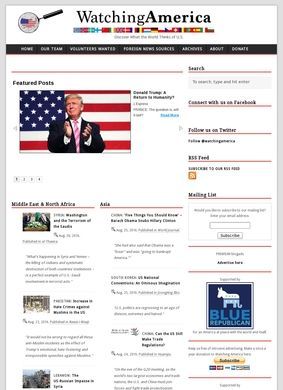
Watching America publishes English translations of what the rest of the world's press writes about the United States, and it does the translating with a human volunteer team instead of machine software. That is the whole premise, and it is an unusual one. Most sites gathering foreign coverage lean on automatic translation; this one recruits people to do it by hand. That single choice, human translators over software, colours everything the site publishes.
The result is a curated stream of foreign opinion and analysis about American politics, foreign policy and domestic affairs, pulled from newspapers and commentators outside the country and turned into readable English. For an American reader, Watching America opens a window onto how a given policy looks from Cairo, Beijing or Berlin, the kind of view the domestic press rarely supplies.
The value of that is easy to underrate. American coverage of American politics is abundant. Coverage of how the same events read in Ankara, Lagos or Sao Paulo is not, and a foreign editorial often flags an angle the home press has quietly treated as settled. Surfacing that gap is the entire reason the site exists.
What the site publishes
The content is arranged to be browsed by where it comes from. Watching America sorts its translated articles by world region, the Americas, Europe, Asia, Africa and the Middle East, so a reader can go straight to how a particular part of the world is reading Washington.
Two more layers sit on top of that regional split: subject tags that cut across regions, and a directory naming exactly where the translations come from. Together the three make the site easier to search than a plain feed of translated headlines would be.
Organised by region
That regional split is the sensible backbone for a site like this. A reader curious about Chinese commentary on a trade dispute, or European reaction to a US election, can filter to it without wading through everything else first. Featured and recent pieces sit up front, and an archive holds the older material for anyone tracing how foreign opinion shifted over a longer stretch of time.
Topic tags and the archive
On top of the geography, the site tags its pieces by subject. Tags such as Donald Trump, China and foreign policy let a reader cut across regions and follow a single theme through many national viewpoints at once.
The archive gives that some depth. Between the two, someone researching how one issue played out across a dozen countries has a genuinely usable tool, which is more than a plain list of links would ever give them.
The Foreign News Sources directory
One page worth singling out is the Foreign News Sources directory, which lists the international publications Watching America draws from. That is a quiet mark of seriousness. Naming the sources it draws from lets a reader check the original outlet and weigh its leanings, instead of taking each translation purely on trust. For a project built entirely on second-hand material, that transparency counts for a lot.
Who makes it and how it holds up
The people behind Watching America are largely volunteers, and the site is open about wanting more of them. It recruits translators aged 18 and up, experience preferred but not required, who agree to turn around at least one article every two weeks. It states plainly that the translation is done by a human language team, not by AI.
Two-week turnaround, unpaid work, an open call for more hands: those are the terms Watching America sets for the people producing its content, and they shape the site as much as any editorial choice does.
The volunteer translators
That volunteer model cuts both ways. Human translation should read better and catch the nuance a machine flattens, which is a real point in the site's favour. The flip side is capacity. A roster of part-time volunteers, each filing one piece a fortnight, sets a natural ceiling on how much and how fast Watching America can publish, and coverage will tilt toward whatever those translators happen to follow.
The two-week cadence is itself a telling detail: frequent enough to keep the site alive, slow enough to make clear nobody is being paid to chase breaking news. It is an honest arrangement, and a fragile one.
Getting in touch is limited. An email address is offered, and there are team and about pages, but no phone number and no postal address turn up anywhere on the site. A donations page rounds out the picture, which fits a reader-supported, volunteer model and helps explain the absence of the commercial-review trail a normal business leaves behind. For a publication run this way that is understandable enough, though a reader wanting to reach an actual editor has only the one channel to try.
Outside verdicts are hard to come by, and what little exists needs reading with care. No reader or customer reviews of Watching America surfaced in a search: no Google, Trustpilot, Yelp, Facebook or comparable ratings at all. What did turn up were workplace reviews from people who have worked or volunteered there, a few on Glassdoor and listings on Indeed and CareerBliss, which speak to the experience of contributing, not to the quality of the reading.
An automated site-safety scanner rates it a medium trust score, but that is a program scoring domain characteristics, not a human vouching for the work.
Set against the obvious alternative, running a foreign newspaper through automatic translation with no human involved, Watching America offers two things a browser cannot: someone has already chosen which foreign pieces are worth reading, and a person rather than an algorithm has done the translating. The trade is breadth and speed, since a small volunteer team will never match the reach of an automatic tool.
For a reader who wants curated, human-checked foreign commentary on the United States and does not mind that the well fills slowly, Watching America is a genuinely useful stop; for one chasing the very latest reaction the hour it lands, the automated route still wins.