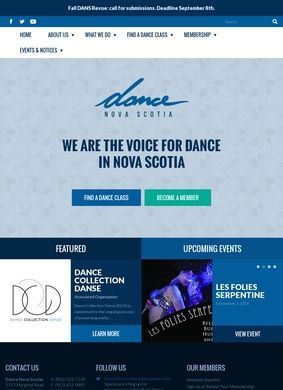
Who represents dance at the provincial level in Nova Scotia? Dance Nova Scotia does, as the governing and professional association for the sector, describing itself on its own pages as generously funded by the Province of Nova Scotia. That public backing shapes what the organisation is: a sector body rather than a single studio, built to serve dancers, companies, educators, and the wider community across the province.
Programs built around who dances
The Dance Nova Scotia program list is where the association's reach shows. Breakspace and Perform! sit alongside Dance Week and Dance Day initiatives, and the range points outward to specific communities instead of a single audience of trained performers. The programming reads as a sustained attempt to widen who feels invited into a studio in the first place.
Dance Week and Dance Day work as public-facing moments, the kind of calendar anchors that give a scattered sector a shared occasion and give the general public a reason to pay attention. Perform! and Breakspace point the other way, toward the working artists and companies who need platforms and development. The association is clearly trying to serve the audience and the practitioner at the same time.
Youth bursary programs run underneath all of this, opening a financial door for younger dancers who might otherwise be priced out of training. The spread of initiatives tells you the organisation treats dance as something for a whole population, from children through to older adults, and never a discipline reserved for people already inside it.
Move with Pride and Dance for Health programs
Two programs are worth singling out because they name their audiences directly. Dance for Health treats movement as something older bodies benefit from, with seniors' classes on the schedule, while Move With Pride carves out space for LGBTQ+ community members. Together they push the association past performance and into public wellbeing and inclusion, a broader remit than the word "dance" alone might suggest.
Programs like these are how a provincial body justifies public funding: it reaches people a private studio has no commercial reason to court.
Practical services for the sector
Beyond the programs, the Dance Nova Scotia site works as a hub of tools a working dancer or company can actually use. A dance events calendar tracks what is happening around the province. DANSpace offers bookable studio and rehearsal space. A dance-sector database gathers the field in one searchable place, and there are job postings for anyone looking for paid work in dance.
For an educator or a company manager, this is the useful, unglamorous machinery of working in the sector: a calendar to plan around, a room to rehearse in, a directory to find collaborators, and a board that lists the jobs. It is the sort of infrastructure individual studios cannot build alone, which is a fair part of the argument for a provincial body funding it centrally.
Dance Nova Scotia also sells ballet shoes, a small and concrete detail that says something about the whole operation: the association handles the mundane supply needs of dancers as readily as the loftier ones. Member benefits stretch to insurance, a genuinely useful thing for freelancers and small companies that struggle to arrange coverage on their own, and a Program Partnership scheme offers fundraising support to member organisations.
DANSpace and the sector database
For a choreographer or an independent company, the pairing of bookable rehearsal space and a searchable directory of the local dance world is the practical heart of what Dance Nova Scotia offers. DANSpace answers the perennial question of where to rehearse, and the database makes the province's dancers, teachers, and organisations findable to one another.
These are the resources that get used week to week, quietly, by people with a show to mount and a deadline to hit. A directory is only as good as its coverage, and a database maintained by the provincial association has a better chance of being complete than any single company's private list of names.
Community, communication, and acknowledgment
Dance Nova Scotia keeps members informed through VOCAB, a member newsletter, and runs a podcast, so there is an ongoing editorial voice attached to the organisation, a living channel instead of a static set of pages. Presence on Instagram, Facebook, TikTok, YouTube, and LinkedIn extends that reach toward where younger dancers already spend their time.
The fundraising support under Program Partnership turns Dance Nova Scotia into a practical backer of the smaller groups under its umbrella, a concrete kind of help instead of a vague promise of advocacy. The framing the site keeps returning to, "Building A Community United in Dance," lines up with what the pages actually assemble.
VOCAB, the podcast, and a land acknowledgment
The newsletter and podcast give the sector a regular pulse, while the site also carries a land acknowledgment recognising Mi'kmaw ancestral and unceded territory. That acknowledgment, placed alongside the programming and the member services, situates Dance Nova Scotia within the province it works in. A visitor can book a rehearsal slot, order a pair of ballet shoes, and read that acknowledgment inside the same handful of clicks.