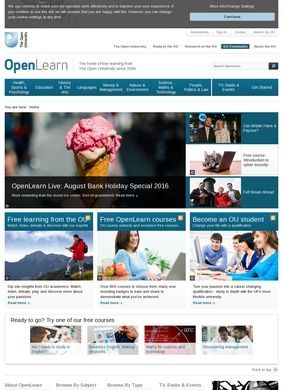
Finish certain courses on OU Open Learn and the platform hands over a digital badge or a statement of participation, and it does this without asking for payment at any point. Free study with something to show for it at the end is the concrete promise the site is built on.
The scale behind that promise is large. OU Open Learn cites more than 10 million course enrollments across hundreds of free courses, and it runs under The Open University, the UK institution that has delivered distance learning for decades. The line it uses to describe itself, "20 years of changing lives with free learning," is a claim the enrollment figure backs up.
The audience it is built for is anyone at all. The Open University's whole premise is open access to education, and the free arm carries that into practice by dropping the two barriers that usually stop people: cost and entry requirements. This is not a small outfit that turns up as a single line in a business directory, it is the free-access wing of a public university system built to reach as many people as possible. There is no application, no fee, and no prior qualification needed to begin a course.
Free courses across a wide subject spread
The catalogue is broad by design. OU Open Learn sorts its free content into subject areas that cover most of a general curriculum: Digital and Computing, Education and Development, Health, Sports and Psychology, History and the Arts, Languages, Money and Business, Nature and Environment, Science, Maths and Technology, and Society, Politics and Law. A learner can move from a coding primer to a language taster to a politics explainer without leaving the site or reaching for a card.
The formats vary too. Alongside structured courses sit articles, videos, and interactive activities, so a topic can be picked up as a five-minute read or worked through as a longer guided course. That flexibility fits how most people learn online, in short bursts around other commitments.
The completion markers deserve a second look, because they are the feature that pushes a browser into a finisher. A badge or statement of participation gives a free course a finish line, and for someone rebuilding study habits, that small proof of progress does real work. It is a light incentive, not a heavyweight credential, and the site treats it as exactly that.
Subjects from computing to law
The spread maps onto a working university's departments. Science, Maths and Technology sits beside History and the Arts, and the Society, Politics and Law strand carries current-affairs material that dates quickly and needs a credible source standing behind it. Open University academics feed that pipeline, which gives OU Open Learn an academic grounding under the free label. It shows most in the subjects where accuracy is easy to get wrong.
Some strands are more useful day to day than others. The Money and Business material suits someone trying to understand personal finance without paying an adviser, the Languages tasters give a low-stakes way to test whether a new language will stick, and the Health, Sports and Psychology courses reach a general audience that would never open a textbook on the topic. The value is in lowering the cost of curiosity to nothing.
Interactive activities and quizzes run through much of this, which keeps the shorter pieces from turning into a wall of text. A quiz that scores an answer, or an activity that asks the learner to do something, holds attention better than a page that only asks to be read.
Skills, quizzes, and themed hubs
Beyond the subject courses, the site adds the connective tissue that keeps casual learners coming back to OU Open Learn. Study-skills and work-skills content helps people returning to learning or preparing for a job. Games, quizzes, and interactive activities turn passive reading into something with a score attached. Seasonal themed collections, such as sports or politics hubs timed to events, plus curriculum-linked material aimed at schools and home learners, give teachers and parents a ready set of resources to pull from. A personal profile tracks progress across all of it, and a newsletter keeps regulars informed of what is new.
For schools and home learners, the curriculum-themed collections are the real draw. They gather material against the topics a syllabus covers, so a parent teaching at home or a teacher hunting for a supplement finds something aligned instead of improvising. That practical framing, content organised around how it will be used, is a sign OU Open Learn thinks about how its material gets applied, well beyond where it gets filed.
Who the free model suits, and its limits
Creating an account costs nothing and switches on the progress tracking, so there is no barrier to starting. Someone topping up a skill on their own, chasing a subject out of plain curiosity, or building lessons for a child at home finds OU Open Learn close to ideal, because the price is zero and the range is genuine rather than a thin sampler.
The progress tracking is quietly important for the people OU Open Learn serves best. Adults fitting study around work rarely finish anything in one sitting, and a profile that remembers where they left off, paired with a newsletter that nudges them back, is often the difference between a course started and a course completed. None of that convenience sits behind a payment.
The honest limit sits in the credentials. A digital badge or a statement of participation records that someone completed a course, and neither is a formal qualification. OU Open Learn is upfront that its free tier is separate from the accredited degrees The Open University charges for, so anyone hoping to turn this study into a recognised certificate will have to move to the paid side of the house.
That caveat frames the offer instead of undercutting it. As a place to learn something real at no cost, to sample a subject before paying for accredited study, or to keep a curious mind occupied, OU Open Learn does what it sets out to do and asks nothing in return. Judged on its own free and broad terms, it is one of the more useful learning resources online, provided a user goes in understanding that a badge here is a record of effort and not a diploma.