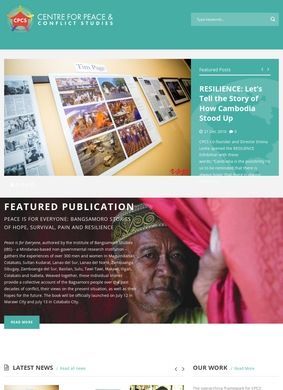
A ceasefire in Myanmar stalls, a community in the southern Philippines splinters along old lines, and the people trying to hold things together often bring passion but no formal grounding in how a conflict actually shifts over time. That gap is the one the Centre for Peace and Conflict Studies sets out to close. The Siem Reap organization describes its work as "Leadership and Facilitation for Positive Peace in Asia," and it backs the phrase with training, research and graduate study aimed at practitioners who are already in the field rather than at students starting from scratch.
What the Centre for Peace and Conflict Studies offers is not abstract. It is a peacebuilding NGO built around three connected activities: conflict transformation, peace research, and the training that ties them together. The audience it has in mind is clear from the geography it names, with program focus across Myanmar, Cambodia, the Philippines, Nepal and the wider Asian region.
Training built for people already in the work
The heart of the offering is education pitched at working practitioners. The Centre for Peace and Conflict Studies runs an MA Programme and a PhD Programme in Applied Conflict Transformation Studies, known by the shorthand ACTS, and the word "applied" is doing real work in that title. These are degrees for people who need theory they can carry back into a negotiation or a community meeting, not credentials to hang on a wall.
That framing sets the Centre for Peace and Conflict Studies apart from a conventional university department, where peace studies often stays at arm's length from the places it describes. Here the training and the field are meant to feed each other.
The ACTS degree programmes
The ACTS structure lets someone active in Cambodian or Nepali peace work study conflict transformation formally while keeping a foot in practice. It is a demanding proposition, and the payoff depends heavily on the quality of the teaching and the cohort, neither of which a listing can verify from the outside.
What the Centre for Peace and Conflict Studies makes plain is the intent: scholarship grounded in real cases from the region, taught to the people living closest to them.
Research, publications and the annual gathering
Alongside the degrees, the Centre for Peace and Conflict Studies keeps a working library of publications on peacebuilding, plus multimedia resources for people who want to read or watch rather than enroll. The catalogue leans practical, the sort of material a facilitator might consult before walking into a difficult room.
One concrete example stands out. The Centre for Peace and Conflict Studies produced a report on security sector reform in collaboration with the Australian Civil-Military Centre, or ACMC, which is the kind of institutional partnership that lends weight to an organization operating far from the usual funding capitals. Co-authored work with a government-linked body is a signal a reader can actually check.
The annual practitioners' conference
The Annual Peace Practitioners' Research Conference has been running for more than a decade, which gives the Centre for Peace and Conflict Studies a track record of bringing field researchers together in one place year after year. A recurring conference is one of the surer signs that an organization is doing continuous work and not coasting on a single project, and this one anchors the research side of the Centre for Peace and Conflict Studies to a fixed point on the calendar every year.
It also gives practitioners scattered across several countries a reason to compare notes in person, which is worth more in this field than any single published paper.
Standing, reach and the harder questions
Values sit at the front of how the Centre for Peace and Conflict Studies presents itself: being "Grounded," "Excellence," "Trust," courage, and "Continued Learning." Stated values are cheap on their own, but the applied bent of the programs and the security-sector report give at least some evidence that the first of those, being grounded, is more than a poster.
There is also a change worth noting for anyone weighing the organization. A Facebook post records that the founding Executive Director, Dr. Emma Leslie, stepped away after two decades leading it. Twenty years of continuity followed by a leadership handover is a real inflection, and how the Centre for Peace and Conflict Studies holds its direction through that transition is a fair thing for a prospective student or partner to ask about directly.
A name that many other institutions share
Checking the reputation of this specific organization is genuinely awkward, and the awkwardness is not the fault of the Centre for Peace and Conflict Studies. A search for the name mostly turns up unrelated units that use almost the same words: centres or centers for peace and conflict studies at Ball State University, Seton Hall University, Wayne State University, RIT Kosovo, and the University of St Andrews, all separate bodies. Beyond that overlap sit the organization's own Facebook page and a partner profile hosted by Conciliation Resources at c-r.org.
No consumer ratings, scores, or review counts turned up for the Cambodia-based group in particular. That absence is not damning for a specialist NGO, since peacebuilding outfits rarely collect stars the way restaurants do, but it does mean an outsider leans on the visible partnerships and the conference record instead of a tidy tally. Contact is handled through a listed contact page with links to Facebook, Twitter and LinkedIn, though no phone number, email address or postal address showed up in the pages that were reviewed, which is a small friction for anyone wanting to reach the office quickly.
So the picture is one of a serious, regionally rooted peacebuilding organization with real programs, a named institutional partner, and a long-running conference, set against limited public verification and a leadership change still settling. It reads as a school built inside the conflicts it studies, in Siem Reap and across the wider region, and that closeness to the field is the strongest case for choosing it over a distant university department that studies the same conflicts from afar.