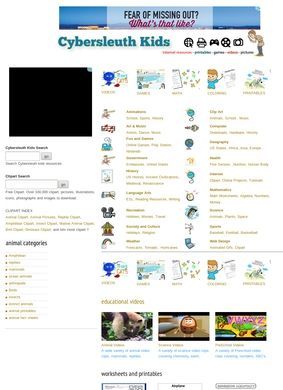
CyberSleuth Kids advertises a clipart library of over 100,000 images: illustrations, icons, photographs, and plain pictures a teacher can pull straight into a worksheet. That is the biggest number the site puts in front of you, and it sets the register for the whole place, which trades in sheer volume of free, printable material for young children. Almost everything here is built to be downloaded and used off a printer at home or in a classroom.
So the fair way to judge CyberSleuth Kids is by the size and usefulness of that pile, not by any surface polish.
Worksheets, coloring pages, and the core lessons
Math is the spine of CyberSleuth Kids. It runs through addition, subtraction, counting, fractions, and division as separate worksheet sets, so a parent can print a stack of counting sheets for a five-year-old and, a couple of years on, come back for the fraction and division pages without starting over somewhere else.
The material is sorted by topic instead of pinned to one age label, which suits a household teaching more than one child at different levels, and it suits a teacher who wants a specific skill on paper by the next morning.
Math practice and coloring pages
Next to the arithmetic sit coloring pages grouped by theme: animals, plants, health, and transportation. These are the low-effort, high-use kind of printout a teacher burns through on a wet afternoon, and filing them by subject means a lesson on healthy eating or road safety can borrow a matching picture without a separate search.
I liked that the split between drill worksheets and coloring is clean, because one visit to CyberSleuth Kids covers both the serious practice and the filler that keeps a restless class occupied. Neither half is fancy. Both are ready to print, and that is the whole appeal.
Animal anatomy and subject lessons
The animal anatomy printouts are more specific than the coloring section lets on. They cover mammals, reptiles, amphibians, and birds, which lines them up neatly with a primary-school science unit on how different creatures are built. Past biology, CyberSleuth Kids spreads into history, geography, mathematics again, and sports through its subject-based learning materials, plus a set of videos and animations for children who take in a topic better on screen than on paper.
The spread is wide. The depth of any one topic is harder to gauge from the outside, and the site gives a visitor little to signal how far each unit actually goes before the files are open in front of you. The videos and animations are the one part that leans on more than a printer, and for a child who takes in a life cycle or a water cycle better in motion than in a still diagram, they add something the worksheets cannot.
How many there are, and how current they look, the page does not say, so a teacher planning around them will want to preview a few before building a lesson on them.
Games, puzzles, and that clipart claim
The interactive corner is thinner than the printable one, and CyberSleuth Kids does not oversell it. The online games and puzzles come down to slider puzzles and wordsearch games, mostly, the sort of small browser activity that fills five minutes between lessons. They read as a supplement to the worksheets, not a reason on their own to visit. A child who wants polished educational games will find more elsewhere; CyberSleuth Kids keeps its real strength in the printables, and it is smarter for staying in that lane.
The puzzles run in a browser without a login, which keeps them handy for a shared classroom machine, though a parent hoping to hold one child's attention for a whole session will run out of variety fast.
The 100,000-image clipart claim
That clipart library deserves its own look, since it is the headline asset of CyberSleuth Kids. A pool described as over 100,000 clipart, pictures, illustrations, icons, photographs, and images is genuinely large if it holds up, and for a teacher assembling handouts or a parent making flashcards, one free image bank of that size can be worth more than any single worksheet set the site hosts.
The catch is that the figure is the site's own, with nothing on the page to check it against, so the exact number is better read as a claim than a measured count. Even a fraction of it would leave plenty to work with. For the two groups the site is built for, the children learning and the adults preparing lessons, that image bank is probably the single most reusable thing on CyberSleuth Kids, worth more across a school year than any one printable set.
Who stands behind the pages
Here the site goes quiet. There is no phone number, no email, no mailing address, and no contact form anywhere on CyberSleuth Kids. The only identifying text is a short copyright line, and that is the whole of what a visitor learns about who assembled these thousands of files.
For a children's education resource like CyberSleuth Kids, that silence matters more than it would on a hobby blog, because a parent or teacher tends to want a name behind the material their kids are handling, and this site gives them none.
No contact route, and no outside track record
Searching for outside opinion turns up nothing useful either. The results are swamped by an unrelated video game that shares part of the name, and no genuine third-party review of the CyberSleuth Kids website surfaced at all. So it stands on its content and nothing else: no reputation trail, no ratings, and no channel to ask a question or flag a broken download.
For a free stockpile of printables that is a tolerable trade. For anything a family would lean a whole term of schooling on, the missing accountability is a real limit, and an honest one to weigh before relying on it.
A homeschooling parent hunting for no-cost practice sheets is the reader who gets the most from CyberSleuth Kids. Pull down a set of the fraction worksheets and a couple of the animal anatomy pages, run them past your own child for a week, and judge the material directly. Used as a free printable library it delivers; asked for support or a track record, it stays silent.