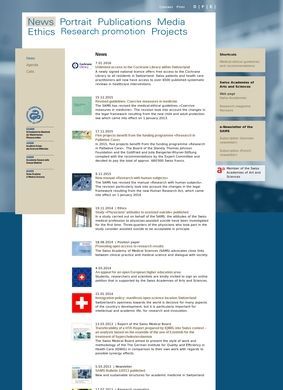
Probably the single most consequential thing on this site is the MD-PhD Program, because it funds the physicians who go on to do laboratory science in Switzerland, and it sits alongside a set of prizes and grants that most people outside academic medicine will never have heard of. EnDocument of Service of the Swiss Academy of Medical Sciences (DOKDI) is the English face of Switzerland's national academy of medical sciences, and once you get past the somewhat opaque listing title, what the site actually delivers is a mix of ethics guidance, research money, and the kind of reference material that hospitals and university departments lean on when a hard case lands on someone's desk.
Medical ethics guidelines for Swiss clinicians
Start with the guidelines, because that is the part of the academy's output Swiss clinicians depend on most. EnDocument of Service of the Swiss Academy of Medical Sciences (DOKDI) publishes medical-ethical guidelines and position papers on the questions clinicians dread having to decide alone: end-of-life care, genetic testing, how scarce resources get allocated when there is not enough to go around. These are not abstract essays. They function as reference documents that Swiss doctors and institutions treat as a common baseline, and the site is where the current versions live, along with handbooks and reports that expand on the same territory. I found the ethics material to be the clearest reason a working clinician would keep the address bookmarked, more than any of the prize announcements.
MD-PhD program and research prizes
The grant side is broader than I expected before clicking through. Beyond the MD-PhD Program, EnDocument of Service of the Swiss Academy of Medical Sciences (DOKDI) administers the Robert Bing Prize and the Stern-Gattiker Prize, plus dedicated funding for palliative care and for clinical research more generally. For a researcher trying to map out where support might come from, that concentration is genuinely useful: several distinct programs, each with its own remit, sit under one roof instead of being scattered across a dozen foundations.
What gives these programs their pull is who stands behind EnDocument of Service of the Swiss Academy of Medical Sciences (DOKDI). Because the academy sits within the Swiss Academies of Arts and Sciences, its prizes and grants carry a national imprimatur, and the site lays out the individual programs with enough structure that an applicant can work out fairly quickly whether they fit the criteria. The palliative care and clinical research streams in particular fill gaps that commercial or purely disease-specific funders tend to ignore, which makes their presence on the site more than a formality.
Coordinating research across Swiss institutions
The academy also coordinates collaborative projects that span Swiss academic and healthcare institutions, and this is the part of EnDocument of Service of the Swiss Academy of Medical Sciences (DOKDI) that is hardest to see from the outside but arguably does the most work. Coordinating across hospitals, universities, and research groups is thankless, slow, and easy to underrate, yet it is exactly what a national body is placed to do. The site presents this coordination role plainly, without dressing it up.
A word on that listing title. The name references DOKDI, styled as a Document of Service, which points toward a specific certificate or administrative document issued under the academy's framework. The core of the site, though, is not built around handing out individual documents. It centers on the guidelines, the funding, and the publications, so anyone arriving expecting a form-filling portal for a single certificate should recalibrate. The document reference is one administrative thread inside a much larger scientific and ethical mandate, and the site's own emphasis makes that hierarchy obvious.
Navigating EnDocument of Service of the Swiss Academy of Medical Sciences (DOKDI) in English is workable, with the caveat that a Swiss institution operating across German, French, and Italian will inevitably have some material that reads as translated or lives more fully in another language. That is the nature of a body serving a multilingual country, and it is a fair trade for having the ethics guidelines and program descriptions accessible to a wider readership at all. The English section covers the substance: what the academy is, what it publishes, and what it funds.
The audience is fairly narrow, and the site does not pretend otherwise: practising physicians who need the ethics guidance, researchers hunting for the specific grants, hospital administrators tracking Swiss standards, and academics involved in the collaborative projects. The general public can read the position papers too, and some of them, on end-of-life care especially, touch questions that reach well past the medical profession. Even so, EnDocument of Service of the Swiss Academy of Medical Sciences (DOKDI) is built as a working tool for the professional community, not a public-facing explainer.
Depth is the honest verdict here. EnDocument of Service of the Swiss Academy of Medical Sciences (DOKDI) covers a lot of ground, from bioethics to competitive research funding to inter-institutional coordination, and it does each with the seriousness the subjects demand. The one thing a first-time visitor should brace for is the gap between the English listing name and what the site actually foregrounds; the DOKDI document framing undersells how much of the operation is guidelines and grants. Read past the title and the value is plain enough.
Comparing the academy to the Swiss National Science Foundation
If a researcher needs to know where to look for Swiss biomedical funding and ethical guidance, the closest alternative worth weighing is the Swiss National Science Foundation, which funds research at far greater scale across every discipline. The two are complementary more than competing. EnDocument of Service of the Swiss Academy of Medical Sciences (DOKDI) is narrower, anchored in medicine and its ethics, and that focus is precisely its strength: for medical-ethical guidance and the specific prizes and physician-scientist programs it runs, the academy is the source the SNSF is not built to be. A researcher in Swiss medicine or biomedical work has good reason to keep both bookmarked, treating EnDocument of Service of the Swiss Academy of Medical Sciences (DOKDI) as the first stop when the question is ethics rather than funding scale.