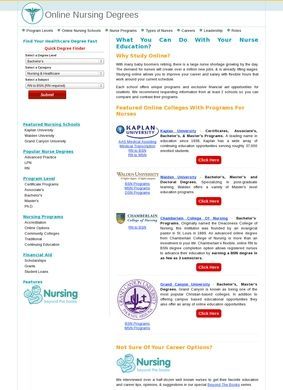
Spend ten minutes with Online Nursing Programs and the purpose is obvious: a sortable, CCNE-accreditation-filtered database of nursing degree options broken out by state, program level, and clinical specialization. Most education guides front-load a handful of featured schools and bury the comparison tool. At Online Nursing Programs, the filtering is the whole point, and it is why someone weighing a return to school would actually bookmark the page and return, not close the tab after a quick scroll.
Degree pathways from certificates to doctorates
The coverage of degree pathways is genuinely complete. It runs from certificate programs through associate degrees, the BSN at the bachelor's level, the MSN, and on into doctoral study. A working CNA thinking about an associate route and a registered nurse eyeing a doctorate are at completely different stages, and a guide that only addressed one of them would be half useful at best. Online Nursing Programs tries to cover the full span, and the structure is built to match that ambition: the navigation separates the levels clearly enough that a user does not have to scroll past irrelevant material to get to what applies to them.
Clinical specializations in nursing practice
Specialization is where the depth becomes distinctive. The content at Online Nursing Programs breaks into clinical tracks rather than treating nursing as one undifferentiated field: oncology, cardiac, pediatric, emergency, and dozens more. A reader who already knows they want to work with children, or who is drawn to the pace of an emergency department, can follow that thread instead of wading through general advice pitched at nobody in particular. That granularity is harder to assemble than a single overview page, and it is the strongest argument for spending real time here.
Beyond The Books interview series
The aggregator function is not everything on offer. There is a "Beyond The Books" interview series featuring practicing nurses, which is a smarter editorial choice than it might sound at first. Prospective students generally want the texture of the job, the day-to-day reality of it, and admissions criteria alone do not answer that question. Talking to people actually doing the work gives Online Nursing Programs a voice that a pure listings page would lack, and the interviews read like they were conducted with some care rather than assembled for SEO filler.
Financial aid guidance and career development
Financial aid guidance covers scholarships and grants, and career development material walks through the roles and credentials a nurse can pursue after graduating. A blog and news section rounds it out. None of this is unusual for the category, but it is present and organized, which counts for more than novelty when someone is working toward a multi-year commitment. The career content pairs well with the specialization pages, since picking a track and understanding where it leads are really the same question approached from two directions.
How to spot online college scams
One editorial decision deserves credit on its own terms. The site explicitly walks nursing students through how to spot online college scams while they are shopping for programs. That is a useful and slightly unglamorous thing to publish. It shows the people behind Online Nursing Programs understand the predatory corner of for-profit online education that a newcomer might not anticipate. Many guides in this space would rather not draw attention to the bad actors operating nearby.
Sponsored placements and advertiser relationships
The flip side of that candor is worth naming. Schools like Purdue University Global, Walden University, and Grand Canyon University appear prominently as sponsored or partnered listings. There is nothing inherently wrong with that, and the site does not pretend otherwise, but it does mean a reader should treat the featured placements as advertising and rely on the accreditation database for a neutral comparison. The scam-avoidance content and the sponsored placements coexist a little awkwardly, and the honest read is that both things are true at once: the warnings are real, the paid prominence is real, and keeping the distinction in mind is on the reader.
Limited third-party verification available
On credibility from outside the site, there is not much to report. A search for third-party coverage of Online Nursing Programs turned up competitor guides and one university's own ratings, but no consumer reviews of Online Nursing Programs itself on any of the usual platforms. That is not damning. Reference and aggregator sites rarely accumulate user reviews the way a shop or contractor does. It does mean, though, that the site has to be judged on the quality of its own content, because there is no outside chorus to weigh in either direction. That absence puts more weight on the accreditation data being current and the editorial choices being defensible, which is a reasonable ask of any site positioning itself as a guide to serious decisions.
Missing contact information and accountability
The clearer weakness is contact. No phone number, email, or mailing address surfaces on the homepage or in the page content, and there is no obvious route to reach whoever runs the operation. For a site steering people toward serious financial and educational commitments, the absence of any visible accountability is a fair thing to dock points for. It does not undermine the useful parts, but a reader who hits a question or wants to verify how the program rankings are compiled has nowhere to turn.
Strengths and limitations for program research
Weighing it all up, Online Nursing Programs is a solid working tool with a real soft spot. The accreditation database, the specialization depth, the nurse interviews, and the candid scam warning are all things a prospective student can put to genuine use, and they are organized well enough to navigate without much frustration. Against those strengths sit the sponsored placements and the complete silence on who is behind the site. For early-stage research, comparing programs and mapping the landscape, the time spent here is well spent. For the final decision, verifying accreditation directly with the schools and applying the same skepticism that Online Nursing Programs itself recommends for bad actors is the sensible move.