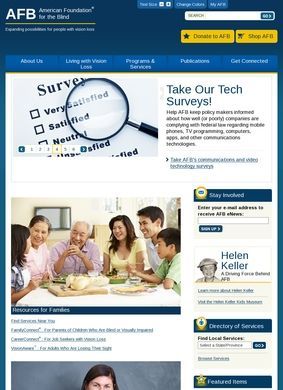
Someone gets a diagnosis of macular degeneration, or a teacher is handed a student who reads braille for the first time, or an HR manager realizes the hiring portal locks out screen-reader users. Each of them needs the same thing: reliable information from people who have spent decades on vision loss and know what actually works. The American Foundation for the Blind is built for exactly those arrivals, and it spreads its material widely enough that a parent, a rehabilitation specialist, and a corporate accessibility lead all find something written with them in mind.
Four organizational tracks
The organization runs on four broad tracks. There is public policy research and advocacy, the slow work of shaping laws and standards so that accessibility is treated as a right and not a favor. There is employment and education, aimed at getting people who are blind or have low vision into classrooms and jobs and keeping them there. There is a whole strand devoted to aging, since most vision loss arrives later in life and rarely announces itself. And there is accessibility and digital-inclusion research, the part that studies how technology either opens doors or quietly shuts them. The American Foundation for the Blind keeps these threads distinct instead of blurring them into one vague mission statement, which makes it easier to tell where your own question belongs.
Artificial intelligence and digital inclusion
The digital-inclusion research is where the work feels current. A named initiative called "The AI Quagmire" looks at how artificial intelligence is reshaping what blind and low-vision users can do, and where it introduces new obstacles dressed up as progress. That is a hard subject to write about honestly, because the easy move is to cheer for every new tool. The American Foundation for the Blind instead treats AI as something to interrogate, which is the right posture for a group whose readers will live with the consequences.
Consulting services
Plenty, and the consulting side is the clearest answer. The American Foundation for the Blind offers professional services in digital accessibility and applied research, backed by case studies and named organizational partnerships. A company that suspects its app or website excludes disabled users can bring in expertise that has been tested against real programs, not against a checklist alone. The case studies let a prospective partner see the shape of prior work before deciding whether to hire the foundation.
Training programs and free resources
Alongside the consulting there is a training pipeline. Accessibility internships and training programs feed people into the field, and a "Talent Lab Tech Notes" blog documents the technical detail that practitioners trade among themselves. There are technology guides for individuals who want to understand a device or a workflow without paying a consultant. So the value runs in two directions at once: an enterprise can hire the foundation, and a self-directed learner can pull from the same body of knowledge for free.
Publishing across multiple formats
Few nonprofits sustain a publishing arm this deep. AccessWorld magazine covers assistive technology in plain terms. The Journal of Visual Impairment and Blindness carries peer-reviewed scholarship for the academic and clinical side. AFB Studios produces documentaries, videos, and podcasts, which reaches people who would never open a research journal but will watch a film. A blog and newsletter keep the more casual reader current between the bigger releases. Few groups in this space maintain a scholarly journal and a documentary studio under the same name.
Helen Keller Archive
Then there is the Helen Keller Archive, which sets the American Foundation for the Blind apart from almost any peer. Keller worked with the foundation for decades, and the archive collects her correspondence, speeches, and papers alongside lesson plans built for classroom use. A history teacher can pull primary sources directly; a student can read Keller's own words instead of a paraphrase. It is a genuine research collection, digitized and structured for teaching, and it gives the organization a cultural weight that goes beyond its service programs.
Audience segmentation and research approach
The breadth is the point, and it is also the risk. When one group covers policy, employment, aging, digital research, a magazine, a journal, a studio, and a historical archive, a first-time visitor can feel scattered. The American Foundation for the Blind manages this by segmenting its audiences openly, calling out educators, employers, HR professionals, aging adults, and organizations as distinct groups rather than lumping everyone into a single pipeline. That segmentation is what saves the site from feeling like a warehouse. You arrive as a particular kind of person with a particular problem, and the material sorts itself accordingly.
What stands out across all of it is that the American Foundation for the Blind does not treat blindness as a single experience with a single fix. A congenitally blind software tester, a veteran losing sight to injury, and a seventy-year-old adjusting to low vision have almost nothing in common except the label, and the American Foundation for the Blind builds programs that reflect that spread. The aging services in particular fill a gap that younger-skewed advocacy groups often miss, because vision loss in later life comes tangled with other health changes and a reluctance to identify as disabled at all.
The research posture deserves one more note. Applied research that feeds directly into consulting and policy is more useful than research that sits in a repository, and the American Foundation for the Blind closes that loop. Findings from accessibility studies inform the advocacy, the advocacy shapes standards, and the standards give the consulting arm something concrete to hold clients against. That circulation is why the organization can speak to a legislator and an engineer in the same week without contradicting itself.
Set the American Foundation for the Blind next to the National Federation of the Blind, and the difference in character comes into focus. The Federation is a membership and civil-rights movement, powered by chapters and organized advocacy from blind people themselves, and someone looking for community, mentorship, or a rights campaign will feel more at home there. The American Foundation for the Blind is the research-and-resource institution: the place to go for peer-reviewed evidence, professional accessibility consulting, technology guidance, and the Keller archive. Many people will end up drawing on both, but if the need is documented expertise and applied research rather than grassroots organizing, the American Foundation for the Blind is the one worth opening first.