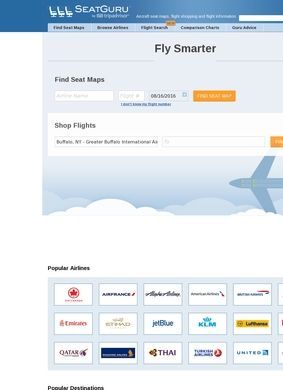
The site no longer works. Anyone who lands on Seat Guru today gets a single line telling them the service has closed and pointing them to Tripadvisor to plan their next trip, plus a leftover tagline about travel news, tips, deals, gear, and airport and airline updates. There is no seat map, no search box, no aircraft picker. What was for years one of the first bookmarks a nervous flyer reached for is now a farewell note.
Inside Seat Guru's original seat maps
What makes the shutdown sting is what Seat Guru used to be. Owned by Tripadvisor, the site built its name on one deceptively simple job: enter your airline and flight number, and it showed you the exact cabin layout for the aircraft you were booked on. Every seat was color coded. Green meant a good pick, yellow flagged a seat with a catch, red warned you off the row by the toilets or the one that would not recline. The detail went well past the diagram. Seat Guru listed which seats had a power outlet, whether a row offered extra legroom or lost some to a bulkhead, how wide the seat was, what the pitch measured, and whether the plane carried in-flight entertainment or Wi-Fi.
Aircraft-level layout differences
The value was in the granularity. Two flights on the same route could put you in genuinely different aircraft, and Seat Guru knew the difference. It tracked layouts down to the specific variant an airline flew, so a traveler comparing a morning and an evening departure could tell which one had the better cabin before spending a cent. For frequent flyers this was the deciding factor between a tolerable overnight and a miserable one.
Crowd-sourced cabin details
Beyond the maps, the site pooled cabin reviews and amenity notes contributed over years of use, which is how it became a reference point instead of a novelty. The layouts were crowd-checked and corrected, so an outdated diagram tended to get flagged. That accumulated knowledge is exactly what a static closure page cannot preserve. When the tool goes dark, the data behind it stops being reachable in any practical form.
So the honest thing to record here is a gap between the name's standing and the page in front of you. Seat Guru built its reputation on a tool that answered a real question fast, and that reputation is intact even though the utility behind it is gone. A visitor arriving with a booking reference and a hope of dodging a bad seat will leave with neither the map nor a substitute, only a link.
Behind the Tripadvisor redirect
The redirect sends visitors to Tripadvisor, the parent company, but Tripadvisor is a hotel and activity review platform, not a seat-map engine. It does not reproduce what made Seat Guru worth opening. The specific promise, aircraft-level seat intelligence tied to your flight, is not something the destination page delivers. The link is a courtesy rather than a replacement, and nobody should arrive expecting the old functionality under a new roof.
What detail-focused travelers lose
It is a real loss for a certain kind of traveler. The person who reads seat pitch numbers before booking, who cares whether row 31 actually reclines, who wants to know if the long-haul bird has power at the seat, was precisely the person Seat Guru served best. Airlines publish their own seat maps during booking, but those rarely warn you about the misaligned window or the tray table jammed into an armrest. That editorial judgment, the color coding that said "avoid this one," was the part that took years of contributions to build and cannot be rebuilt from a booking widget.
Retired bookmarks and dead links
For the sake of anyone updating their own bookmarks: there is nothing on Seat Guru to interact with anymore. No account, no saved trips, no lookup. Treat this entry as a record of what the resource was and a marker that it has been retired rather than a working link to click. If you kept it in a folder of travel tools, it can come out.
None of this erases the years the site spent being genuinely useful. Seat Guru set a standard for how seat information could be presented to ordinary travelers, and plenty of newer seat-comparison tools clearly took notes from how it laid things out. The closure is a shame precisely because the concept worked so well and filled a niche that airline booking flows still handle poorly. A tool that good going quiet leaves a hole the parent company has not obviously moved to fill.
Absence of a true successor
With Seat Guru shut down and its map data gone, there is no clear successor doing the same job at the same level of detail. Airline booking flows and general travel sites cover pieces of what it did, but nobody has replicated the full package: aircraft-specific layouts, crowd-checked accuracy, and a color code you could trust at a glance.