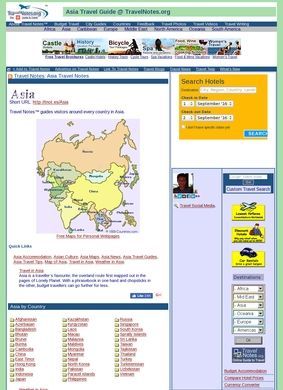
Asia on TravelNotes.org is divided into five regional groups: South Asia, Southeast Asia, East Asia, Central Asia, and Western Asia, with more than 48 country pages branching off from there. Click into any country and you get a guide page, city-level entries, local tourist notes, and a set of external links that TravelNotes.org has reviewed by hand, not scraped wholesale. That editorial filtering changes how the whole section reads: this is a curated index of the web as much as a guide written from scratch, and the hand behind it is visible in what gets a link and what does not.
TravelNotes.org has been running since 1997, built by a publisher who goes by Michel, and the age shows in a way I found reassuring instead of dated. The structure is dense and link-heavy, closer to an old-school portal than a modern blog with ten posts and a newsletter popup. You move from region to country to city by following links, and the depth becomes clear once you get a few levels down. Someone planning a trip across Central Asia can land on the regional page and work outward into individual countries without bouncing back to a search engine every few minutes.
Live data layered over editorial content
Around the editorial core sits a layer of live data. The Asia pages pull in an Asia News Network feed and weather forecasts, so a country page is not a static wall of text frozen at publication. Travel articles are scattered through the section too, and they read as longer pieces rather than quick SEO filler. The combination of evergreen guide content, syndicated news, and current weather gives the section a reason to be checked more than once, which a lot of static travel pages cannot claim.
How affiliate links fund the operation
Money clearly enters through affiliate links, and TravelNotes.org is upfront about it: flights, hotels, car rentals, travel insurance, rail travel, vacation rentals, and tour operators all have planning links woven into the destination pages. This is the standard funding model for an independent guide of this vintage, and the site does not pretend otherwise. The affiliate links stay travel-relevant, so a reader looking at Thailand gets pointed at flights and hotels for Thailand, not random banner ads. The commercial layer does not poison the editorial content, which stays focused on destinations. TravelNotes.org keeps the planning links and the guide writing in separate lanes, and that separation is part of why the country pages still read like guidance instead of a sales sheet.
From user submissions to regional coverage
The community angle gives TravelNotes.org an unusual texture. It accepts user-submitted travel content, lodging listings, location entries, and URL additions, so a chunk of what you read has come in from contributors and been folded into the structure. That cuts both ways. It widens coverage well past what one publisher could write alone, and it means quality across 48-plus countries is not perfectly even, since contributed entries vary. TravelNotes.org functions partly as a contributed index, and anyone using it heavily should keep that in mind when weighing one country page against another.
Who stands behind the site is not fully spelled out. There is a Travel Notes Feedback link and a Contact Travel Notes page over at the new.htm address, so a route in exists, but it is web-form-based. No phone number and no physical address sit on the Asia landing page, and email is not pushed to the surface. For a personal publishing project that has run for decades this is normal enough, and a form is a fair way to handle contact, but a reader hoping to reach a named desk or office will not find that here. The named publisher and the long track record do most of the credibility work in place of a corporate contact block.
Checking reputation and publisher credibility
Outside reputation is harder to pin down. A search for TravelNotes.org does not surface a body of third-party reviews or ratings on the usual platforms; what comes up tends to be unrelated names that sit close in spelling, like The Travel Review and TravelerNews.org, which is a search-noise problem more than a verdict on the site. Where it does show a current pulse is social. There is an active X account at @TravelNotes and a Reddit presence at u/travelnotes that posts travel content instead of sitting dormant, so the operation behind TravelNotes.org is still being tended. A companion project, TravelTwip.com, runs under the same creator, which fits the picture of one publisher keeping a small cluster of travel properties going, not a faceless content farm.
So what you actually get from the Asia hub of TravelNotes.org is a long-running, hand-built collection of destination pages with live news and weather layered on, funded by travel affiliate links and topped up by reader submissions. It rewards the kind of visitor who likes to dig through links and assemble their own picture of a place, and it will frustrate anyone expecting a polished single-author blog with a tidy contact page and a stack of star ratings.
The coverage is broad, the regional breakdown is sensible, and the editorial filtering of external links is the feature that separates TravelNotes.org from a plain link dump. The site shows its age in its layout and its funding model both, and the reputation evidence beyond the publisher's own channels is limited. The countries are there, the structure holds together, and the news and weather feeds keep refreshing on their own.