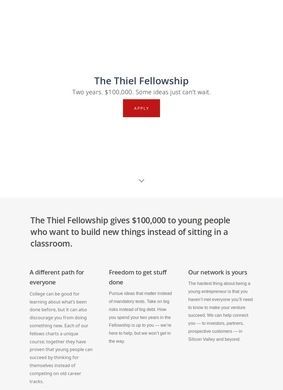
A young person accepted into the Thiel Fellowship receives $250,000 spread across two years, on a single condition: skip or defer college and spend that time building a company or chasing a scientific idea instead. That grant is the public face of the Thiel Foundation, the private philanthropy Peter Thiel set up after co-founding PayPal, and it is the first thing the site puts in front of a visitor.
The rest of the site reads almost entirely as a recruiting pitch aimed at would-be fellows, so the funder itself stays in the background while the program does the talking.
What the grant pays for
The money is the headline, and the fellowship wraps it in mentorship, workshops, and introductions. Winners get access to a network of founders, investors, and scientists, which across two years may end up worth more than the cash. The argument runs through the section names. "A Different Path for Everyone" makes the case against a conventional degree and pitches an alternative route into serious work. "Freedom to Get Stuff Done" sells the promise that a fellow's two years belong to the project, with no syllabus or professor's deadlines pulling against it.
Two years is a deliberate span. It is long enough to build a prototype, test it, and fail once without the whole thing collapsing, and short enough that a fellow cannot coast. The choice to let people either skip college outright or defer it is a deliberate hedge as well: deferral leaves a door open, and the program does not force anyone to burn the degree behind them. That is a piece of quiet pragmatism inside a pitch that otherwise leans hard on the romance of walking away from school.
The support around the money is where the pitch turns practical instead of flashy. Mentorship pairs fellows with people who have already built companies or run labs, workshops give some structure to two years that would otherwise have none, and the whole arrangement assumes a fellow already knows what they want to build and needs runway more than instruction. That assumption is doing heavy lifting. A candidate still hunting for the idea itself is not really who this is for.
Behind all of this sits the Thiel Foundation as the grant-making body. Outside profiles describe the wider Thiel Foundation as funding scientific research, new technologies, and human-rights causes, with reported assets around $45 million. By the standards of the household-name American foundations that is a modest endowment, and it points to a focused operation with a few defined bets instead of a sprawling one trying to fund everything. A visitor arriving with images of a giant institutional philanthropy will find something smaller and more particular.
The Thiel Foundation lets the press coverage do a good deal of the persuading. Logos and quotes from the New York Times, TechCrunch, and the Wall Street Journal get pulled in to make the same case on repeat: a fellowship that spares its winners the debt of a degree while handing them mentors and connections most twenty-year-olds could never assemble on their own. The pitch is coherent, and the figures under it are concrete enough to check against the program's own terms.
The people the Thiel Foundation wants are specific too. The program aims at young people with an entrepreneurial or scientific venture already in motion or close to it, the kind who would treat two unstructured years and a quarter of a million dollars as fuel instead of a holiday. That is a narrow audience by design, and the site does little to pretend otherwise. Anyone who reads "A Different Path for Everyone" as an open invitation will find the reality a good deal more selective than the heading sounds.
Sizing up the foundation
Reviews are the usual way to weigh a business, and here there are effectively none. A search on the Thiel Foundation returns Crunchbase, Inside Philanthropy, InfluenceWatch, the Foundation Directory maintained by Candid, an Instrumentl report built on the group's 990 tax filing, and a Stanford business-school case study. Every one of those is an institutional write-up of a grant-making body, not a customer rating, and an open Quora question about the organisation sits there with no answers under it.
None of that is a mark against it. For a private foundation that sells nothing and takes no walk-in customers, the absence of star ratings is exactly what a person should expect, and it cuts neither for nor against. The Thiel Foundation cannot be judged the way a shop or a service can.
What can be judged is the program it attaches its name to, and on that front the specifics are unusually concrete: a fixed sum, a fixed term, and one plain condition tied to it. The profiles that do exist confirm the shape of the thing without ever telling a reader how a past fellow felt about the two years.
The network it opens
The claim that probably lands hardest with a candidate sits under "Our Network is Yours," where the Thiel Foundation promises to connect fellows with investors, partners, and customers. That is the part money cannot easily buy. A young founder with a working prototype and no contacts stands to gain more from a warm introduction to a serious investor than from another slice of funding, and the program frames its network as the fellow's to use, not a favour doled out sparingly.
There is also a Job Board pointed at employment opportunities inside fellow-founded companies. It is a small feature, and a telling one: the Thiel Foundation treats the cohort as an ongoing community that hires from within, not a set of one-time cheques mailed out and forgotten. For a young builder with no established circle, that access is the genuine draw, arguably more than the $250,000 attached to it. The cash runs out; the introductions, in theory, do not.
Applying and reaching out
The Thiel Foundation routes prospective fellows through an Apply page and form, which is where a program built on selection ought to spend its effort. Contact past that point narrows fast. An email address for the fellowship team is visible on the site, though no phone number and no physical address surfaced on the pages that load, so a question gets funneled toward that email or into the application itself.
For a selective grant that surely fields far more hopefuls than it can take, that is workable and fairly defensible; a foundation this size runs no call centre and does not pretend to. Even so, someone with a question gets one real channel and little beside it, and a visitor curious about the Thiel Foundation as an organisation, its board, its wider giving, has to leave the site to find any of it.
The verdict lands somewhere in the middle. The Thiel Foundation offers something genuinely distinctive, a large grant with mentorship and a live founder network attached, and it is specific about what a fellow receives in exchange for stepping off the usual track. What it does not offer, at least here, is much transparency about the Thiel Foundation as an institution, or any outside signal of how earlier fellows have fared beyond the press quotes the site chooses to display.
The fellowship itself is a strong, well-defined bet for the right candidate; the foundation behind it stays mostly out of view, its fuller record scattered across the outside profiles rather than gathered on the Thiel Foundation's own pages.