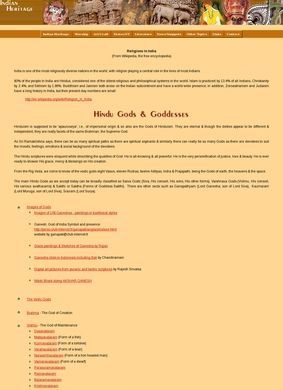
Where can a curious reader get a plain map of the Hindu pantheon without buying a fat reference book first? That is the practical question the gods page at indian-heritage.org sets out to answer, and Indian - Hindu Gods is the name this listing gives it. The page gathers the major deities, their families, and the stories attached to them into one browsable place, aimed at someone who wants orientation more than scholarship.
The first thing worth being clear about is who built it. Indian - Hindu Gods is maintained by an individual, credited as Sumathi ALN of Saigan Connection, not by a temple, a university, or a government cultural body. That single fact shapes how to read everything else on the page. This is a personal reference project, put together by an enthusiast, and it deserves to be judged as one.
Judged that way, it does a fair amount. The Gods and Goddesses section carries detailed pages on the three central figures of the tradition, Brahma the creator, Vishnu the preserver, and Shiva the destroyer, along with their consorts. A reader can move from deity to deity and pick up the basic roles, relationships, and iconography without needing any prior grounding, which is exactly what a newcomer usually lacks.
Beyond the deities, the wider site reaches into related territory. There is an overview of India's mix of faiths, which notes Hinduism accounting for roughly 80 percent of the population, sections on arts and crafts, a page of spiritual guidance drawn from Hindu philosophy and the teachings of gurus, and curated links out to books, magazines, forums, blogs, and classical dance. A site-search box helps when the navigation gets dense, which on a reference site of this kind it quickly does. There is also a news and announcements page kept current.
The overview of India's faiths is a useful piece of framing that many single-deity pages skip. By placing Hinduism, at roughly four fifths of the population, next to the country's other traditions, Indian - Hindu Gods gives a newcomer some sense of proportion before the deity pages start naming figures. The curated outbound links serve a similar purpose, pointing a reader who has exhausted this page toward books, magazines, discussion forums, and even pages on classical dance, so the site works as a hub as much as a destination.
Contact is the weaker spot, and it is worth being honest about. A contact link sits in the navigation, but the specific details, an email address, a phone number, a postal address, did not surface in the pages as fetched. Someone wanting to reach the maintainer would have to click through and hope a form or address is waiting there. Links to Facebook and Pinterest give an alternate route, so Indian - Hindu Gods is reachable, just not as openly as a clearly posted contact line would make it.
Outside opinion is close to nonexistent. The Facebook page tied to indian-heritage.org shows a single review and no numeric rating, listed as not yet rated. A wider search turns up unrelated books and retail products about Hindu gods, not appraisals of this page. So there is no body of feedback to lean on. Indian - Hindu Gods stands or falls on the content itself, which for a hobbyist site is a fair enough test to hold it to.
Mapping the deities, avatars, and planets
The organizing idea across Indian - Hindu Gods is to take the sprawling cast of the tradition and give each piece its own page. It works better in some corners than others, but the ambition is clear, and the structure mostly holds together as a visitor clicks around.
The pages lean toward description over argument. There is little in the way of sourcing or scholarly apparatus, which is the trade-off with a one-person reference site: it reads easily and never intimidates, and in return it asks to be taken largely on trust. Whether that trade is acceptable depends entirely on what a reader needs from it. A student writing a paper will want footnotes the page does not supply. A traveler trying to understand a temple carving, or a parent fielding a child's question about why Vishnu has ten forms, will find the level of detail about right.
Gods and goddesses
This is the core, and the strongest part. Indian - Hindu Gods devotes real space to Brahma, Vishnu, and Shiva, the trinity most newcomers start with, and extends to their consorts, so the goddesses are present rather than an afterthought bolted on at the end. The writing sticks to who each figure is and what they govern. For a reader trying to keep Vishnu and Shiva straight, or to place a particular goddess within a divine family, the pages do the job without fuss.
What they do not do is argue about interpretation or flag where traditions disagree. A deity can be read very differently across regions and centuries, and a single enthusiast's summary flattens some of that. For orientation it is fine. For nuance a reader will have to go elsewhere. Still, as a first pass at three figures who confuse almost everyone at the start, the Gods and Goddesses pages on Indian - Hindu Gods do more good than harm.
The ten avatars and the nine planets
Two of the more distinctive sections sit here. The Dasavataram pages walk through the ten incarnations of Vishnu, the sequence of forms the preserver takes across the ages, which is one of the tradition's better stories and often the very reason a curious reader lands on a page like this. Alongside it, the Navagraham section covers the nine planetary deities, the celestial bodies treated as gods in Hindu astronomy and astrology.
That pairing, the avatars and the planets, is where Indian - Hindu Gods goes a step past the obvious and starts to feel like a genuine reference instead of a summary anyone could throw together. The nine planets in particular are a topic many general introductions skip, so covering them gives Indian - Hindu Gods a reason to exist beyond the headline deities.
A reader who came only for Vishnu and Shiva may leave having learned why Saturn or Mars looms as large as it does in a horoscope, and that kind of side trip is the mark of a reference built by someone who finds the whole subject interesting.
Arts and crafts and spiritual guidance
The last stretch broadens from theology into culture. The Arts and Crafts section turns to traditional paintings, sculptures, and other artistic expressions tied to the deities, which grounds the abstract figures in objects that people make and worship with. The Spiritual Guidance pages collect articles on Hindu philosophy and lessons drawn from gurus, aimed at readers who want the ideas behind the images. This is where Indian - Hindu Gods stops being a catalogue of names and tries to say something about how the tradition is lived.
These are also the sections most exposed to the site's central limit. Without an institution or named scholars standing behind them, the guidance is one person's curation, and a reader looking for authoritative doctrine will feel the absence. Taken as an entry point instead, a place to get the shape of things before going deeper somewhere better sourced, the material holds up. Indian - Hindu Gods is honest about being one enthusiast's connection to the subject, and that honesty counts in its favour.
So the verdict comes down to what a visitor wants from it. As a free, browsable, beginner-friendly map of Hindu gods, avatars, and planetary deities, assembled with evident care, Indian - Hindu Gods does what it sets out to do and rewards the time spent on it. As a citable authority it does not pretend to be one, and the sparse contact details and single review mean there is almost no outside signal to vouch for it. The content is the whole case: a knowledgeable enthusiast's guided tour, offered without footnotes, built for orientation rather than proof.