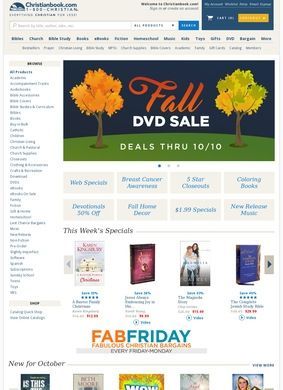
Say you teach your kids at home and the math curriculum you have used for three years is suddenly out of stock everywhere local, with a co-op start date two weeks out. That is the situation Christianbook is built to solve. The store carries roughly half a million products, and a search for a specific grade level usually turns up the textbook, the teacher guide, the answer key, and the consumable workbook bundled or sold separately, so you can fill the whole gap in one cart. Homeschool families are clearly a core audience here, and the site backs that up with an advisory service for parents who are not sure which program fits a particular child.
Inventory for homeschool families
The Christianbook catalog reaches well past schoolbooks. Bibles are the obvious anchor, and the range is genuinely deep: journaling editions with wide margins, study Bibles, and Bible study guides for small groups sit alongside the standard translations. Beyond the printed word there are Christian DVDs and music, gifts, home decor, clothing, toys, and children's faith materials, plus church supplies that run all the way down to communion elements. A small congregation restocking for a service and a parent buying a baptism gift are shopping the same store, which says something about how wide the inventory has been allowed to grow since the operation started in 1978.
Bibles, gifts, church supplies
Christianbook has layered a fair amount on top of plain checkout. There is a Rewards loyalty program for repeat buyers, an autoship option for things you reorder on a schedule, gift cards, and a GiveBack affiliate arrangement that routes a cut back to a church or organization you nominate. None of this is exotic for a retailer this size, but it is the sort of structure that rewards a household or a ministry that buys regularly instead of once. The Rewards tier in particular makes more sense for a homeschool family ordering a fresh curriculum every August than for a one-time gift buyer.
Loyalty programs and self-publishing
Christianbook also runs self-publishing services, which is a less common thing to find bolted onto a storefront. An author working on a devotional or a church history can, in theory, both produce the book and sell it through the same channel. I find that vertical reach more interesting than the loyalty points, because it points to a business that has spread into the supply side and onto the retail shelf in the same move.
Scale is part of the pitch, whether or not the shopper ever sees it. A 370,000-square-foot fulfillment center in Peabody, Massachusetts, staffed by more than 600 people, is what sits behind the half-million SKUs. That footprint explains how Christianbook can list communion cups and homeschool science kits and worship CDs without any one of them feeling like a token category.
Shipping delays and customer reviews
Here is where a buyer should slow down. Third-party reviews for Christianbook are not kind. On SmartCustomer the average lands at 1.7 stars across 150 reviews; Reviews.io shows 1.8 from 42; ResellerRatings sits at 2.18 from 23. Trustpilot's aggregate did not come through cleanly, but the visible reviewer quotes there skew to one-star complaints. The Better Business Bureau has a profile for the Peabody location with customer reviews on file. Those are low numbers by any standard, and they cluster around one theme instead of scattering.
That theme is shipping. Across the platforms, the recurring grievance is slow delivery and order fulfillment problems, not bad products or a sketchy catalog. It is worth weighing what that pattern means. People rarely post a glowing review for a package that simply arrived on time, so retail rating pages tilt negative by nature, but a spread this consistent across four independent sites is a real signal, not noise. If you have a hard deadline, a co-op date or a Sunday service, that is the risk to plan around. Order early.
On reaching a person, Christianbook is in better shape. A customer service page is easy to find, the toll-free line 1-800-CHRISTIAN is referenced prominently, and a privacy contact address is published for data requests. So the channels to chase a late order are there; the complaints suggest the friction is in how quickly things move, not in whether anyone will pick up the phone or answer the form.
Weighed against a general giant like Amazon, the trade is clear enough. Amazon will almost certainly get a mainstream title to your door faster, and that speed gap is exactly what the reviews keep flagging. What Christianbook offers in return is depth Amazon cannot match in this niche: the obscure homeschool teacher's manual, the specific church communion supply, the journaling Bible edition curated by people who know the field. The advisory help and Rewards structure tilt it further toward regular buyers, and the catalog depth is real in a way that a mass retailer cannot replicate. The documented weakness is shipping pace. Order early if there is a hard deadline, or accept that a mainstream retailer is the faster bet.