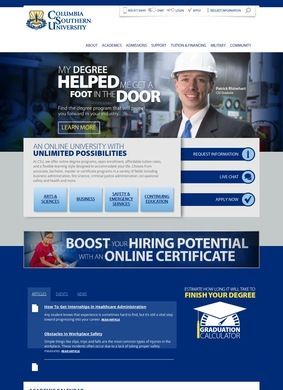
Textbooks cost nothing at Columbia Southern University, a line that sounds like marketing until you check it against more than 450 courses and find it holds. For an adult student weighing a degree against a mortgage and a job, the price of books over four years is a real number that other schools quietly pass along. Putting it front and center says something about how Columbia Southern University thinks about its audience.
Online programs across multiple fields
This is a fully online private university based in Orange Beach, Alabama. The catalog runs to more than 150 active degree programs, and the spread is wide without being scattered: business, occupational safety and health, fire administration, healthcare and nursing including an RN to BS track, criminal justice, information technology, and public administration. A student can stop at an associate, push through a bachelor's or master's, or go all the way to a doctorate. Certificate programs and continuing education courses exist for people who want a credential without committing to a full degree. Columbia Southern University also offers an accelerated path from bachelor's to master's, which suits the learner who already knows where they are headed and resents wasted semesters.
Military members and working professionals
The audience is specific, and the programs reflect it. Working professionals, military members, veterans, and military spouses are the core. That focus shows up in the subject mix, where fire administration and occupational safety sit alongside the more common business and IT offerings. Those are fields where people already hold jobs and need the credential to advance, not eighteen-year-olds shopping for a campus experience. Columbia Southern University reports having served more than 60,000 adult learners and conferred over 100,000 degrees, figures that point to an operation doing this at scale for quite some time.
Accreditation and quality standards
Accreditation is where online universities either earn trust or lose it, and this is the part worth slowing down on. Columbia Southern University holds SACSCOC accreditation, which is regional and the standard employers and transfer registrars recognize most broadly. Its business programs carry ACBSP accreditation on top of that. Quality Matters certification covers course design, and the school has received a Blackboard Catalyst Award along with recognition from Military Advanced Education and Transition. None of these individually closes the question, but stacked together they point to an institution that has submitted itself to outside review more than once.
Tuition and financial aid options
The financial side is built around the same practical audience. Tuition is advertised at less than half the average cost of competitors, and combined with the zero-dollar textbook policy, the total is meant to come in well below what a traditional program runs. Federal student aid is available, as are scholarships, military tuition assistance, and learning partnerships that can lower the cost further. Columbia Southern University provides a cost comparison tool and a net price calculator so a prospective student can see a personalized number instead of a rough average. That clarity helps when someone is budgeting a degree around an existing salary and household.
Academic support services
Support services round out the picture, and they read like a list assembled by people who have watched online students struggle. Academic advising and a registrar handle the mechanics. Career services exist for the obvious reason. Disability services and a transfer credit evaluation process address two things that trip up returning students who arrive with prior coursework, military training, and half-finished degrees from years ago. A school that takes evaluation seriously can shave real time and money off a program. Given the military lean of its student body, Columbia Southern University maintains a Veterans Center and dedicated military spouse resources, and those are clearly central rather than decorative.
Evaluating the online learning experience
What is harder to judge from the outside is the texture of the experience: how responsive advising is, how rigorous individual courses run, how well a doctoral program holds up against a campus equivalent. Those are things a prospective student can only test by talking to recent graduates in their specific field. The structure is sound and the credentials are in place. Whether the day-to-day delivery lives up to the framework is the part no accreditation seal can fully answer.
For the right person, the case Columbia Southern University makes is coherent. The breadth of programs, the practical subject areas, the layered accreditations, and the genuinely low cost line up with the needs of someone juggling work, service, or family while finishing a degree. Columbia Southern University is not pretending to be a residential university, and it does not need to. The doctoral and master's options mean it can carry a student a long way without forcing a transfer elsewhere.
The open question is not whether Columbia Southern University is legitimate, because the accreditation record answers that plainly. It is whether a fully online format, however well supported, fits the way a given person learns and whether their field treats an online degree from an accredited school the same as any other. Both of those questions have clear, answerable answers before any enrollment decision is made, and the published evidence from Columbia Southern University gives enough to work with on the institutional side of that equation.