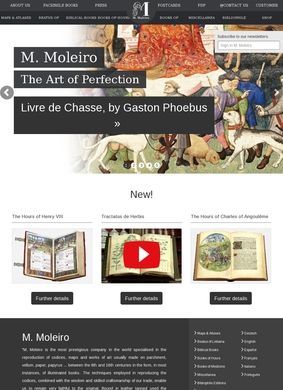
What do you actually receive when a publisher sells you a copy of a manuscript that has spent six centuries locked inside a cathedral library? At Moleiro Editor the answer is unusually literal: an exact replica, bound in leather tanned by traditional methods and printed on hand-made paper, produced to match the original page for page rather than the looser thing the word facsimile usually describes. The Barcelona house has built its entire catalogue on that one distinction, and the site exists mainly to explain it to the small group of people most likely to care.
How the replicas are made
Most publishers who reproduce old books settle for a sharp photograph on decent stock. Moleiro Editor sets the bar somewhere else entirely, and it documents the process in the open. The pitch is an exact replica of the source object rather than a print of it, and the production notes lean on materials as heavily as on imagery: leather tanned the old way, paper made by hand, a binding chosen to suit the original volume.
I will admit the claim that every hide is tanned by traditional methods is the sort of promise I would want to hold in my own hands before fully believing it, yet it is at least specific and checkable, not a vague wave at quality.
Why go to that trouble? Because the objects Moleiro Editor reproduces were never designed to be read as flat images. A medieval codex has heft, a particular give to the vellum, gold that catches the light at an angle. A reproduction that ignores those physical facts is a poster; one that respects them is closer to the thing itself, and that closeness is the whole value proposition here.
None of this comes cheap, and Moleiro Editor does not pretend otherwise. These are limited editions aimed at buyers who treat a book as an heirloom, and the site is upfront that the print runs are small and the objects are built to outlast their owners. For anyone expecting a discount reprint, the price will land as a shock; for the collector the company is actually courting, that scarcity is a large part of the appeal, and the small runs are the reason a title can sell out and never return.
Leather, paper, and binding
The materials are the argument. Because Moleiro Editor tans its leather by older methods and prints on hand-made paper, each edition is meant to feel like the object a medieval reader once handled, weight and texture included. That is a different proposition from a coffee-table art book, and it explains the price bracket these editions occupy. A buyer is paying for craft and for a deliberately small print run, and the company is candid that these are collector objects made in limited numbers, not mass-market reprints.
The source material covers a long historical stretch. Moleiro Editor works from illuminated manuscripts, codices, maps, and works of art produced between the eighth and sixteenth centuries, which is most of the span of European book illumination. That the company holds a Wikipedia entry describing this methodology is a useful outside confirmation: the approach gets documented and discussed independently, beyond what the company's own pages say about it.
Inside the catalogue
The range on offer is genuinely varied for so specialized a field. Moleiro Editor publishes facsimiles of illuminated manuscripts, maps and atlases, Books of Hours, biblical texts, and medical and botanical manuscripts, alongside its editions of the Beatus of Liebana. The maps and atlases pull in a different buyer than the devotional books do, and the medical and botanical volumes reach historians of science who might never open a Book of Hours.
Site sections cover About Us, Shop, Events, Press, Customer Reviews, and downloadable PDF catalogues, so a prospective buyer can study the full list without having to write in and request one.
The audience is narrow and self-selecting: collectors, bibliophiles, historians, and art enthusiasts, the sort of readers who already know what a codex is and why the binding matters. The Events and Press sections speak to that crowd, and a Customer Reviews page gives prospective buyers a place to read what earlier ones thought before spending several thousand euros on a single volume.
The biblical texts and the cartography sit at opposite ends of that catalogue and show how far the method stretches. An illuminated Gospel or Bible asks for careful color work across hundreds of pages; a historical atlas asks for fold-outs, faithful scale, and legible place-names that a sloppy reproduction would smear into guesswork. Moleiro Editor treats both as objects worth reproducing exactly, and a single publisher moving this comfortably between devotional art and early maps says something real about the depth of the operation.
Books of Hours and the Beatus editions
Two strands stand out for the kind of buyer Moleiro Editor is chasing. The Books of Hours rank among the most sought-after illuminated manuscripts of the medieval period, prized for their painted calendars and devotional miniatures, and reproducing one convincingly is a genuine test of the method. The Beatus of Liebana editions matter for a separate reason: these illustrated commentaries on the Apocalypse shaped early medieval Iberian art, and a faithful reproduction puts a manuscript most people will only ever glimpse behind museum glass onto a private desk.
For a collector who has wanted one for years, a Moleiro Editor edition is often the only realistic way to own the thing at all, short of a museum acquisition budget and the connections to match.
The companion study volume
Every facsimile ships with a companion study volume written by manuscript experts, and this is where Moleiro Editor pulls away from a plain reproduction service. The replica hands you the object; the study volume hands you the scholarship, the history of the manuscript, its provenance, and its place in the wider tradition. For a historian or a committed collector, that second book is frequently the real reason to buy, since a beautiful copy stripped of context is just a beautiful copy.
Moleiro Editor clearly knows exactly who is reading, and it builds each release for that reader instead of a casual gift-buyer.
Standing, and where to find it
Contact is refreshingly direct, well past what a bare business directory listing would offer. Moleiro Editor lists a Barcelona phone number, a street address on Travesera de Gracia, and a contact page in English, so reaching the company takes no detective work. That openness suits Moleiro Editor's model, which is selling expensive, low-volume objects to a small international clientele who will usually want to speak with a person before parting with that kind of money.
Ordering runs through the Shop section and the downloadable PDF catalogues, which let a buyer study specifications, image samples, and the scope of each edition well ahead of a purchase. For objects at this price, that plain transparency about what actually arrives in the box is what a careful collector needs, and it lowers the odds of an expensive surprise on delivery day.
The outside reputation is partial but encouraging. The Facebook page for Moleiro Editor shows 379 reviews with 86 percent recommending the business, a solid signal from a meaningful number of buyers. Moleiro Editor also holds its own Wikipedia article, and it appears on BookScouter as a publisher whose titles can be price-compared across more than twenty-five bookstores. No numeric rating turned up on Google, Trustpilot, Yelp, or the BBB in this search.