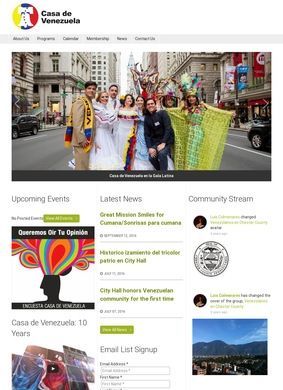
A Venezuelan family that arrives in Philadelphia mid-asylum-case needs several things at once, usually in a language they are still learning: a doctor who will see them, a way to earn a first paycheck, English classes, and someone who can explain what Temporary Protected Status even means. Casa de Venezuela is built around exactly that arrival. The nonprofit, founded in 2004, arranges its help so a newcomer can walk in with the whole tangle and leave with a few threads pulled loose.
Most of that help runs through one structure the group calls The Miranda Program, which splits into three areas that map onto what an immigrant actually chases in a first year.
How the Miranda Program is organized
The program is the spine of Casa de Venezuela, and its three parts are worth taking one at a time because they answer different problems. None of them is abstract cultural work. Each points at a concrete obstacle a Venezuelan immigrant hits in the first months, and the split keeps the organization from spreading itself into vague good intentions. It also means each area comes with something a person can show up for, not a statement of values.
The rest of what Casa de Venezuela runs fills in around that spine: immigration resources, English language programs, and scholarship opportunities that a student or a working parent can reach for once the immediate crisis passes.
Culture and education
The Culture and Education strand runs cultural events that put Venezuelan food, music, and tradition in front of a Philadelphia audience, and pairs them with integration and skill-building work aimed at helping newcomers find their footing. The dual purpose is deliberate. The same event that celebrates where people came from also doubles as a room where they meet others who made the same trip and can point them toward a landlord, a job, or a clinic.
For a community that describes itself as the first bilingual nonprofit in Greater Philadelphia dedicated to Venezuelan culture, keeping that culture visible is part of the mission, and Casa de Venezuela treats it as connective tissue between arrivals rather than a museum display. These gatherings do practical work too, since an informal conversation at a cultural night is often how a newcomer learns which lawyer, school, or clinic to trust.
Professional development and health
Two of the three Miranda strands are flatly practical. Professional Development puts on career workshops and networking sessions for people who often held real credentials back home and now have to rebuild a resume from scratch in a new market. Health and Wellness supplies healthcare information and connects immigrants to providers, which for someone without insurance or an English-speaking doctor is frequently the hardest door to open.
Casa de Venezuela is trying to shorten the distance between a new arrival and a clinic that will actually take them, which is a concrete service and one of the more useful things the organization does.
For a former engineer or nurse now driving for a delivery app, the career workshops are the bridge back toward the kind of work they actually trained for.
Advocacy and the policy fights
Beyond direct services, Casa de Venezuela does advocacy, and it names the fights specifically: Temporary Protected Status and the VERDAD Act, both of which decide whether Venezuelans can legally stay and work. That shifts the group from handing out resources to pushing on the policy that creates the need for them in the first place. Community events round the calendar out, spanning education, networking, and sports, and the organization keeps an active presence on Facebook, Twitter, Instagram, and YouTube.
Donations run through PayPal on the site, the standard route for a 501(c)(3) this size. Naming specific legislation also gives supporters something concrete to rally behind, which is harder to do around a general call to help immigrants.
Outside verification is a different story. The Facebook page, listed as Casa de Venezuela Philadelphia, shows a 96 percent recommend rating on a review count that appears to be around 22, though the figure is partly cut off in search results. That is a warm signal from the people it serves. It is also nearly the only signal.
No reviews turn up on Google, Yelp, Trustpilot, the BBB, or any other major platform. The reach is regional, centered on the Delaware Valley around Philadelphia, and the bilingual framing matters here: a group that works in both Spanish and English removes the exact barrier that keeps many newcomers from asking for help at all.
For a group the size of Casa de Venezuela, that silence is not damning. Small community nonprofits rarely collect star ratings the way a restaurant does, and a single strong Facebook score is at least a real one. But a prospective donor or volunteer hoping for independent confirmation will not find much to lean on. A basic business directory listing will confirm the group exists; it will not confirm how well the work lands.
One caution for anyone searching the name. Most results for "Casa Venezuela" point somewhere else entirely, to hotels and restaurants in Mexico and a separate social club called Casa de Venezuela en Canarias in Spain. Neither has any link to the Philadelphia organization, and it is easy to land on the wrong one and credit it with the wrong reputation.
Casa de Venezuela routes contact mostly through digital channels. A physical address in Philadelphia is posted, and the site funnels visitors toward a Linktree directory and its social accounts instead of a prominent phone number, which was not visible on the page. A newcomer comfortable with Facebook or Instagram will reach someone quickly enough. A person who would rather pick up a phone has a harder time finding the number, and for an organization whose whole point is helping people who may not yet be fluent online, that is a real gap worth flagging.
The verdict lands qualified. Casa de Venezuela clearly does concrete, needed work for Venezuelan immigrants in the Philadelphia area, and the Miranda Program gives that work a structure instead of a loose list of services. What it cannot offer a prospective supporter is much outside proof: one warm Facebook rating, a truncated review count, and quiet everywhere else. Someone who already knows the community, or who can visit the Market Street office and see the programs firsthand, has plenty of reason to get involved.
Someone relying purely on independent reviews will have to accept that, for now, the record is mostly the organization's own account of itself.