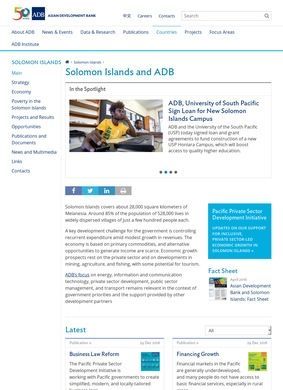
A 15-megawatt plant designed to supply roughly 70 percent of Honiara's electricity sits near the center of this page: the Tina River Hydropower Project. That single line tells you what the resource is for. Solomon Islands and ADB documents the money and the engineering behind a set of infrastructure and reform programs in one of the Pacific's smaller and more exposed economies, and it does so with numbers a reader can check.
The framing is honest about the terrain. The country is described here as a fragile and conflict-affected small island developing state, sitting inside the Pacific cyclone belt. That classification is not decorative. It shapes which projects get priority, and the reason disaster resilience keeps recurring across the portfolio becomes obvious once Solomon Islands and ADB spells out the operational context.
What the country page tracks
The spine of Solomon Islands and ADB is operational. It sets out the Asian Development Bank's strategy and portfolio across a handful of clearly named sectors: transport infrastructure, public sector management, education, renewable energy, urban and water infrastructure, and disaster resilience. These are not vague headings. Each connects to live work.
Water shows up repeatedly, which fits a place where reliable supply is a genuine constraint. The Noro water supply upgrade and the Honiara water supply trunk mains both appear as current projects, alongside the Kirakira wharf. An outsider might skim past that wharf entry, but in a scattered island geography a functioning wharf is the difference between a province being connected and being cut off.
The softer sectors get their due too. Public sector management and education both sit in the sector list, and their presence means the work here is not confined to concrete and turbines. Strengthening how a fragile government manages its own finances is slower and less photogenic than a hydropower plant, but it tends to determine whether the physical projects last. A reader who only skims the marquee infrastructure will miss that half of the story.
Energy is the other visible thread on Solomon Islands and ADB. Tina River Hydropower anchors it, and the target of powering most of the capital from a single renewable plant gives the reader a concrete sense of scale. A page that named a sector and stopped would be thin. This one names the plant, the megawattage, and the share of demand it is meant to cover.
Reading the financial figures
The money is laid out plainly, and Solomon Islands and ADB does not hide behind round numbers. The current public sector portfolio is given as 8 loans and 14 grants worth 298.76 million dollars. The cumulative figure is larger and separately stated: 135 public sector loans, grants, and technical assistance operations totaling 635 million dollars.
Keeping the active portfolio and the historical total apart is a small thing that helps a lot. A researcher trying to gauge the current commitment level does not have to disentangle decades of past lending from what is running now. The precision of that 298.76 million figure, rather than a smoothed-off estimate, signals a page maintained from actual accounting. On this point Solomon Islands and ADB is more disciplined than many country summaries that round everything to the nearest ten million.
The mix of instruments is worth pausing on. Fourteen grants against eight loans is a telling ratio for a fragile, cyclone-exposed economy, since grants do not add to a debt burden the way loans do. That balance is not spelled out in a sentence anywhere, but it is legible in the raw counts, and a reader who understands development finance can infer a fair amount about the terms on which this money is being extended.
Who the material is built for
Several audiences are served at once, and they want different things from the same page. A government official reviewing sector priorities, a development partner checking for overlap, a journalist verifying a spending claim, and a researcher building a longer study can each start with Solomon Islands and ADB. Each of those readers can work with it because the underlying data is specific enough to cite.
That breadth is also a mild limitation for a casual reader. Someone who only wants a quick sense of the place will find more institutional detail than they need. The material rewards a reader who arrives with a question already in mind, and Solomon Islands and ADB makes little effort to court anyone browsing idly.
A search for outside commentary on the page itself turns up nothing usable. There is no third-party rating attached to a resource like this, no review count on an app-store-style platform, and none should be expected; institutional country pages of this kind are not the sort of thing the public rates, so its absence here says nothing about quality one way or the other.
How deep the linked material runs
Solomon Islands and ADB is a hub as much as a summary. It routes to country partnership strategies, fact sheets, gender assessments, and news releases, which is where the real depth lives for anyone who needs primary documentation. A country partnership strategy in particular lays out the multi-year logic behind the project choices summarized on the main page.
Gender assessments earning a place in that document set is worth noting. It reflects the kind of analysis that shapes lending conditions and program design, not a footnote bolted on afterward. For a researcher, these linked reports are frequently the actual destination, with Solomon Islands and ADB acting as the map.
The news releases keep the picture current. Development timelines move slowly, and a static overview can drift out of date within a year, so having project announcements and milestones linked from the same place lets a reader confirm whether a program is still on the trajectory the summary describes.
Fact sheets fill a different gap. They compress the same figures into a form a busy reader can absorb in a couple of minutes, which is exactly what a journalist on deadline or an official prepping for a meeting tends to want. Having the quick reference and the deep documents side by side means the page suits a five-minute visit and a five-hour one equally well, and that flexibility is rarer than it should be among official portals.
Its value as a reference
Solomon Islands and ADB does the thing a good institutional country page should do: it states what is being financed, how much, in which sectors, and toward what end, then hands you the source documents. The writing assumes some familiarity with development finance, and it will feel dry to anyone hoping for narrative color about the islands themselves. That is a fair trade for accuracy, and Solomon Islands and ADB never pretends to be a travel guide.
The value is cumulative. One project entry is informative. The whole set, read together against the portfolio totals and the partnership strategy, gives a coherent picture of where the Asian Development Bank is directing money and why those choices track the country's fragility and geography. Few single pages assemble that much verifiable detail, and that density is the real argument for Solomon Islands and ADB over a general encyclopedia entry.
Solomon Islands and ADB is the natural first stop for a policy researcher, a journalist chasing a specific figure, or a development partner scoping the field. Start with the portfolio totals to orient yourself, then follow the country partnership strategy link and the individual project entries, such as Tina River Hydropower or the Honiara trunk mains, to get from the headline numbers down to the detail you came for.