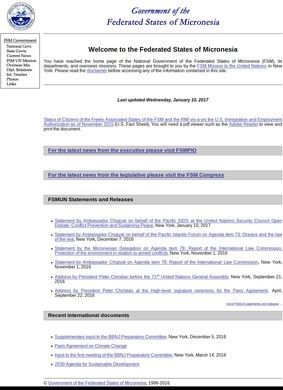
Where does a citizen of Chuuk, a researcher tracking Pacific climate policy, or a diplomat preparing for a posting actually go to read the official word from the FSM national government? The answer is fsmgov.org, the online home of the Government of the Federated States of Micronesia. That address is the single national point through which the four states of Chuuk, Kosrae, Pohnpei, and Yap connect to their shared federal institutions, and that alone is the reason to consult it: when you need the sovereign source instead of a secondhand summary, this is where the trail begins.
A national portal for a small Pacific nation has a job that outranks most government websites. The Federated States of Micronesia sits in free association with the United States, runs its own foreign policy, and legislates through its own Congress. A visitor arriving here is not browsing for entertainment. They want a law, a department, a press release, or a name and title they can trust, and they expect the Government of the Federated States of Micronesia to be the one place that supplies it straight.
What a national portal like this is built to hold
The purpose of the Government of the Federated States of Micronesia site is aggregation. It is meant to pull together the separate arms of the state under one roof so that a person does not have to guess which office handles what. In practice that means the Office of the President, the national Congress, the judiciary, and the executive departments each get a doorway from a central place. When a portal does that job well, it saves a citizen an afternoon of dead ends.
Those departments cover the machinery you would expect a sovereign state to run. Foreign affairs. Finance and administration. Health and social affairs, education, transportation and infrastructure, resources and development, environment and climate, justice. For a country strung across a wide stretch of ocean and facing real pressure from rising seas, the climate and resources functions are not decoration. They are close to the center of what the Government of the Federated States of Micronesia spends its days on.
There is also the reference layer that any government portal is supposed to carry: national statistics, the text of laws and legislation, public notices, and press releases issued in the government's own voice. That combination is the whole point. One place to read what the state has decided and what it is announcing.
Who ends up needing it
The audience is broader than it first looks. Citizens and residents of the FSM come for services and official notices. Businesses need the legal and regulatory text. Researchers and journalists want statistics and primary documents they can cite without hedging. And foreign visitors, diplomats, and anyone arranging contact with FSM institutions rely on it to reach the correct office instead of a general inbox.
Each of those groups is looking for the same underlying thing from the Government of the Federated States of Micronesia: an answer that carries the authority of the state behind it. A secondary site can describe FSM governance. Only the Government of the Federated States of Micronesia, speaking through its own portal, can be the source that others are describing. That gap between description and record is what keeps a national site relevant even when tidier pages exist elsewhere, and it is why a thin front page does not sink the case for visiting.
A redirect notice instead of a front page
Here is where honesty is owed to the reader. Loading the site for this review did not produce a working homepage. What came back was a bare "FSM Government redirect" notice, with no visible navigation, no department menu, no press releases, nothing of the substantive structure the Government of the Federated States of Micronesia is meant to present online.
That does not mean the content is gone. A redirect notice usually points to a real destination, a subdomain or a rebuilt site living at another address, and it can also mean a rendering quirk that a plain fetch could not follow. The likeliest reading is that the Government of the Federated States of Micronesia keeps its material somewhere reachable and that the front door simply hands you off instead of serving the page directly.
As for outside reputation, a check for reviews or ratings of the portal on any consumer platform turns up nothing, which is normal for a national government address rather than a business, and no absence of that kind should be read as a mark against it.
Still, a visitor should know what to expect. If you type the address and land on a stub, you have not reached the end of the road. Follow the redirect, or search for the specific department or the specific FSM Congress or presidential page you are after, and you will have a better chance of getting to the actual document than by trusting the landing page to render everything in one pass.
Reading the offering through the redirect
This review describes what the Government of the Federated States of Micronesia portal is understood to be and what a national government presence of this kind is organized to deliver, because the live front page did not render its sections to inspect directly. That is a fair caveat to hand a reader. It is also a normal state of affairs for the web presence of a small government, where budgets are thin and the site may be mid-migration.
What it does not change is the standing of the source. A portal that redirects is still the official channel of a sovereign nation. The value the Government of the Federated States of Micronesia offers holds even when the presentation stumbles. Better to know going in that the front page may bounce a visitor onward than to expect a polished dashboard and walk away assuming the whole thing is broken.
Whether it is the right first stop
For the questions this site is meant to answer, there is no equivalent substitute. If you want the position of the FSM national government on a treaty, the text of a national law, or the correct department to approach, the Government of the Federated States of Micronesia is the primary record, and everything else is commentary on it. No third party can stand in for a nation speaking about itself.
Weigh it, though, against the obvious alternative. Someone who mainly wants a clean, readable overview of the country, its history, its political structure, its four states, might do better starting at the CIA World Factbook entry for Micronesia, which is stable, well organized, and always renders. The Factbook is excellent for orientation. It is a summary produced by an outside body.
Where the Factbook stops and the portal begins
The distinction matters the moment you need something official. The Factbook will tell you how the Government of the Federated States of Micronesia is shaped; it will not give you the press release, the statute, or the departmental contact you can act on. For a first sketch of the nation, start with the Factbook. For anything that must carry the state's own weight, the answer sits with the Government of the Federated States of Micronesia.
The verdict lands in two parts, then. Consult the Factbook to orient, then follow the redirect and get to the Government of the Federated States of Micronesia itself for the material only a national government can issue. On those documents the source outranks any description of it, even when the front page makes you work a little to reach what is behind it.