ABC Australia runs nine radio networks under one roof: triple j and its Unearthed offshoot, Double J, ABC Radio National, ABC Classic, ABC Jazz, ABC Country, ABC NewsRadio, and a children's stream called ABC Kids listen. Few broadcasters anywhere operate a spread that wide, and it is the first thing that marks the site apart.
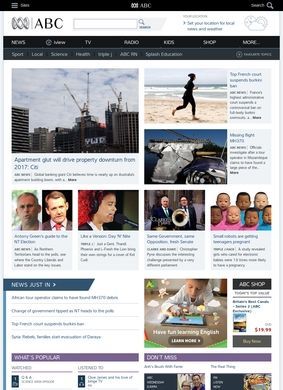
The site at abc.net.au is the online home of the Australian Broadcasting Corporation, the national public broadcaster. Its front page works as a news hub before anything else, billed as Australia's most trusted media source, and it stacks live events, audio, and on-demand video onto a single screen. ABC Australia behaves as a broadcaster and a publisher at the same address, and the homepage is built to send a visitor toward whichever of those they came for.
News anchors the whole thing. Live coverage, written reporting, and video all funnel through that front page, so a reader arriving for a single headline finds audio bulletins and full broadcasts a click away. It is a lot to hang on one landing page, and the layout leans on the news brand to hold it together.
Television and the iview stream
Television is the part most visitors will recognise. ABC Australia carries a set of linear channels, ABC TV, ABC Family, ABC Entertains, ABC Kids, and ABC News, each aimed at a different slice of the audience: general programming on one channel, a dedicated children's channel on another, a rolling news feed on a third. The line-up is built to cover a household without sending it elsewhere for the evening.
The catch-up side lives on iview, the on-demand platform where those channels turn into a browsable library. iview is where ABC Australia does most of its streaming: full programmes sit there for later viewing instead of being tied to a single broadcast slot. For viewers who no longer sit down to a fixed schedule, it is the piece of the operation that has kept the broadcaster in the habit.
Audio and on-demand video follow that same catch-up logic. A programme that aired live can be read about, listened to, or watched again later, and the site keeps those formats close together instead of splitting them across separate destinations. For anyone who missed the original broadcast, that convenience is genuine.
What holds the television and streaming pieces together is that single front door. A visitor does not have to decide in advance between a live channel, a catch-up episode, and the rolling news feed; ABC Australia funnels all of it through the same site and app, and the iview library runs deep enough that older programmes stay findable long after they first went out. For a broadcaster expected to serve a whole country, that one-destination approach does a lot of quiet work.
The 24/7 news channel and regional feeds
Inside iview sits a continuous ABC NEWS channel, a live stream that runs around the clock, so a viewer can open the app at any hour and land on current coverage without waiting for a scheduled bulletin. That always-on feed is a genuine utility during a fast-moving story, when a fixed nightly broadcast would leave hours of silence in between. ABC Australia treats rolling news as a standing service that sits on the same platform as its drama and documentaries.
Regional feeds sharpen the picture further. Collections such as ABC News NSW pull state-level reporting into one place, so a viewer in a particular part of the country can find coverage tuned to it instead of sifting the national feed. For a country this spread out, that local layer is the substantive part, not a decorative one.
A wall of radio networks
Radio is where the breadth turns almost startling. ABC Australia broadcasts its networks digitally, and the roster splits cleanly by taste and purpose: ABC Radio National for speech and ideas, ABC NewsRadio for continuous news, ABC Classic and ABC Jazz for two very different musical audiences, and ABC Country for another again. Each one is a full network, not a side channel.
The youth music end is a small ecosystem on its own. triple j anchors it, triple j Unearthed feeds it new and unsigned artists, and Double J serves listeners who have aged out of the main station but still want music programming. ABC Australia keeps all three distinct, so they complement each other instead of competing for the same ears.
A children's network rounds the roster out. ABC Kids listen gives younger listeners their own stream, which fits the instinct on show across the television side as well, a service built for a specific age rather than a single feed meant to stretch across everyone. Few commercial groups attempt a range this wide.
Music services and speech networks
The split between music and speech is the clearest way to read the radio side. A listener after discussion and reporting has Radio National and NewsRadio; a listener after music has a genre for most moods across Classic, Jazz, Country, and the triple j family.
ABC Australia does not force those audiences onto one channel and hope, and that separation is why each network keeps a recognisable identity instead of blurring into a single station. The cost is obvious: running this many services is expensive. Yet the clarity for a listener is hard to argue with.
Reviewing its own programming
One page turns the lens inward. ABC Australia publishes an Editorial Reviews section that describes how it checks its own output against editorial standards, and as a statement of process it is more openness than many outlets bother to put on record. It reads as a broadcaster taking its own accuracy seriously enough to write down how the checking is meant to work.
The mechanics are spelled out in the broadcaster's own terms. ABC Australia describes program reviews, content reviews, and on-air air checks, three layers of scrutiny meant to catch problems before and after they go to air. Laid out plainly, it is the sort of internal quality process a large newsroom needs if its standards are to mean anything in practice.
The trouble is who holds the pen. These are the ABC's reviews of the ABC, measured against standards the ABC wrote for itself, and the homepage's claim to be Australia's most trusted media source is the broadcaster's own line about its own work. A documented internal process is worth something, yet ABC Australia grading its own output can only reassure so far. The site can describe in detail how carefully it checks itself; whether that self-assessment lines up with how outside audiences actually judge the coverage is the one thing it cannot settle from the inside.