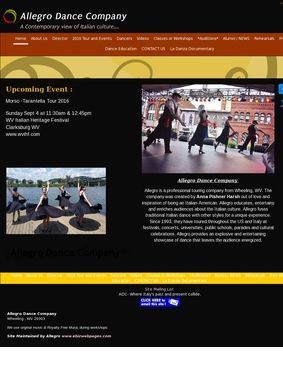
Where in the United States can you book a touring company that performs nothing but traditional Italian folk dance? Going by its own site, the answer is Allegro Dance Company, founded in 1994 and run out of Pittsburgh. The claim it makes is unusually specific: it says it is the only touring dance company in the country devoted to authentic regional Italian folk dances, the Tarantella among them. That is a narrow lane, and a narrow lane is exactly what makes the site worth reading closely, because there is no padding to hide behind. Either the company can deliver live performances of regional Italian dance to a festival or a university, or it cannot, and the pages here are built almost entirely around proving it can.
Live performance and workshop offerings
The core of what Allegro Dance Company sells is live performance. The site frames the company as something a festival organizer, a cultural society, or a school can hire to put authentic Italian folk dancing in front of an audience. Universities and educational institutions are named as typical hosts, which fits the material: regional folk dance carries a lot of context, and an academic or cultural setting is where people tend to want that context spelled out. The Tarantella gets singled out by name, and the framing throughout is regional, meaning the dances are tied to particular parts of Italy instead of being sold as a single all-purpose "Italian" routine. That regional emphasis runs through the whole of Allegro Dance Company's presentation.
Performance is only the front end. Allegro Dance Company also offers workshops in the Tarantella and other Italian dance styles, which moves it from "watch us dance" into "learn to dance yourself." That is a meaningful distinction for the kind of client booking it. A folk festival might want a thirty-minute stage set; a university Italian department might want a hands-on session its students can actually join. Allegro Dance Company appears set up to do both, and the workshop offering is described plainly enough that a prospective host can picture what they would be paying for. The same flexibility shows up in how the company pitches itself to different room sizes, from a single classroom to a festival main stage.
Cultural education beyond the stage
Beyond the dancing itself, there are lectures and presentations on Italian cultural heritage, documentary screenings, and speaking engagements. That combination is more persuasive than a slicker performance-only pitch would be, because it lines up with how regional folk traditions usually get presented in the US: part stage show, part education, part cultural preservation. A company that can supply a screening and a talk alongside the live dance is built for the people who actually program these events, which tend to be cultural organizations and educators rather than party planners. The breadth here reads as genuine subject knowledge instead of a menu padded out to look fuller. It also tells you something about how Allegro Dance Company positions itself: less a troupe for hire by the hour, more a cultural resource that an institution can build a whole event around.
Classes taught by founder Anna Harsh
Allegro Dance Company also runs classes, taught by founder and director Anna Harsh and bookable through the website. This is the part of the operation aimed at individuals rather than institutions, and it ties the whole thing back to a named person. Harsh runs a separate personal site at AnnaHarsh.com, which gives the company a visible human face and a second point of reference for anyone trying to gauge who is actually behind it. For a small specialist outfit, having the director named and reachable does more for credibility than a polished corporate look would.
Site structure and booking process
Structurally the site keeps things to a short, sensible set of sections: Tour Schedule, Classes, Hire, and Contact. A tour schedule is a useful thing for Allegro Dance Company to publish, since it lets a potential host see where the company already travels and whether it might reach their region. The Hire section is the obvious conversion point, and Classes covers the individual-learner side. Nothing here is bloated. The navigation matches the actual offering, which is more than can be said for plenty of small arts sites where the booking path disappears under decoration. For an organizer who already knows what Allegro Dance Company does and just wants to lock in a date, the path from landing page to inquiry is short.
Paid auditions for company dancers
One detail worth flagging is the audition route for dancers. The company advertises paid performance opportunities for its dancers, handled through an audition application that runs on an external Google Form. So the site serves two audiences at once: clients who want to hire a show, and dancers who want to join the roster. The Google Form is a low-budget tool, but for a touring folk company it is a practical one, and listing the performance work as paid is a concrete sign that this is an operating company and not a hobby page.
Contact methods and location details
Reaching Allegro Dance Company requires going through a contact form or an email signup; the site lists no phone number or street address anywhere. For a one-person-fronted touring outfit that is not damning, and a form does cover the basic need to get in touch, but a visible phone line or a city-level mailing address would help an event organizer who needs to firm up logistics quickly. The Pittsburgh base is stated, at least, so prospective hosts have a sense of where the company travels from.
Reputation and independent reviews
There is genuinely little outside reputation to report. A search for reviews of Allegro Dance Company turns up other businesses sharing the "Allegro Dance" name, a boutique and a couple of studios among them, but nothing that clearly maps to allegrodancecompany.net. No Google, Yelp, or comparable third-party ratings appear to be attached to Allegro Dance Company itself. Anyone who likes to check independent feedback first will find none here, which leaves the site's own account doing all the work. It is also common for a niche cultural performer whose bookings come through festivals, universities, and word of mouth instead of the kind of foot traffic that generates online reviews.
Internal consistency of company details
What the site does carry is internal consistency. The 1994 founding date, the Pittsburgh base, the named director, the regional framing of the dances, the split between hiring and auditions: these line up into a coherent picture of a small, specialized company that has been doing one thing for a long time. A prospective host weighing Allegro Dance Company is essentially trusting the site's own account and the visible track record of its director, since there is no independent rating to lean on.
Assessing credibility without ratings
None of that detail contradicts itself, which is the most you can ask of a site for a performer this specialized. For an Italian cultural event, a folk festival, or a university program, the specificity of what Allegro Dance Company offers is the strongest argument in its favor, and the booking path is short enough to act on. The schedule page shows where the company is already heading next.