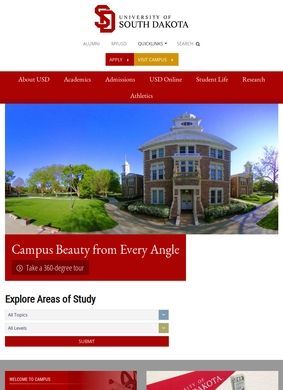
State flagship public universities have to decide what to put in front of the people who visit their websites. For the University of South Dakota, the answer is close to everything a research institution does, laid out for prospective students, current ones, faculty, alumni, and members of the wider South Dakota public who just want to look something up. Based in Vermillion, with an added footprint at USD Sioux Falls and the Sanford School of Medicine campus, this is the school the state points to when it means its top public research university, and the site reads like it knows that job.
Separate pathways for different students
Start with admissions, because that is what most first-time visitors are after. Undergraduate admissions, the graduate school, and continuing or online education each get their own path, so a high school senior and a working adult chasing a master's are not funneled through the same door. A program and major finder lets you sort by what you want to study, which beats reading a static catalog cover to cover. That kind of filtering matters at a school this size, where the number of degree paths can bury a browser who is only half sure of a direction. The academic side is broad: arts and sciences, business, education, fine arts, health sciences, and nursing all sit under the University of South Dakota umbrella, alongside two things worth naming outright.
South Dakota's only law school
The USD School of Law is the only law school in South Dakota. That single fact changes what this institution means to the state. Anyone in South Dakota who wants to become a lawyer without leaving home comes here, which gives the University of South Dakota a role in the legal profession that no other school in the state shares. The site treats the law school as its own destination, spelling out the program information a would-be applicant needs when years and tuition are on the line.
Sanford School of Medicine
Medicine works the same way through the Sanford School of Medicine, which anchors the health-focused campus and ties into the broader health sciences and nursing programs. Pairing a medical school and the state's lone law school inside one university is unusual, and it means the research office pages and department listings reach well beyond the usual undergraduate story. The department directory is genuinely useful for figuring out who does what, since a big institution can otherwise turn into a maze of acronyms. The academic calendar and research office information round out the part of the site aimed at people already inside the machine.
Professional schools without marketing gloss
What makes the combination effective is that the University of South Dakota does not hide these professional schools behind a marketing gloss. The law and medical programs get concrete program detail, the kind an applicant can measure against a decision. Health sciences and nursing sit close by, so a student drawn to one health field can see the others without navigating away. For a state with a modest population, concentrating this much professional training in one place is a practical answer to a real problem, and the University of South Dakota site presents it plainly.
NCAA Division I athletics
Athletics get real space too. The USD Coyotes compete at the NCAA Division I level, and for a lot of alumni and locals that is the front door to the whole University of South Dakota, the thing they check on a Saturday before they ever read a course description. Wrapping sports into the same site as the law school and the medical school is the honest picture of what a flagship university is: an academic body, a research operation, and a public institution people feel loyal to, all at once.
Student resources and daily portals
The student-facing material is thorough. Financial aid and scholarships, campus housing, student life, campus safety, and career services are all present, which covers the practical arc from figuring out how to pay for school to landing a first job after it. These are the pages a current student returns to over and over, and the University of South Dakota keeps them distinct instead of burying them in one bloated hub. Portal links handle the daily grind: self-service, email, and the learning management system are reachable without hunting, which is more than some large schools manage.
Museums and community access
Then there is the part of the site that serves people who will never enroll. A library system, the bookstore, an events calendar, and news and media relations open the University of South Dakota to the surrounding community. The museums stand out here, and the National Music Museum in particular is a legitimate cultural draw, not a token line on a list of amenities. A resident of South Dakota can use the University of South Dakota as a public resource, which is exactly what a land-grant-style flagship is supposed to be.
How do tours and applications connect?
For prospective students specifically, the visit and campus tour scheduling and the application portals do the practical work of turning interest into an actual step. Alumni, giving, and foundation pages point the other direction, toward people who already graduated and might give back. A faculty and staff directory serves both the curious outsider and the person who needs to reach a specific professor. Taken together, the University of South Dakota site is trying to be many things to many audiences, and mostly it keeps those audiences from tripping over each other.
Scheduling tools that reduce friction
The scheduling tools deserve a specific nod. Campus tour booking that a family can complete in a few clicks removes one of the quiet frictions that stops prospective students from ever setting foot on campus, and a physical visit still decides more enrollments than anything a student reads from a distance. The application portals sit right next to it, so the path from touring Vermillion to submitting an application does not scatter across unrelated pages. It is a small thing done sensibly, and those small touches are what separate a functional university site from a frustrating one.
Managing breadth for new visitors
If there is a fair caution, it is the one that comes with any institution this size: the sheer breadth can overwhelm a first-time visitor who does not yet know whether they want law, medicine, an undergraduate degree, or a museum ticket. The program finder and the separated admissions tracks soften that, but a site covering a whole university will always ask you to know roughly what you came for. That is a reasonable trade for completeness, and the navigation choices suggest the University of South Dakota understood the risk and worked to blunt it.
The verdict is straightforward and mostly warm. This is the web presence of South Dakota's flagship public research university, and it behaves like one: comprehensive academic offerings, the state's only law school, the Sanford School of Medicine, Division I athletics, real cultural assets, and clean paths for each type of visitor. A prospective student weighing the University of South Dakota, an alum checking on the Coyotes, or a South Dakotan looking for the National Music Museum will each find what they need without much friction. The only knock is scale, and scale is the point when you are the biggest name in the state. For anyone with business at the University of South Dakota, the site earns the visit and then some.