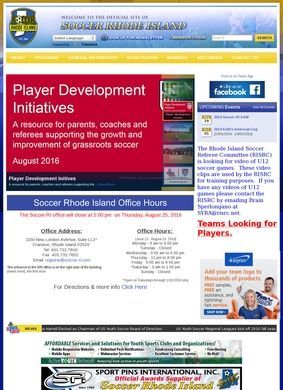
Soccer Rhode Island answers to more than 23,000 youth players and around 3,500 coaches spread across the state, which makes it the organising spine of youth soccer in Rhode Island instead of one club among many. It is the US Youth Soccer state association for Rhode Island, a 501(c)(3) non-profit founded in 2000, and its remit runs from a five-year-old's first festival to the referee standing on the touchline and the coach who trained both of them.
That breadth is the thing to grasp first. Soccer Rhode Island is a governing body, so its real product is the structure wrapped around the game: player pathways, coaching licences, referee certification, tournaments, and the club-support machinery that keeps a statewide system upright. A parent browsing the site is looking at the rulebook and the ladder, not a single team's schedule, and once that clicks the site makes far more sense.
Programs on the field
The player-facing programs are where most families will first meet Soccer Rhode Island. They span the full spread of ambition, from casual early play to a genuine competitive ladder, and they include a strand many associations treat as an afterthought.
TOPSoccer is that strand. It is adaptive soccer for players with disabilities, and Soccer Rhode Island runs it as a proper program with its own DSG TOPSoccer Festival instead of a token line on a list. For the parent of a child who gets left off ordinary rosters, that alone can decide where to register. It is one of the clearer signs that Soccer Rhode Island reads its mandate as the whole state, including the players other systems tend to overlook.
The rest of the on-field menu builds a graded path. The SRI Academy and the Player Development Program give younger and developing players structured coaching, and an Academy Summer Camp fills the off-season. None of this is unusual for a state association, but having the strands sit under one roof means a family is not hunting across a dozen private outfits to find the right level for a child.
Scale is what lets all of this coexist. A single club could never fund an Olympic Development track, a disability program, and a summer camp at the same time; a statewide non-profit with 23,000 players behind it can spread the cost and the coaching talent across every corner of the state. That is the quiet advantage of a governing body over a scatter of independent clubs, and it shows up directly in the breadth of the calendar.
The Olympic Development Program and player pathways
For the competitive end, the Olympic Development Program is the headline route, the identification-and-training track that funnels the strongest players toward regional and national attention. Below and beside it sit the SRI Academy, the Player Development Program, and the summer camp, which together give Soccer Rhode Island a graded set of steps instead of a single all-or-nothing tryout. A child can climb as they grow into the game.
The competition calendar backs this up with the Soccer Rhode Island Cup, the U8 and U10 Festival, the USYS Rhode Island Championship, and the Presidents Cup, so there is a real match to aim at across age groups and ability levels. Whatever a young player is ready for, Soccer Rhode Island has a fixture that fits, and the range from an U8 festival to a state championship is the point.
Building coaches, referees, and clubs
A governing body lives or dies on the adults it trains, and Soccer Rhode Island puts real weight behind that side. This is the part of the operation a parent never sees and every player feels on a Saturday morning, in whether the coach knows what to do with a group of six-year-olds.
The coaching-education menu at Soccer Rhode Island starts at the grassroots level and includes dedicated U6 and U8 developmental training, the age band where good early coaching matters most and is most often fumbled. Soccer Rhode Island runs this in partnership with United Soccer Coaches and US Soccer, which ties the local courses to national curricula instead of leaving each club to invent its own.
A coach earning a licence here is being measured against the same standard as coaches everywhere else in the country, and that consistency is worth a great deal to a parent handing over a child on a Tuesday evening.
There is a knock-on effect worth naming. Better-trained coaches keep more children in the game, since the fastest way to lose a young player is a joyless first season, and grassroots coaching aimed squarely at the U6 and U8 years is the direct remedy for it. The investment in the adults is, in the end, an investment in whether a seven-year-old comes back next spring.
Coaching education and referee pathways
Referee training and certification sit alongside the coaching track, feeding the officials without whom none of the festivals or cup rounds happen at all. Soccer Rhode Island also runs safe-soccer initiatives and a set of support services for its member clubs, the unglamorous administrative backbone that lets a volunteer-run club operate to a shared standard. A login and registration portal handles players, coaches, and clubs in one place, and the site stays current, with recent news postings, live coaching-education scheduling, and open board recruitment all visible on it.
The impression Soccer Rhode Island gives is of an association being actively run, not one coasting on a domain name and a logo.
The referee side deserves its own note. Youth leagues everywhere run short of officials, and an association that trains and certifies its own referees is quietly solving a problem that otherwise ends in cancelled games or a parent pressed into refereeing a match they do not understand. Soccer Rhode Island treating referee development as core work rather than an optional extra is a sign of an organisation planning past next weekend.
The member-club support and safe-soccer initiatives fill in the rest. Behind every local team is a volunteer treasurer, a registrar, and a field coordinator, and a common set of standards and safeguarding rules keeps those clubs pulling in the same direction while keeping children safe as they do. It is dull, necessary work, and a body that handles it well is one parents can rely on without ever opening the policy pages.
Taken together, the programs make Soccer Rhode Island less a website to browse than a system to enrol in. The Olympic Development Program and the graded academy strands give the ambitious player somewhere to climb; TOPSoccer and the U6 and U8 courses give the newcomer and the overlooked a real place to start. Few state associations cover both ends this deliberately, and Soccer Rhode Island has plainly decided that reach across the whole player population is the job, from the child who needs an adaptive program to the future ODP call-up.
The registration portal is where all of this actually converges. A local member club, grassroots programming, Olympic Development Program tryout dates, and the next coaching course with United Soccer Coaches are all reachable through that one login instead of a dozen separate contacts scattered across the state. That single point of entry, as much as the size of the membership, is what makes Soccer Rhode Island function as a system rather than a loose federation of clubs sharing a name.