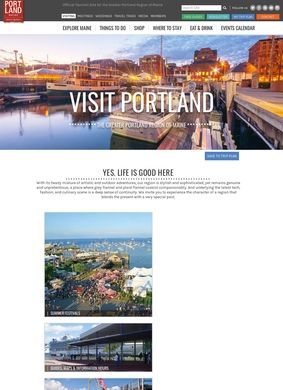
Visit Portland is the official tourism site for Greater Portland, Maine, run by the region's destination marketing organization. It is built to answer the practical questions a traveler asks before booking anything: where to sleep, what to eat, what is worth doing, and what is happening the week of the trip. The structure follows those questions closely, and Visit Portland reads like a working reference kept current by people who actually manage the destination.
Plan your trip by neighborhood
The homepage funnels into a handful of large sections, and each one is deep enough to plan from without leaving the site. Plan Your Trip breaks the area down by neighborhoods, attractions, and events, so someone who only knows the name "Portland" can figure out how the city and its surrounding towns fit together. Where to Stay covers hotels, bed-and-breakfasts, cabins, and rentals, a wider spread than a lot of single-city visitor sites bother with. That range fits a place like Greater Portland, where a weekend in the Old Port has almost nothing in common with a cabin stay out toward the islands. It goes past what a plain business directory of hotel listings would offer, since everything is sorted by the kind of trip a visitor has in mind instead of by property type alone.
Food and drink as main attractions
Food gets its own serious treatment. The Eat + Drink section points travelers toward restaurants, breweries, and lobster experiences, and anyone who knows Portland's reputation as a food town will expect exactly that emphasis. The brewery coverage is not an afterthought here, which fits a city that has become a genuine destination for beer as much as for seafood. Grouping the lobster material separately is a smart call, because it is often the single thing an out-of-state visitor wants to get right and the hardest to sort through on your own. Visit Portland treats the local food scene as a headline attraction, and given the city's national profile for restaurants, that weighting reads as honest rather than inflated.
Museums, outdoor activities, shopping
Things to Do spreads across museums, outdoor activities, shopping, and the arts, and the breadth keeps the site useful past a first visit. A traveler who has already done the harbor and the lighthouses can dig into galleries or hiking instead of hitting the same short list everyone else sees. The event calendar ties it together, since a destination site lives or dies on whether it tells you what is happening on your dates. Visit Portland puts that calendar front and center, paired with guides that give more shape to the loose lists.
Interactive map of area towns
There is also an interactive map of the area towns and islands, a feature that sounds minor and turns out to be the thing you use most. Greater Portland is not one tidy downtown; it is a city plus a scatter of communities and islands, and seeing them laid out spatially does more for trip planning than any amount of prose. The map turns a vague sense of "somewhere near Portland" into an itinerary you can drive or ferry. Visit Portland leans on that geography instead of pretending the region is a single walkable core.
Meetings and weddings planning
Beyond the leisure traveler, Visit Portland carries dedicated tracks for people who bring groups to the region. The Meetings & Weddings section gathers event-planning resources for those two audiences, and keeping them distinct makes sense, since a conference organizer and a couple planning a wedding weekend need very different things from the same city. A planner scouting a venue for two hundred delegates and a couple looking at a harbor-view reception both find material pitched at their actual decision, which is more useful than a catch-all page.
The Travel Trade section speaks to industry professionals, the tour operators and partners who sell the destination to their own clients. That is standard for a destination marketing organization, but it signals that Visit Portland connects the region's businesses to the wider travel industry as well as to individual travelers. A blog with trip-planning tools rounds out the consumer side, giving Visit Portland room to go longer on seasonal ideas than the fixed section pages allow.
International language support
One detail worth calling out: downloadable brochures in Chinese, Italian, French, Japanese, German, and Spanish. International visitors are a real slice of Portland's tourism, and six languages is more effort than plenty of American city sites bother with. It shows Visit Portland takes its overseas audience seriously.
The site also runs a newsletter signup pitched around deals, the usual way a tourism board keeps a warm audience and pushes seasonal offers. For a traveler still months out from a trip, that is a low-commitment way to catch a hotel promotion or an event announcement without checking back constantly. The same split shows up in the contact routes, with separate addresses for meetings, weddings, and partner inquiries, so a query lands with the right team instead of a general inbox.
Across all of it, the material stays anchored to Greater Portland, not padded out with generic New England travel copy. That focus is the site's strength: neighborhoods, restaurants, islands, and the towns immediately around them, from an organization whose whole job is knowing that ground. Visit Portland keeps its social accounts active too, which is where last-minute event and seasonal information tends to surface first, and it does not try to be a guide to the entire state.
If there is a limit to lean on, it is the one built into any destination marketing site: this is promotional material by nature, assembled to make the region look worth the airfare. That does not make it inaccurate, and the depth of the listings works against pure boosterism, but a traveler should still read the recommendations as an official pitch and cross-check the specifics, hotel availability, ferry schedules, restaurant hours, against the individual businesses. A search for outside reviews of Visit Portland as an organization turns up nothing worth citing; it is a tourism office, not a business people rate on a review platform, and the closest thing to public feedback is how often its own guides get shared or linked. The site is the map, not the final word on any single stop.
Where Visit Portland lands well is coverage that is both broad and current. The combination of an event calendar, six-language brochures, an interactive area map, and separate planning tracks for leisure, weddings, meetings, and the trade gives it more range than a casual visitor would guess from the clean front page. It is the sort of resource a traveler can start a trip with and keep open through the booking, which is more than plenty of city tourism sites manage.
Deeper than statewide tourism sites
Set it against the Maine Office of Tourism, the statewide site a reader might reach for first, and the trade-off comes into focus. The state portal covers everything from Acadia to Aroostook, which is why it thins at the city level. For someone whose trip is anchored on Portland and its islands, Visit Portland goes deeper on the neighborhoods, the lobster shacks, the breweries, and the specific towns than any statewide overview can, and that density is the reason to open this one first.