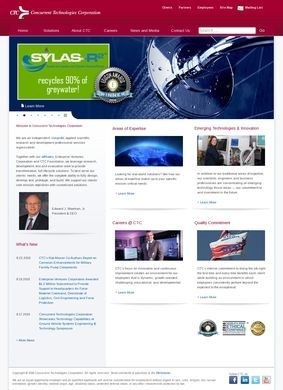
Concurrent Technologies Corporation is a nonprofit, and among the things it does under that status is work on hypersonic technologies, nuclear manufacturing, and armaments engineering for the United States government. The About section states the nonprofit status plainly. It reads as an odd pairing on first contact: a charitable-status organization whose day job includes cold spray additive manufacturing and post-quantum cryptography for the military. The label sits uneasily next to the work, until you understand that a good deal of federal research and development runs through exactly this kind of independent nonprofit institute.
In practice, Concurrent Technologies Corporation is an independent applied research and development and professional services organization, and its clients are overwhelmingly U.S. government and military. The work splits into four solution areas, and the spread between them is wide, from writing software to welding metal.
A nonprofit built around federal work
The catalog of what Concurrent Technologies Corporation takes on is long enough that no single client will ever need all of it. That is the nature of a federal contractor: it keeps many capabilities on the shelf and pulls the relevant ones for each agency and each contract. A visitor browsing the site is looking at a menu written for procurement officers, not a tidy pitch aimed at one buyer.
The company holds a stack of federal contract vehicles that tells you exactly who it sells to and how. GSA Federal Supply Service MAS, MCICOM PRISM MATOC, GSA OASIS+, OTA memberships, SeaPort-NxG, and SHIELD are the procurement channels a government buyer recognizes on sight. A civilian will not, and that is the point. This is a business whose front door faces contracting officers, and the presence of that many vehicles signals an organization that has done the paperwork to be easy to hire across several branches of government.
Digital mission solutions
The digital area covers cloud architecture and security, cybersecurity, cross domain solutions, and Cybersecurity Maturity Model Certification work. It runs into newer territory too, with post-quantum cryptography, data management and analysis, DevSecOps, edge node systems, and machine learning and AI. It is a credible list for a defense IT contractor, weighted toward security and the compliance frameworks the Department of Defense cares about, and it lines up with the cyber-heavy direction most of that market has taken.
Cross domain solutions and post-quantum cryptography in particular are narrow, hard specialties, and their presence suggests the work here goes deeper than generalist IT support.
Engineering and advanced manufacturing
This is the meatiest section by a distance. Additive manufacturing shows up in several forms, including cold spray, hybrid AM, and laser powder bed fusion. Around it sit armaments engineering, coatings and corrosion services, custom fabrication, digital engineering, friction stir welding, hypersonic technologies, mechanical testing and materials analysis, nuclear manufacturing, prototype manufacturing, rare earth elements, and systems engineering. Few contractors list nuclear manufacturing and hypersonics in the same breath. Concurrent Technologies Corporation does, which places it at the hard end of defense industrial work, well past the software-and-slides tier of the industry.
Rare earth elements sitting on that list is worth a second look, given how much attention supply of those materials has drawn in defense circles.
Readiness, energy, and the rest of the map
Two more solution areas round out the offering. Energy, Resilience and Sustainability handles critical infrastructure planning and engineering, energy and sustainability for military installations, and policy and planning advisory. It is aimed at the base commander worried about whether the lights stay on when the grid does not, and it treats energy as a readiness problem, not a green talking point.
None of that reads like an entry pulled from a general business directory, where a listing usually assumes a reader who has never heard of the company. This one assumes the opposite: that whoever lands on the page already knows what a continuity-of-operations plan is for and just needs to confirm Concurrent Technologies Corporation can deliver one. The language never drifts toward a commercial audience because it was never written for one.
Readiness solutions
The readiness area gathers advanced learning, identity, credential and access management, logistics and program management support, safety and occupational health services, and technology-based readiness. These are the less glamorous support functions that keep large programs staffed, trained, and compliant. Concurrent Technologies Corporation groups them as a single practice, which suggests a fair slice of its revenue is steady services work sitting behind the headline engineering. Program management support and logistics rarely make a website's front page, but they are often what pays the bills year to year.
The site also carries the sections expected from an organization the size of Concurrent Technologies Corporation: Who We Are, Leadership, History, Locations, Clients and Partners, Careers with job openings, News and Media, Awards and Recognition, and Videos. It is a conventional corporate structure, and it does the job of orienting a visitor without much flourish.
What outside sources say
Here the outside evidence runs short, and it is worth being straight about why. The only third-party ratings that turn up come from employees, not clients. Glassdoor lists Concurrent Technologies Corporation at 3.3 out of 5 across 201 company reviews, with a separate Johnstown-location entry at 2.9 from 77 reviews and a differently named "Concurrent Technologies" listing at 3.4 from 44. Indeed shows somewhere between 72 and 75 employee reviews. No client-facing ratings turned up at all, nothing from BBB, Trustpilot, or Google Reviews.
That is not a small point for a firm like this. A 3.3 on Glassdoor tells you how it feels to work there, middling by that measure, and says nothing about whether the agencies it serves walk away satisfied. Defense clients rarely leave public reviews anyway, so the silence there is not damning, just uninformative. A prospective employee learns more from these numbers than a prospective client does.
Contact follows the same reserved pattern. Concurrent Technologies Corporation offers a Contact Us area, with separate routes for general comments or questions and for reaching the Chief Quality Officer, plus dedicated Small Business and Vendor Registration and Accounts Payable links, which is precisely the plumbing a subcontractor or supplier would go looking for.
What the landing page does not put in front of you is a phone number, an email, or a street address. Reaching a specific person means clicking into a subpage first. For an organization whose real customers already hold their program contacts, that ordering of priorities fits the audience it actually serves.
Every star rating attached to Concurrent Technologies Corporation comes from people who have worked there, and none from the government buyers who sign its contracts.