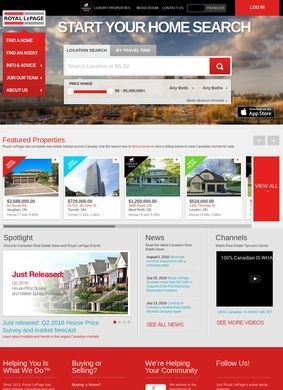
Someone deciding where to put down roots in a new city has a fairly specific worry: the house might be perfect on paper and still sit a forty-minute drive from the office, or fall just outside the catchment of the school the kids need. Most property sites hand you a map and a price filter and leave the rest to guesswork. Royal LePage takes a different angle, and that is the thing worth slowing down to look at. The search does not stop at city and bedroom count. You can search by commute time, by school zone, and by lifestyle, which turns house hunting into something closer to the decision people are really making.
Specialty search tools for buyers
The catalogue underneath all of this is large. Royal LePage pulls from MLS and lists well over 224,800 properties for sale, spread across every Canadian province. With a national pool that size, the Travel Time Search or the School Search will usually have something to show, and specialty filters are only worth having when the underlying inventory is deep enough to return real results. A buyer can also look by neighbourhood, by street address, or by MLS number directly when they already know the listing they are chasing.
Beyond the standard purchase path, the search tools branch into cases that other portals tend to ignore. Royal LePage has an Income Property Search for people buying to rent out, a Rent-To-Own option for buyers who cannot or do not want to commit to a full mortgage yet, and a section for specialty properties that includes military relocation, which is a genuinely useful niche given how often service members move on short notice. These are not headline features, but they point to a site built to handle the awkward, real-world situations that do not fit the typical first-time-buyer mould.
Estimating home value for sellers
Sellers get their own entry point, and it starts with a number. The QuickQuote tool produces a property value estimate, which is the first question almost every homeowner has before they decide whether this is even the year to sell. An estimate from an automated tool is never the final word, and anyone treating it as gospel will be disappointed, but as a starting reference point it does the job of grounding the conversation in something concrete instead of a hopeful guess.
From there Royal LePage leans on its agent network. The Find an Agent directory lets a seller locate someone local and reach out directly, which is the right structure for a brokerage of this kind: the website is the front door, and the actual transaction runs through a person who knows the specific market. For a category as relationship-driven as real estate, having that human handoff built cleanly into the site is more valuable than another layer of automated tooling.
The seller and homeowner guides round this out. There is written material on preparing to sell, on maintaining a home, and on home efficiency, alongside Canadian housing market reports and a blog that runs market analysis. None of it reinvents the genre, but it is the sort of reference content a person reads once while they are deciding and then never again, and it is sensible that it exists in one place next to the listings and the agents.
For buyers the informational side mirrors this with its own guides, covering the steps of a purchase and the homeowner tips that follow it. The market reports are the part most worth returning to, since they carry information that changes over time and give a person browsing some sense of where prices and demand are heading in the area they care about. Royal LePage is positioning itself as a place to learn the market, and the editorial layer has real substance rather than photo galleries with price tags.
Saved searches and listings
Registered users get a layer of persistence on top of all this. Saving listings, saving searches, and managing a profile sounds minor until you have tried to track a dozen properties across several weeks of weekend viewings. A saved search that remembers your commute-time and school filters means you are not rebuilding the same query every time you log back in, and that small convenience is what keeps people coming back to Royal LePage over a portal they have to relearn each visit.
Franchise opportunities for agents
Royal LePage also serves people on the other side of the desk. The company recruits agents and team leaders and advertises real estate franchise opportunities across the country, so the same domain works as a careers and business-development hub as much as a consumer storefront. A personal listing portal, referred to as VOWS and run under Royal LePage Real Estate Services, Brokerage, gives registered members a more private view of the inventory than the open public search. The platform is bilingual in English and French, which for a national Canadian service is not a nicety but a requirement, and it is handled rather than bolted on.
There is a charitable side as well. The Royal LePage Shelter Foundation is noted as the network's giving arm, and while a foundation does not tell you anything about how well a given agent will sell your house, it is a real and longstanding part of how the company presents itself. Social presence is the expected set, with active channels on YouTube, Facebook, and Instagram for anyone who wants to follow market commentary or new listings in a feed instead of on the site.
A search for third-party reviews of Royal LePage as a corporate entity turns up no substantial volume, which is largely because the brokerage experience lives with individual agents, not the brand entity. The company has been operating in Canada since 1913, and that longevity is documented history, not marketing copy.
The honest weakness, if there is one, is that breadth like this can feel like a lot to wade through. A buyer who only wants to type in a postal code and see houses may find the wealth of specialty searches more than they asked for. That is a small complaint against a site that is trying to cover the whole spectrum of a real estate transaction, and the plain search is still right there for anyone who wants to skip the extras.
A relocating professional or a military family moving on a deadline gets the most out of Royal LePage, because the commute-time and school-zone filters and the relocation section do work that a basic price-and-bedroom search cannot. The practical next step is to run a QuickQuote if you are weighing a sale, or to use the Find an Agent directory to reach a local Royal LePage representative and ask specifically how the school catchment and travel-time tools map to the streets you care about. A national network with this much inventory is only as good as the person you end up working with, and Royal LePage makes finding that person the straightforward part of the process.