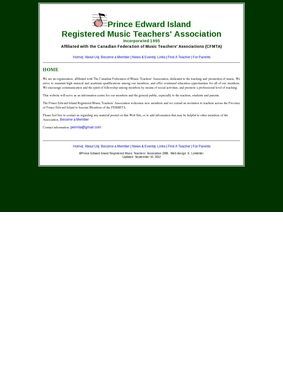
A parent in Charlottetown who wants piano lessons for a seven-year-old runs into the same wall every time. Plenty of people advertise music instruction, and there is almost no way to tell a trained teacher from a hobbyist with a spare afternoon and a keyboard. The Prince Edward Island Registered Music Teachers' Association exists to answer exactly that, and its Find a Teacher directory is the front door most families will walk through.
That directory is the practical heart of the site. A member of the public types in what they are after and gets connected to registered music teachers around the province, instructors who have affiliated with a professional body instead of simply posting a classified ad. For a family with no way to judge a stranger's qualifications, that single filter does real work, and it is the clearest reason the site exists.
Where the public meets a registered teacher
The Find a Teacher tool is the reason most non-members will ever land here. It is a search and directory function, and its whole value rests on one promise: that everyone listed has gone through the association and carries the registered credential. The Prince Edward Island Registered Music Teachers' Association is arranged around connecting students, and the parents deciding for them, with instructors it recognizes as its own.
How useful that directory turns out to be depends entirely on how many teachers it holds and how current it stays, and the public-facing pages do not make those figures visible. A directory covering a whole province of instructors is genuinely useful. A sparse one is a phone book with three entries. The site leans on the search working well, and a visitor cannot really gauge its depth without running a query and seeing who comes back.
Still, the design instinct is sound. A prospective student does not want an essay about the organization; they want a name, an instrument, and some assurance the person on the other end is qualified. By putting the teacher search near the center of what it does, the Prince Edward Island Registered Music Teachers' Association keeps the public's actual task in view instead of burying it under institutional description. That choice suggests the site was built with the anxious parent in mind first, ahead of the membership.
What being registered is meant to signal
The word registered is doing the heavy lifting throughout the site. In a professional association it stands for a member who has met the body's standards and agreed to be accountable to it, which is a different thing from self-declared expertise. A parent reading the Prince Edward Island Registered Music Teachers' Association listing is being handed a shortcut past the awkward job of vetting a music teacher entirely on their own, and for most families that is worth a great deal.
That is the pitch, and taken on its own terms it is a reasonable one.
What the site does less to spell out, at least on its public face, is what the standard behind the word involves. Someone signing a child up for years of lessons would want to know what a teacher has to do to register with the Prince Edward Island Registered Music Teachers' Association, and how far that vouches for teaching ability as opposed to simple membership in good standing.
The credential is only as reassuring as the requirements sitting behind it are clear, and a visitor is largely asked to take the meaning of registered on faith. That gap is the one soft spot in an otherwise sensible idea.
The member side of the association
The other half of the site speaks to teachers themselves. A Become a Member section and the membership information around it lay out the case for joining, while an events and networking area points to the professional life the Prince Edward Island Registered Music Teachers' Association organizes: the meetings, the shared learning, and the contact among instructors who otherwise spend their working days alone in separate studios. Music teaching is an isolated trade, and a provincial body is one of the few settings where the work turns collegial.
For a teacher weighing affiliation, the Prince Edward Island Registered Music Teachers' Association offers the two things a professional association usually offers. One is a credential the public can look up and trust. The other is a standing network of peers. The listing inside the Find a Teacher directory is the visible payoff, since it routes prospective students toward members who might otherwise never be found; the networking is the quieter benefit, and harder to see from outside.
Both of those matter, and the site gives each its own room to breathe. A teacher new to the province, or newly out of training, would find in the Prince Edward Island Registered Music Teachers' Association a ready-made way to be discovered and a set of colleagues to lean on, which is a fair bit for one membership to carry.
The events and networking piece is easy to underrate. Independent music teachers rarely have a staff room, a department, or anyone to compare notes with about repertoire, pacing, or the business side of running a studio. A provincial association is where those conversations happen, and where standards get quietly maintained through contact rather than decree. That quiet upkeep is part of what a family buys into when it picks an instructor through the Prince Edward Island Registered Music Teachers' Association, even if the family never sees it directly.
An About section fills in what the organization is and who it serves, which for a small provincial body is the part that establishes it as a real, continuing institution and not a one-person effort. The whole site is arranged around two distinct visitors, the public hunting for a teacher and the teacher hunting for a professional home, and the Prince Edward Island Registered Music Teachers' Association keeps those two paths cleanly apart. I went in expecting a dry membership page and came away with a clearer sense of purpose than expected.
Read as a piece of professional infrastructure, the Prince Edward Island Registered Music Teachers' Association makes sense in a way many local sites do not. It is not trying to sell anything to the visitor directly. It connects two groups who genuinely need each other, the qualified teacher and the family that cannot judge qualifications, and it stakes the connection on a credential it manages. For an island with a limited pool of instructors, having one recognized place to look is worth more than it would be in a big city with a hundred studios competing.
What stays unresolved is whether the Prince Edward Island Registered Music Teachers' Association delivers on the one thing everything else depends on.
The credential, the networking, and the About page all point back to the Find a Teacher directory, and a parent cannot know from the outside whether that directory runs deep enough to actually turn up a suitable teacher nearby, in the instrument they want, taking new students this term. A body like this is only as useful to the public as the roster it can put on screen, and the site asks a first-time visitor to trust that the roster is full and current before it has shown them a single name to go on.