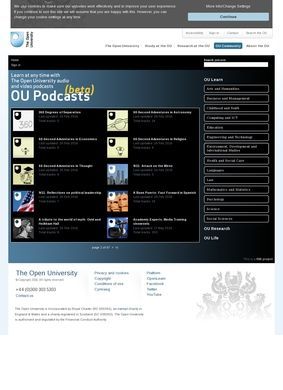
Everything on Open University Podcasts is free, and the material comes from a working university, not a hobbyist with a microphone in a spare room. That pairing is the whole reason to look. The audio and video sit inside fourteen academic subjects, a spread wide enough that Arts and Humanities shares a menu with Engineering and Technology, Law, Psychology, and Mathematics and Statistics.
The pitch behind Open University Podcasts is blunt in its tagline: learn at any time with the university's audio and video. No enrolment form, no fee, no waiting for a term to begin. A listener presses play on a lecture the way anyone else queues up a music track, and the university's name is the only credential attached to it.
A free feed sorted by subject
Fourteen subjects form the backbone of Open University Podcasts. Beyond the ones already named, the list takes in Business and Management, Childhood and Youth, Computing and ICT, Education, Environment and development studies, Health and Social Care, Languages, Science, and Social Sciences. Each subject opens onto recorded episodes aimed at people who want the substance of a topic without registering for a degree, and the range is wide enough that a single field can hold enough to fill an afternoon.
A viewer drawn in by one video on climate policy, say, can just as easily find a run of lectures on environmental law sitting one click over, without switching sites or paying for either.
That is the quiet strength here. Someone who came to Open University Podcasts for one psychology episode can drift sideways into education or health and social care without leaving the site or reaching for a wallet. The subjects are labelled the way a university actually divides its faculties, so a listener who knows what they want lands on it fast, and one who does not know yet has fourteen doors to try instead of one.
OU Learn and the subject shelves
The catalogue is grouped into three named collections, and OU Learn is the one most visitors will live in. It holds the subject-based teaching content, the episodes tied to what the university teaches for real. This is the part that behaves like a course reader played on a commute, arranged so a topic is easy to find and just as easy to leave when the next stop arrives.
It rewards browsing. The subject shelves inside Open University Podcasts invite the kind of aimless clicking that turns one search into a habit, and because none of it is gated, that curiosity costs nothing. A listener who wandered in through a single search result can lose twenty minutes to adjacent episodes without ever hitting a paywall or a sign-up prompt.
OU Research and OU Life sections
Within Open University Podcasts, OU Research gathers the material tied to the university's research work, which feeds a different appetite from OU Learn. The audience here is the person who wants to hear what the institution is investigating, beyond what it puts in front of undergraduates. OU Life rounds out the set with university and campus programming, the wider texture of the place beyond any single reading list.
Three collections keep the sprawl legible. Without that split, fourteen subjects of audio and video would land as one undifferentiated wall; with it, a visitor decides up front whether the pull is a subject, the research, or campus life, and the library stays navigable even as it grows. It is a minor piece of information architecture, and it is exactly the kind that keeps a big catalogue from turning into a dumping ground.
Built for distance learners and the merely curious
The audience splits two ways, and Open University Podcasts holds both without forcing either to pretend to be the other. It serves the university's own distance-learning students, who get a supplement to their coursework, and it serves the general public, who get open learning with no strings. Those two groups arrive wanting different things from the same feed, and the site never seems to have to choose between them.
For enrolled students the Open University Podcasts feed sits next to the real machinery of study. Sign-in options lead through to the StudentHome and TutorHome portals, so the audio is a tab away from the coursework it supports. For everyone else, the same episodes are simply there to take, and the public content complements the university's broader undergraduate and postgraduate offerings, giving a casual listener an obvious path forward if the interest sticks.
Sign-in doors and open doors
Accessibility is treated as a starting condition here, not a bolt-on afterthought. Open University Podcasts carries a dedicated accessibility statement and a set of accessibility resources, which counts for a lot in a service built on audio and video, where a listener with a hearing or sight difference gets shut out quickly if nobody planned for them. Social links to Facebook, X, YouTube and LinkedIn give each episode somewhere to travel once it leaves the page.
The portal sign-ins, and this is my one hesitation, can make the place feel as though it belongs to enrolled students first and the public second, even though the open content is genuinely open to all. That is a matter of framing, and it never blocks anyone from pressing play. A first-time visitor who ignores the sign-in buttons entirely will still find the whole catalogue waiting.
Where the podcasts hold up
The verdict is easy for once. Free university audio and video, sorted into fourteen subjects and three clear collections, is a strong offer with very little downside, and Open University Podcasts delivers what its name promises without asking for anything back. A curious commuter and a registered student can use the identical feed for entirely different ends.
Weigh it against a general catalogue like Apple Podcasts, where the same kind of lecture competes for attention with millions of unrelated shows and nothing vouches for the source, and the case for one curated university feed gets sharper. Open University Podcasts trades the breadth of everything for depth in one credible thing, and that trade holds up well against the alternative: paying nothing and enrolling in nothing, yet still getting material with a university's name behind it.