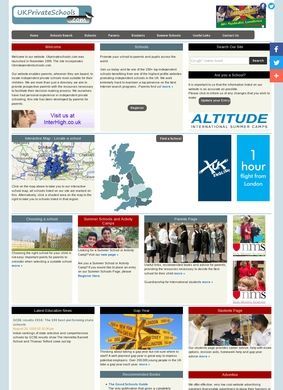
UK Private Schools grew out of an older directory called Ukindependentschools.com, and it has been running for more than a quarter of a century, which makes it one of the longer-lived independent-education resources on the British web. It bills itself as developed by parents for parents, and that phrase turns out to be the key to how the whole thing is put together.
The core of UK Private Schools is a school directory built to help parents locate the independent private schools most suitable for their children. That is the promise the site opens with, and it sets out to be more than a bare list by wrapping the listings in the kind of guidance a family actually reaches for when it is trying to choose. The parents-for-parents framing is the difference it is selling: a resource assembled by people who have been through the process instead of a marketing department.
It leans, sensibly, on outside authority where it can. UK Private Schools points readers toward The Good Schools Guide, an independent publication, instead of pretending to be the last word on the subject. For a site run by parents, knowing where its own limits sit is a point in its favour, and it sets a more honest tone than a directory that claims to rank everything itself.
More than a list of schools
The offering fans out well beyond the directory. UK Private Schools organises its listings by region, so a family can start from where they need to be instead of scrolling a national A-to-Z. It carries a summer schools database, guidance on the mechanics of getting in, a gap year section and a guardianship service, and each of those answers a different question that a parent of an independent-school child tends to hit in turn.
The structure follows the real timeline of a decision instead of the tidy categories of a filing system. A parent rarely needs all of it at once, and the site is built so a family can come back for the next piece as the process moves on.
Taken together, that spread is the argument for the site. A bare directory sends you off to research everything else on your own. UK Private Schools tries to keep the whole decision in one place, from the first shortlist through to the guardian a boarding school will ask for once a child is enrolled.
Regional listings and the interactive map
The regional structure is the backbone. Listings are grouped by geographic area, with sections for the South East, the Midlands, London, Scotland and Wales among others, and an interactive map marks the listed schools so a parent can read clusters and distances at a glance. For anyone weighing a daily commute or a boarding radius, seeing the schools plotted rather than named in a column does far more work.
UK Private Schools treats that map as a genuine navigation tool, and it is one of the features that lifts the site above a plain alphabetical index. Distances and clusters are exactly what a boarding decision turns on, and reading them off a map is far quicker than piecing them together from a column of postcodes.
Summer schools and gap year routes
Two sections stretch the site past term-time placement. The summer schools database gathers academic programmes and activity camps, the short residential courses families use to fill a long holiday or let a child try out a school before enrolling. The gap year section is the more surprising of the two. UK Private Schools lists gap year programmes and advice down to specific qualifications, such as the BASI level 1 and 2 ski-instructor courses, a level of detail you would not expect from a schools directory and a sign the site follows its users well past the school gates.
It reads like something added because parents kept asking, which fits the whole premise. It also gives the site a reason to stay useful over the summer, when the main directory sees less traffic.
Entrance exams, scholarships and choosing a school
The guidance layer is where UK Private Schools tries hardest to be useful. It carries resources on entrance exams, scholarships and the general business of school selection, exactly the questions that leave prospective parents anxious and confused. Entrance procedures and scholarship routes differ from school to school in ways that are genuinely hard to keep straight, and a plain-English explainer sitting next to the listings is exactly what UK Private Schools set out to provide.
Fees, bursaries and the timing of registration all belong to this same anxious stretch of the process, and gathering the explanations in one place is a genuine convenience.
Whether the UK Private Schools guidance runs deep or stops at a useful orientation is harder to judge from the outside. A careful parent would treat it as a starting point, cross-checked against The Good Schools Guide and against the schools themselves before any money or paperwork changes hands. As a way of learning which questions to ask, though, it does the job.
Guardianship for overseas families
The guardianship service is the piece aimed squarely at international families. UK Private Schools connects families with guardian providers for students staying in the UK, the local guardians a boarding school will usually insist on for a child whose parents live abroad.
It is a real and often last-minute practical need, and folding it into the same site that helped choose the school is a sensible piece of joined-up thinking that a purely alphabetical directory would never bother with. Getting a guardian wrong can hold up a visa or a school place, so having a starting list of providers alongside the school search spares a family one more frantic hunt.
For those overseas families in particular, the way the site handles contact is a weak point. UK Private Schools shows an email address, but it is flagged for advertising enquiries, and the general way in is a contact form. No phone number and no postal address appear on the pages reviewed. For a directory rather than a school in its own right that is not fatal, and a form covers most enquiries, but a parent on the other side of the world hoping to reach a person quickly will find the door narrower than they would like.
Independent comment is the one thing missing. A search for UK Private Schools by name and by domain turns up mostly its own pages, a scattering of unrelated best-of ranking articles and an unrelated American site, with nothing that amounts to an independent review of UK Private Schools itself. That silence cuts both ways.
There is no third-party praise to lean on, and there is no trail of complaints either, so the site has to be judged on what it plainly offers. For a resource of this age, an absence of reviews in either direction is itself a mild signal: it has quietly done its job without producing evangelists or a backlash.
A parent beginning a UK independent-school search from scratch, and especially an overseas family who will eventually need a guardian, will find UK Private Schools a useful map of the territory to start from.
The concrete first move is to open the regional listings for the area under consideration, mark a shortlist on the interactive map, then use the entrance-exam and scholarship pages to work out what each school will ask of you, before checking every candidate against The Good Schools Guide and contacting the schools direct. Treat UK Private Schools as the place a search begins, not the place it ends.