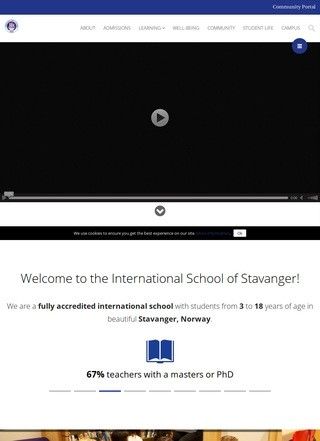
A family lands in Stavanger for a two-year posting in the energy industry, the children are nine and fourteen, and neither of them speaks a word of Norwegian. Where do they go to school on Monday? The International Stavanger School is built for precisely that arrival: a fully accredited school teaching in English, taking students from age three to eighteen, so a relocating household can settle both children into one place without splitting them across the city or waiting for a language to catch up.
The International Stavanger School covers the whole span under one roof. That is the first thing worth knowing.
The stated aim of the International Stavanger School is engaging and challenging English-language education in a supportive, multi-cultural environment, and the site is laid out along the shape of a child growing up: Early Years and Preschool, Primary, Middle, then High School, each with its own curriculum and its own kind of support.
One campus, four stages of school
The divisions are drawn on the usual age lines, and the International Stavanger School keeps each one distinct rather than blurring them into a single programme. A three-year-old in preschool and a seventeen-year-old sitting IB exams need different things, and the site treats them as different populations with pages of their own.
What holds the four together is one accreditation and one language of instruction, which is the practical reason a family with a wide age gap between siblings can commit to the place at all. The multi-cultural environment named in the mission matches what actually walks through the door: an English-medium school in a Norwegian oil city draws children from many countries, and a new arrival is rarely the only outsider in the room. For a child who has already changed schools once or twice chasing a parent's work, that ordinariness counts.
Early years and primary
The Early Years and Preschool division at the International Stavanger School pairs a curriculum with student support and childcare services, which for a working expat couple is a real detail, since the school day and the working day rarely line up.
Primary carries the curriculum through the younger grades, keeps its own student support, and runs extended care for the hours on either end. The through-line is that the youngest children are handled as a full-day proposition, care as well as class.
Middle and high school
Middle School moves into subject courses with continued student support, the bridge years where a child starts to specialise. High School is where the International Stavanger School shows its academic ambition: a standard curriculum sits alongside the IB Diploma Programme, and the school adds university and career counseling on top, which is the part a parent of a fifteen-year-old will read most closely. The IB is a recognised route into universities around the world, and having it in-house means an English-speaking teenager in Norway keeps that path open.
The university and career counseling attached to it is the difference between a diploma and a plan, and for a family that may move again before graduation, guidance that understands cross-border applications is worth more than it looks.
Beyond the timetable
Academics are one half of the pitch. The other is a programme of more than sixty co-curricular and athletic options, a serious number for a school of this size and the clearest sign that the International Stavanger School wants students occupied after the last bell as much as during the day.
The list is broad on purpose, and it spans categories rather than clustering in one: sports and athletics sit alongside language programmes, arts programs and service learning, so a child with no interest in football still has other doors to try.
Sixty-plus activities and the arts
Alongside the sports and athletics there are language programmes, arts programs, and service learning initiatives that push students out into the surrounding community. For a family that has just uprooted a child, this is often what settles them: a fourteen-year-old who joins a team or a play in the first month tends to find friends faster than one who only meets classmates in lessons. The breadth is where I think the school does its quietest, best work, because friendship is half of why an international move succeeds or fails.
Service learning initiatives point the same energy outward, tying students to the place they have landed in instead of leaving them to treat Stavanger as a waiting room between postings.
Learning support and outdoor education
Two more threads round out the offer. Learning support services and advisory or counseling programmes mean a student who struggles, academically or otherwise, has somewhere to turn inside the International Stavanger School. Outdoor education expeditions take learning off campus and into the Norwegian landscape, a fitting use of the setting and something a classroom on its own cannot give a child.
Fjords and mountains are on the doorstep, and a school that puts pupils out in them is using the one advantage of the location that no curriculum could import. Admissions run through a plain enquire and apply process for a family ready to begin.
The span is the fact to hold onto: one accredited, English-language school in Stavanger covering ages three through eighteen, with the IB Diploma at the top end and sixty-odd activities running alongside the lessons.