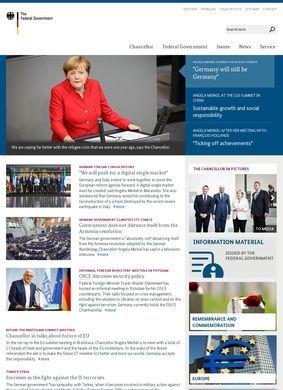
The Federal Government publishes an English-language edition of its official portal at bundesregierung.de, the online front door through which Germany tells the public, in its own words, what the state is doing. This is the German government translating its own communications for readers who do not work in German, and the content is exactly what that promises: press conferences, speeches, cabinet business and formal policy statements, routed straight from source with nothing added.
Most of that portal is news. The Federal Government fills the front pages with the day-to-day flow of announcements, and the current run of topics tells you what is on the country's plate: NATO, support for Ukraine, pension reform, and the diplomacy around G7 gatherings and EU summits. The Federal Chancellor's own statements are given the most room. If you want the official line on a subject before a newspaper filters it, this is the point where it enters the record.
The spread shifts with whatever is dominating German politics at a given moment instead of following a fixed set of themes.
What the English portal carries
The Federal Government organises the site around a few clear areas. News and updates carry the running announcements. A section on government structure explains how the state is assembled. A media centre holds the photographs and video the press office releases from official events. A block of service resources rounds it out with a publications portal, an email subscription and archived material for anyone digging back through older statements.
None of it is dressed up. The design goal is plainly to inform rather than to sell, and that restraint is the right instinct for a state channel. What you lose in polish you gain in the sense that you are reading the source itself.
News from the Chancellery
The Federal Government gives the Federal Chancellor most of the room in its news feed. Speeches, press conferences and formal policy statements make up the bulk of the flow, and I came away with the impression that the head of government crowds out the wider cabinet more than a reader looking for the full breadth of ministries might want.
For anyone tracking German positions on Ukraine or NATO, though, the value is obvious: the wording is primary source, and it is in English, which is rarer among national governments than it ought to be. That skew toward the Chancellor is worth knowing before you treat the feed as a full picture of the government's work.
How the government is put together
The government structure section is the reference half of the site. It lays out the cabinet, the individual ministries and the Federal Press Office, the machinery that most foreign readers can never quite keep straight.
A student or a journalist who needs to know which ministry owns a given brief can settle the question here in a couple of clicks. The section also names the Federal Press Office, the body that runs this very portal, which is a small piece of self-disclosure worth noting. That alone justifies a visit, before a single news item is opened.
Media, archives and staying in the loop
The media centre is the part of the site most people will actually browse. The Federal Government gathers photographs and video from official events in one place, cleared for use and tied to the announcements they illustrate. For anyone producing coverage of German affairs, a supply of usable official imagery saves a great deal of hunting, and having it sit next to the statements it belongs with is a practical touch. Video of the speeches and press conferences sits beside the photography, useful when you need to see the exact delivery instead of reading a transcript.
Behind the headlines the site keeps a deeper layer. The publications portal collects government documents in a form you can download, and the archived material lets you trace how a policy line has moved over time. This is the section that turns a news ticker into something you can research with. It rewards patience more than the front page does.
The publications and archive
The Federal Government treats its back catalogue as part of the offer, not an afterthought. Past statements and documents remain reachable, which means the portal works as a record as much as a feed. Comparing an old position with a current one is the kind of task the archive quietly makes possible, and it is what separates an official source from a press release that vanishes after a week.
Subscriptions and social channels
The Federal Government also pushes its output outward. An email subscription drops updates straight into an inbox, and the same material runs through a long list of social channels: Facebook, Instagram, WhatsApp, X, Mastodon, YouTube and TikTok among them. The Federal Government spreads the same updates across those platforms so a reader can follow along on whichever one they already use. Legal notice and data privacy pages are provided as you would expect from a German public body.
The site uses the open-source Matomo tool for anonymised visitor analytics, a quietly telling choice from a government reluctant to hand its traffic data to a commercial platform.
The whole thing is what The Federal Government claims it to be: an official communication channel, run to inform rather than to campaign. That gives it a clear value and a clear limit. Everything here is the state's own framing, so it is the definitive record of what was said, and it is emphatically not where you learn what critics made of it.
The most useful move for anyone tracking German politics from outside the country is to open the news section, set up the email subscription so the Chancellor's statements arrive as they are released, and keep the government structure pages bookmarked for the moment a ministry name needs checking. Read alongside independent reporting, The Federal Government portal is the primary source you would otherwise have to translate for yourself.