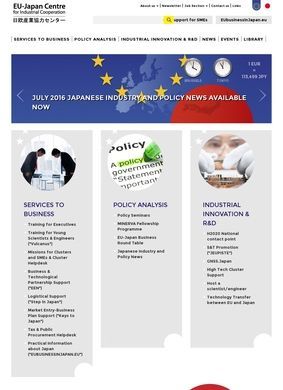
Few organizations of this kind can point to a body created by treaty between the European Union and the Government of Japan, but that is exactly what sits behind the EU-Japan Centre for Industrial Cooperation. It is a joint institution, funded and steered by both sides, with the narrow but ambitious job of getting European and Japanese industry to do more business with each other. That dual parentage shapes everything the EU-Japan Centre for Industrial Cooperation does, and it is worth understanding before reading further into what it provides.
Business missions by sector
The clearest expression of its purpose is the set of business missions it runs. These are organized by sector, and the list is genuinely broad: biotech, digital, green technologies, space, nanotechnology, defense, and smart factory and robotics work. A mission is not an abstraction here. It means a structured trip, a programme of meetings, and a chance for companies on one side to meet counterparts on the other in a field where the two economies have overlapping strengths. For an EU firm working in green technology and wondering whether there is a Japanese partner or market worth pursuing, the EU-Japan Centre for Industrial Cooperation is one of the few places that organizes that contact methodically.
Vulcanus internship programme for EU students
Alongside the missions sits the Vulcanus in Japan internship programme, which I think is the most distinctive single thing the Centre offers. It places EU students and graduates inside Japanese companies, pairing language training with an industrial internship. That combination, learning the language while working on the factory or research floor, is unusual, and it produces people who can later operate between the two business cultures with real fluency. Few other bodies attempt this at scale, and it speaks to how the EU-Japan Centre for Industrial Cooperation treats cooperation as something built over years, not signed in an afternoon.
Partner-finding through the Enterprise Europe Network
Practical, day-to-day support runs underneath all of this. The EU-Japan Centre for Industrial Cooperation offers partner-finding through the Enterprise Europe Network, plus logistical help for EU businesses trying to set up or enter the Japanese market. The Network connection pulls the Centre into a much wider European apparatus for matching companies, so a firm using it is not starting from a blank page. The logistical side covers the parts of market entry that often defeat smaller companies working without local knowledge.
Five helpdesks covering trade and regulatory issues
Then there are the helpdesks, five of them, and they are where the regulatory weight of the place shows. They cover tax, public procurement, questions about the EU-Japan Economic Partnership Agreement, and intellectual property. Anyone who has tried to read a trade agreement cold knows how quickly the detail becomes impenetrable, and the EPA in particular reshaped tariffs and rules across a large range of goods and services. Having a desk that fields EPA queries, and another that handles IP concerns in a market with its own distinct filing and enforcement practices, is the sort of resource the EU-Japan Centre for Industrial Cooperation is well placed to give. A smaller company without in-house specialists avoids expensive mistakes by using them. These desks are aimed squarely at SMEs, which rarely have such expertise available internally.
Training workshops and market access seminars
Training is another pillar. The Centre runs World Class Manufacturing workshops and market access seminars, the former drawing on a tradition of production methodology that Japan helped define and Europe has long studied. A European manufacturer sending staff to a World Class Manufacturing workshop is going close to the source. The market access seminars are more introductory, meant for firms still deciding whether Japan belongs in their plans at all. Between the two, the EU-Japan Centre for Industrial Cooperation covers both the curious newcomer and the company ready to sharpen an existing operation.
Reports, newsletters, policy discussions
The Centre also works at the level of policy and analysis. It publishes reports, newsletters, and research, and it convenes Business Round Table discussions and policy seminars where industry and officials sit at the same table. This is the part of the EU-Japan Centre for Industrial Cooperation's remit that serves researchers and public bodies as much as individual companies. The published material lets someone outside the meetings follow what the two economies are arguing about, where the friction sits in trade and investment, and which sectors are getting attention. For an analyst tracking EU-Japan industrial relations, this output is a steady and credible feed.
What holds the whole thing together is the breadth of who it serves. The EU-Japan Centre for Industrial Cooperation is built for EU and Japanese businesses, for SMEs specifically, for researchers, and for public bodies, all of them trying to develop cross-regional operations or understand the market and regulatory ground they would be standing on. That is a wide audience, and the range of services maps onto it deliberately: missions and partner-finding for the deal-makers, helpdesks and seminars for the operationally cautious, internships and research for the long horizon.
Building durable links between economies
If there is a thread running through the EU-Japan Centre for Industrial Cooperation, it is patience. The missions, the helpdesks, the Vulcanus placements, the round tables, the World Class Manufacturing training: none of these things from the EU-Japan Centre for Industrial Cooperation promise a quick transaction. They are mechanisms for building durable links between two industrial economies that sit a long way apart geographically and culturally but have plenty of reason to trade.
The EU-Japan Centre for Industrial Cooperation does not try to be a marketplace. It tries to be the connective tissue that makes a marketplace possible, and within this entry that focus reads as a genuine strength rather than a limitation. A European SME owner weighing a first move into Japan would do well to start with the relevant helpdesk, whether the question is EPA tariffs, IP filing, or procurement rules, and then check whether an upcoming sector mission fits the field.