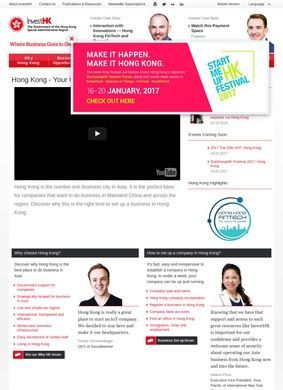
Invest Hong Kong points to eleven focus industries on its front page, and the list makes clear right away what kind of investor it wants to talk to: financial services, fintech, innovation and technology, life sciences, family offices, tourism and sustainability among them. This is the Hong Kong government's investment-promotion department, and its job is to pull foreign and local capital into the territory and then help it land. It works with everyone from a first-time startup to an established multinational planning a regional base.
The case it makes for the territory
A good chunk of the site is devoted to the argument for choosing Hong Kong at all. The "Why Hong Kong" section gathers the selling points a relocating business tends to ask about, headlined by a "Business Friendly Environment" and a "Low and Simple Tax System." These are the two advantages Invest Hong Kong leads with, and for a founder comparing jurisdictions they are the right two to put first, because tax treatment and ease of setup are usually what decide the shortlist.
The framing is aimed squarely at decision-makers weighing one base against another, and it stays practical about what a business needs to know ahead of a final decision. This reads as material written to be acted on, which is the useful kind.
The sectors it targets
The "Key Industries" section is where the eleven priority sectors get their own space. Financial services and fintech sit at the front, in keeping with the city's history as a money centre, alongside innovation and technology, life sciences, family offices, tourism and sustainability.
Each sector page is meant to give an investor in that field the specific lay of the land: the incentives, the local players, the reasons the government thinks the territory fits that industry. A life-sciences company and a family office are looking for very different things, and splitting the guidance by sector is how the department avoids serving both a single generic pitch.
The inclusion of family offices and sustainability alongside the expected finance and technology lines also signals where the territory is trying to grow, which is itself useful intelligence for an investor reading between the lines. A business in one of these named fields would do well to open this part of Invest Hong Kong first.
Help to get set up
Attracting interest is one half of the department's remit; the other half is getting a business through the door. The "Setting Up in Hong Kong" section handles the operational side, the documentation and the practical steps of establishing a company in the territory. This is where Invest Hong Kong moves from persuasion to logistics, and it is the harder, more valuable work of the two.
Practical support runs alongside the paperwork. Invest Hong Kong lays out client support services and points to government funding schemes an incoming business might tap, which is the sort of concrete, money-on-the-table detail a company weighing the move actually needs. A promise of a friendly climate is easy; naming the schemes and the steps is what makes the promise checkable.
Funding schemes and setup guidance
The funding-scheme information is the detail most likely to change a decision. Grants and government support programs can tip the maths for a startup choosing where to incorporate, and the site gathers that guidance in one place alongside the step-by-step of establishing operations. Paired with the documentation help, it turns the abstract idea of moving to Hong Kong into a sequence a company can follow.
That combination, the argument and the operational how-to, is what makes the site useful past the browsing stage. A reader can go from wondering whether Hong Kong fits to knowing what the next form is.
Clients, news and the sector arms
The department also shows its work. A client success-stories section collects case studies of businesses Invest Hong Kong has helped set up or expand, which for a prospective investor is the closest thing to a reference check the site provides. Reading how a comparable firm got established says more than any promotional line, since it shows the process working on a real company rather than in the abstract. A cautious board still deciding whether to commit will often find that evidence is what tips a maybe into a yes.
A "News and Events" section keeps a running feed of industry news and an events listing, useful for anyone tracking what is moving in a given sector or wanting to turn up where the deals get discussed. And Invest Hong Kong runs affiliated sites aimed at specific groups, including dedicated programs for startups and for fintech enterprises, so a young company can land on material written for its stage instead of wading through the general pitch.
Case studies and the fintech and startup arms
The case studies are worth more than they might look. A founder can read how a comparable business handled incorporation, licensing and hiring in the territory, which is a faster education than any list of advantages. The startup and fintech arms extend that, giving those two audiences their own front door into Invest Hong Kong, with content pitched at where they actually are instead of at a generic multinational. That focus is a real convenience for a fintech team especially, since the questions a payments startup asks are not the ones a shipping conglomerate asks.
An overseas founder or a growing company seriously considering Hong Kong as a base, particularly in one of the priority sectors, stands to get the most out of Invest Hong Kong. The sensible first move is opening the "Why Hong Kong" and "Setting Up in Hong Kong" sections together, reading the case studies for a comparable business, and checking which funding schemes apply before going any further. Taken as a whole, Invest Hong Kong is a substantial, well-organised starting point for that kind of decision.