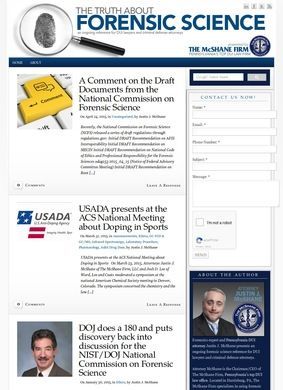
A defense lawyer opens a discovery packet and finds a breath test printout, a DNA mixture interpretation, and a lab report full of terms that were never covered in law school. The prosecution treats these numbers as settled fact. The lawyer has days to decide whether to challenge them and no obvious place to learn the underlying science fast. That gap is the exact space The Truth About Forensic Science tries to fill, and it is worth understanding who built it and why before deciding how much weight to give it.
The site is run by Justin J. McShane, a Pennsylvania criminal defense and DUI attorney who chairs The McShane Firm, with content co-authored by Josh D. Lee, an Oklahoma criminal defense lawyer. That authorship matters. This is not a neutral academic clearinghouse. It is a reference project written by two practicing defense attorneys, aimed squarely at other DUI and criminal defense lawyers who need to cross-examine forensic evidence rather than take it at face value. General readers are welcome, but the vocabulary and the angle assume a professional audience.
What you get in return for that narrow focus is depth on the disciplines that actually decide cases.
What the site teaches
The subject range on The Truth About Forensic Science is broad. It covers DNA analysis, fingerprint comparison, breath and blood alcohol testing, and ballistics, along with the laboratory procedures and equipment behind each. The Truth About Forensic Science goes into how instruments are calibrated and maintained, how results can drift, and where an analyst's judgment quietly enters a process that gets presented to juries as pure objective measurement. For a lawyer trying to understand why a gas chromatography result might be wrong, that machine-level detail is the useful part.
It also reaches into areas that many older forensic primers skip. There is material on cyber crime and blockchain forensics, on courtroom evidence standards and admissibility, and on the professional certifications and credentials that expert witnesses carry into court. Reading through it, I found the sustained attention to lab failures more persuasive than any single tutorial, because case studies of real crime labs getting it wrong are what make the abstract methodology stick.
Ethics and the case studies on lab failure
The ethics thread is the part that separates it from a dry technical manual. It does not treat forensic science as infallible. The Truth About Forensic Science examines documented cases where laboratories cut corners, where analysts overstated certainty, and where flawed procedures put unreliable evidence in front of juries. This is territory that groups like the Innocence Project work in, and it is telling that an Innocence Project article surfaced referencing this same site during background searching.
That framing is honest about its own bias. A defense attorney has every reason to emphasize where forensic evidence breaks down, and the content leans that way. A reader should hold that in mind. The material is not pretending to be a prosecution manual or a lab's internal training guide. Used as one informed perspective among several, the failure case studies are genuinely instructive; taken as the whole story, they would tilt a reader toward assuming labs are wrong more often than a fuller picture might support.
Who it genuinely serves
The audience question answers itself once you spend time on the pages. DUI lawyers get the most out of The Truth About Forensic Science, because breath and blood testing get careful treatment and those cases turn on exactly the measurement details the site dwells on. Criminal defense attorneys more broadly are the next natural fit, given the coverage of DNA, fingerprints, and evidentiary standards. A curious general reader can still learn a great deal about how forensic disciplines work, but the writing does not soften its terminology for them, and it should not have to.
What it is not is a substitute for retained expert help or for the primary scientific literature. The Truth About Forensic Science points a working lawyer toward the right questions and the right vulnerabilities. Turning those into a courtroom challenge still takes an actual expert. Read on its own terms, that is a reasonable scope, and The Truth About Forensic Science does not overpromise on it.
Credibility, ownership, and how to reach a person
Here is where the honest caveats belong. The Truth About Forensic Science functions as marketing and reference content tied to The McShane Firm, and it does not hide that connection. Whether that undercuts the material depends on your expectations. The information can be sound and useful while still working as a shop window for a law practice that handles exactly these cases. Both things are true at once, and a reader who keeps the commercial purpose in view can still take real value from the substance.
Reaching an actual human takes more effort than it should. There is no direct phone number or email on The Truth About Forensic Science itself. Instead it links out to The McShane Firm's website, to social profiles on LinkedIn, Facebook, and Twitter, and to an affiliated blog at paduiblog.com. The firm behind it is based in Harrisburg, Pennsylvania. So the contact route exists, but a visitor has to click through to the parent firm to find a phone number or an address, and that extra step is a small friction on an otherwise transparent operation.
The reputation side is genuinely quiet. A search for outside reviews or ratings of The Truth About Forensic Science turned up nothing on the usual platforms, no Google, Yelp, Trustpilot, or BBB entries specific to this site. What did surface were unrelated results and, more meaningfully, that Innocence Project reference to the site's content.
So there is no crowd of star ratings to lean on. For an educational reference project of this kind, that absence is unremarkable; these are not the sort of sites people leave five-star reviews for, and the lack of them is not a mark against the work.
What would strengthen the whole thing is clearer signaling of how current the material is. Forensic standards and case law move. A reader trusting a page on breath testing or DNA interpretation needs to know it reflects where the science stands now, and that assurance is not front and center.
Weigh the pieces together and a fair verdict emerges. The Truth About Forensic Science is a substantive, unusually deep resource on the weak points of forensic evidence, written by people who fight these fights for a living, and it is upfront about being attached to their firm. The defense-side slant shows up on every page and the contact path runs through a third-party site, but neither of those sinks it.
A DUI or criminal defense lawyer who needs to get literate in crime-lab methodology quickly will get real use out of The Truth About Forensic Science. Knowing the authors argue for a living, the sensible move is to test what the site says against a second source before any of it goes into a filing.