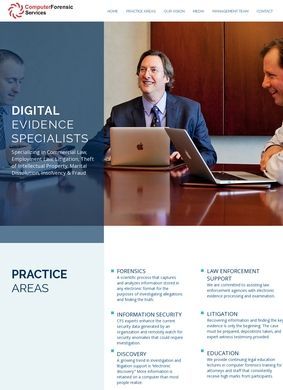
When a company suspects a departing employee copied its client list on the way out, or a lawsuit turns on a text message someone swears was never sent, the data has to be captured in a way a court will actually accept. Mishandle the phone and the evidence is worthless. That careful capture is the core work of Computer Forensic Services, Inc., a Minneapolis digital-forensics and litigation-support firm that has spent years pulling electronically stored information out of devices and turning it into something a judge can rely on.
From evidence capture to the witness stand
The firm's work runs the full length of a case. It starts at the scene, so to speak, with the forensic capture of data, and it ends in a courtroom with an expert explaining what that data means. Computer Forensic Services, Inc. covers both ends and the technical middle, a wider span than many single-service shops attempt.
That end-to-end scope is the main selling point, and it is a real one. Handing evidence capture to one company and courtroom testimony to another creates seams where a case can come apart, since the person who defends the analysis on the stand did not do the analysis. Keeping both under one roof means the analyst who imaged the drive is the same person who can stand behind that image under cross-examination.
Digital forensics and e-discovery
Digital forensics, as the firm defines it, is the scientific capture and analysis of electronically stored information for an investigation. In practice that means imaging a hard drive or a phone without altering the original, recovering deleted files, and documenting the chain of custody so the results survive a challenge in court.
The e-discovery side overlaps but leans toward active litigation: collecting, preserving, and analyzing digital evidence in any format for a case already underway. Computer Forensic Services, Inc. handles evidence in any format, which matters because modern disputes pull in email, chat logs, cloud accounts, and file metadata, and much of that now lives in places well beyond a local disk.
The preservation step is the quiet, important one, since evidence altered after the fact is evidence a court can throw out entirely. For an attorney, that rigor is the whole value, because a brilliant finding is useless if the other side gets it excluded on a handling error, and Computer Forensic Services, Inc. sells the discipline as much as the discovery.
Expert testimony that a jury can follow
The part that separates a forensics vendor from a report generator is what happens in front of a jury. Computer Forensic Services, Inc. offers litigation support and expert testimony, which means translating dense technical findings into language a judge and twelve ordinary people can follow. A hash value or a deleted-file timestamp means nothing to a jury until someone credible explains why it proves what it proves.
That translation work is where forensic cases are frequently won or lost, and a firm that lists expert testimony as a named service is signaling its analysts will take the stand and defend the findings, not hand over a report and disappear.
Security work and teaching the lawyers
Beyond evidence, the firm runs a security-assessment practice: vulnerability scanning, security-policy review, network-architecture evaluation, and penetration testing, where a hired specialist tries to break in on purpose to find the holes before a real attacker does. It also supports law enforcement directly, handling evidence collection, processing, and analysis for police and prosecutors. Computer Forensic Services, Inc. clearly wants to be useful on both sides of a computer crime, the investigation after one and the defense against the next.
That breadth suits its stated client list, which stretches from private individuals to multinational corporations, government agencies, and the attorneys who hire forensic help.
Penetration testing in particular is a different skill set from evidence recovery, so listing both suggests a bench with range instead of a single specialist wearing several hats.
One offering works as a trust signal. The firm gives continuing-legal-education seminars and presentations on cybersecurity and forensics, and teaching CLE to practicing lawyers is not something a shaky operation gets invited to do. Bar-approved education is vetted, and standing at the front of the room puts a firm in front of the exact attorneys who later need this kind of work.
Computer Forensic Services, Inc. uses that teaching role as a credential, and it is a fair one, since it is easier to trust a forensic analyst the local bar was willing to learn from. Few marketing lines carry that kind of built-in vetting.
A long track record, a short review trail
The numbers the firm claims are substantial: more than 120 combined years of forensic experience across its people, over 20,000 devices analyzed, and more than 2,600 court cases handled. Taken together they describe a practice that has been doing this at volume for a long time. The catch is that these figures all come from Computer Forensic Services, Inc. itself. They are the kind of claim a reader has no simple way to verify, and the usual check, a stack of independent customer reviews, is exactly where this listing runs dry.
A BBB profile does exist for Computer Forensic Services, Inc. in the Minneapolis area, and it carries the same phone number as the site, which confirms the entry points at the right company. That profile shows the firm is not BBB accredited and displays no numeric star rating.
A caution belongs here, because the name is common, and anyone checking this business directory entry against outside reviews needs to confirm they have the right company in front of them. A separate, unrelated Computer Forensic Services in Dallas advertises its own five-star Google rating, and a different company called Digital Forensics Corp in Ohio carries thousands of reviews across ResellerRatings and Trustpilot.
Neither has anything to do with the Minneapolis firm, and neither rating should be read across to it. On its own, this practice has an unrated BBB entry and very little else in the way of outside feedback.
So the picture is uneven, in an honest way. Computer Forensic Services, Inc. presents a deep, specific menu of services, a plausible decades-long track record, contact details that are easy to find, and a genuine credibility marker in its CLE teaching. What it lacks is any independent customer voice: no vetted star ratings, no third-party testimonials, only the firm's own figures and an unrated profile.
For a lawyer choosing a forensic partner, the offering looks serious and the credentials hold up on paper, but the reassurance that satisfied clients usually provide is missing, and until that surfaces, a prospective client is buying largely on the firm's own word.