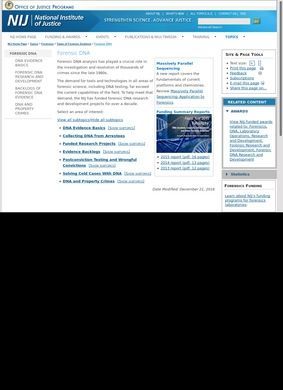
A timeline that begins in 1863 and runs into the 2020s sits near the center of the forensic DNA resource carried under the name National Commission on the Future of DNA Evidence. It traces how genetic science moved out of the research laboratory and into criminal casework. The page belongs to the National Institute of Justice, the research arm of the US Department of Justice, and it reads as a working reference for people who handle biological evidence rather than a primer for the merely curious.
Forensic DNA analysis has shaped the investigation and resolution of thousands of crimes since the late 1980s, and the material gathered here treats that record as live work with open questions still attached.
Where the forensic biology material lives
The core of the page is a hub for forensic biology and DNA that pulls together education, research, funded projects, and training under one roof. The National Commission on the Future of DNA Evidence addresses three audiences at once: researchers, law enforcement professionals, and practicing forensic scientists. That mix shows in the writing, which assumes a reader already knows why a DNA profile matters and wants to know what the field is testing next.
Because the audiences differ so widely, it helps to know which parts reward a quick visit and which reward a long one. Two features sit right at the entrance, and both are built for the newcomer before the specialist.
A timeline from 1863 to the 2020s
The historical timeline is the most approachable thing on the page. It documents DNA history from 1863 forward and ties each stage to its forensic application, so a student can follow the line from early biochemistry through the first casework use in the late 1980s to modern profiling, without stitching together separate sources.
Each entry connects the science to the moment it started to matter in an investigation. For someone new to the field, this is the part of the National Commission on the Future of DNA Evidence worth reading first, and it doubles as a quick orientation before the denser research material further down.
Rapid DNA on the podcast
Audio is thinner but pointed. A podcast episode titled "What's Possible with Rapid DNA Technology?" takes on one of the faster-moving corners of the discipline, the machines that can turn a swab into a usable profile in a couple of hours instead of days in a queue.
One episode is a small sample, and a listener hoping for a full series will come away wanting more. Still, it signals that the National Commission on the Future of DNA Evidence keeps at least one foot in current practice alongside the settled history in the timeline.
Research, grants, and datasets
Past the introductory material, the National Commission on the Future of DNA Evidence turns into a gateway for primary research. This is where its value climbs sharply for a working scientist, and where a casual reader may find the going harder. The page stops explaining and starts pointing, sending a visitor out to studies, reports, and raw data rather than summarizing them in place.
The sourcing is the whole point here. A researcher can use the page as an index into peer-reviewed work and funded projects instead of running a scattered search of their own.
Peer-reviewed articles and profiling methods
The research sections link out to peer-reviewed work on subjects such as facial shape analysis, DNA fragment analysis, and long-read forensic profiling. Alongside the articles sit grant reports and summaries of funded research projects, plus access to datasets and databases.
A practitioner chasing a specific method can move from a plain summary to the underlying study, and the National Commission on the Future of DNA Evidence points in the same breath to award listings and open funding opportunities, so a reader who spots a promising line of work can see who paid for it and whether money is available to pursue more.
Symposiums and on-demand training
Events and training fill out the practical side. The page lists symposiums and workshops, among them the NIJ Forensic Science Graduate Research Symposium, along with on-demand training modules and other instructional resources. Someone who cannot travel to an event still has recorded material to work through at their own pace.
The National Commission on the Future of DNA Evidence treats training as a standing offering, not an afterthought, and the on-demand modules make it usable for a lab team that cannot free up a whole day at once.
Who should consult it
The page does not stop at DNA. It links out to neighboring forensic disciplines, digital evidence, toxicology, anthropology, and pathology, which makes the National Commission on the Future of DNA Evidence a sensible starting point for a case that crosses specialties. There is also a route to submit a FOIA request, which fits its footing as a federal resource and gives a persistent researcher a formal channel when the published material stops short.
The depth cuts both ways. A reader wanting a fast answer about a mail-order ancestry test will find the material far heavier than they need, because the National Commission on the Future of DNA Evidence pitches its writing at people who read study methods for a living. The value sits in breadth and sourcing, not in hand-holding, and that trade is worth naming before anyone clicks in expecting a gentle explainer.
The timeline is the best starting point for framing the field, with the grant reports and open funding listings close behind for anyone drafting a research proposal, since they show what work the National Commission on the Future of DNA Evidence is funding right now. Training modules and the Rapid DNA episode offer a faster way in for someone newer to biological evidence, ahead of the deeper history. The symposium schedule is worth checking periodically, and the links out into toxicology and pathology come into play once a case crosses into another specialty.