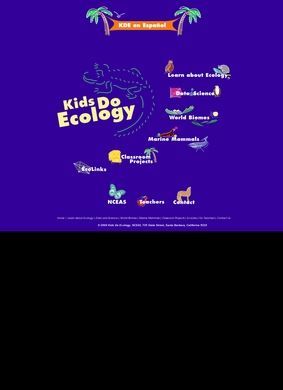
Where does a grade-school teacher send a class to learn what a biome is, in plain language, without wading through pop quizzes and clutter? Kids Do Ecology is built for exactly that. Produced under NCEAS, the National Center for Ecological Analysis and Synthesis at UC Santa Barbara, it is an education site that teaches children the basics of environmental science and organises the whole subject into seven plainly labelled sections a young reader can actually navigate.
The seven sections of Kids Do Ecology map the way a curriculum does. Learn About Ecology lays the conceptual groundwork, Data and Science introduces the methods and the idea that science runs on evidence, World Biomes walks through the planet's major ecosystems, and Marine Mammals narrows the lens to ocean wildlife. Classroom Projects turns the reading into activity, EcoLinks points outward to further resources, and Teachers gathers material for the adults running the lesson. Nothing here is padded with the mascots and reward badges that clutter so many children's sites.
The audience is split cleanly and served on both sides. Kids Do Ecology speaks to school-age children in language they can manage on their own, then keeps a separate shelf for the teachers guiding them, so the same site works for a curious kid at the kitchen table and a classroom of thirty. Free, light on distraction, and tied to a working research center, it carries a credibility that a good many brighter, busier education sites cannot honestly claim.
How the seven sections teach
The design choice worth praising is restraint. Rather than throwing every ecological idea at a child at once, Kids Do Ecology stages them: a concept first, then the scientific reasoning behind it, then a habitat to see the concept alive, then a hands-on task to make it stick. A child can follow that arc without an adult translating every second sentence, which is harder to pull off than it sounds and rarer than it should be in material aimed at this age.
What holds the sections together is a single throughline, that ecology is a way of asking questions about living things and their surroundings, not a pile of facts to memorise. The Data and Science section does most of that work, since it hands children the beginnings of scientific inquiry: how to look closely, how to record what they see, and how to reason honestly from the evidence in front of them. That is the part most kid-facing nature sites skip entirely, and its presence lifts Kids Do Ecology above a simple picture-and-caption tour of animals.
World biomes and marine mammals
The habitat material is the heart of the site. World Biomes gives a child a tour of the planet's ecosystems, from the obvious ones to the ones a ten-year-old has never pictured, and it frames each as a working system rather than a postcard. Marine Mammals then zooms in, and I found this the most fleshed-out corner of the whole site, the place where curiosity about whales or seals turns into a first real lesson about how ocean animals live, feed, and depend on the water around them.
Paired that way, the two sections do something clever. One teaches breadth, the sweep of habitats across the Earth, and the other teaches depth, what it means to study a single group of animals closely and follow where the questions lead. A child who reads both comes away with the shape of the whole discipline in miniature, which is a genuinely good outcome for a free site aimed at nine-year-olds and the teachers who sit them down in front of it.
Classroom projects and the teacher shelf
The activity side is where Kids Do Ecology earns its keep in an actual classroom. Classroom Projects supplies structured, hands-on tasks that take the concepts off the screen and into a lesson a teacher can run, and the dedicated Teachers section backs that up with material pitched at educators, not students. That split saves real time: a resource a teacher can lift straight into a lesson plan is worth far more than one they have to rebuild from scratch on a Sunday night, and the Teachers shelf is aimed squarely at saving that labour.
The EcoLinks section of Kids Do Ecology rounds things out by sending readers onward to vetted external resources, a quiet admission that the site knows its own limits and would sooner point a curious child toward good material elsewhere than pretend to hold everything itself. For a teacher assembling a unit, that curated onward path saves the hours usually lost to sifting search results for something both age-appropriate and scientifically sound, and it is the kind of small mercy that separates a resource made by educators from one made by a marketing team.
The content is text-led and unadorned, so a family expecting slick animation or arcade-style games will find it plainer than a commercial platform, and a reluctant reader may need a nudge to stay with it. That plainness is the trade. Kids Do Ecology reads like something written by people who study ecosystems for a living and want children to understand them, and the seven sections cover the ground a young learner needs without ever talking down to them or dressing the science up as a cartoon.
The trust that comes from a genuine research center standing behind the pages is hard to buy with production values.
Weighed against a glossier destination like National Geographic Kids, which wins on video, photography, and sheer entertainment pull, Kids Do Ecology takes the opposite bet: quieter pages, a clearer teaching structure, and real classroom scaffolding built for the person running the lesson. The entertainment goes to National Geographic Kids; the actual lesson plan goes to Kids Do Ecology.