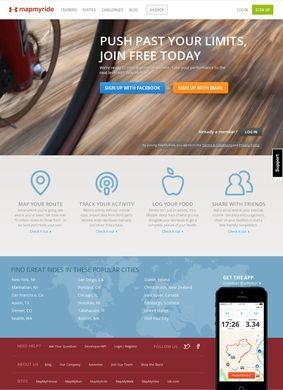
A cyclist finishes a long Saturday loop and wants the cold facts: how far, how much climbing, how the pace held on the back half, and whether next week's ride can beat it. That is the moment Map My Ride is built for. It records a ride by GPS, then turns it into numbers a person can compare ride over ride, which is the whole reason most people open an app like this in the first place.
Ride tracking and stats
The tracking covers what riders need for fitness or fun: distance, elapsed time, elevation gain, climb ratings, and pace. After the ride, the stats get broken down so the day becomes a legible record rather than a blur of effort. For riders chasing improvement, that post-ride breakdown is the payoff, and it is the part of Map My Ride that gets used most.
Finding routes ridden by others
Beyond logging your own efforts, the platform carries a route database with hundreds of user-submitted rides. In an unfamiliar town or when a regular loop gets stale, that library saves time. Instead of guessing where the roads go, a rider can pull up something other people have already ridden and rated. The quality of any crowd-sourced library depends on how many local riders bothered to add their roads, so depth varies by region, but the feature is genuinely useful where coverage is good.
Connecting devices and health apps
Hardware support is one of the stronger points here. Map My Ride connects with Garmin, Apple Watch, Suunto, and Polar, so a rider who already owns a head unit or a sports watch is not forced to ride with a phone strapped to the bars. It also syncs with Apple Health, Google Fit, and MyFitnessPal, which pulls cycling into a wider picture of activity and, for anyone watching calories, ties the ride to the food log without manual entry. People who already live inside one of those ecosystems will appreciate that the data flows where they expect it.
Subscription pricing options
The pricing is straightforward. There is a free tier with ad-supported access on the web and in the apps, which is plenty for someone who just wants their rides recorded and reviewed. The paid step up is the MVP subscription at $5.99 a month. That unlocks Live Tracking, which shares real-time location with chosen contacts, strips out the ads, and adds deeper analytics. Live Tracking is the feature most likely to justify the cost for solo riders who want someone at home to see where they are, and the rest is comfort and detail. At under six dollars, the upgrade asks little, though plenty of riders will never feel the need to pay.
Comparing Map My Ride to competitors
Map My Ride runs on iOS, Android, and through a web interface, owned by Under Armour and now operated under Outside Television Inc. It sits in a crowded field alongside Strava, Runtastic, and RunKeeper, and that context shapes how people judge it. The comparison comes up constantly in cycling circles, and it is worth keeping in mind when deciding whether Map My Ride is the app to settle on.
On reputation, the picture is solid but not spotless. The Apple App Store shows tens of thousands of ratings, historically cited above forty thousand, which points to a large and long-standing user base. The Google Play listing carries user reviews as well. PCMag has reviewed the iOS app, Garage Gym Reviews has covered it editorially, and SaaSHub lists it with user sentiment described as generally positive. So Map My Ride has been put through its paces by both press and ordinary users, and the weight of that feedback leans favorable.
The honest caveats come from riders themselves. Discussion on Reddit's r/bicycling, a community of well over a million people, is mixed. The recurring complaints center on GPS accuracy, and the conversation often drifts into comparisons with Strava. Anyone who depends on precise distance and route tracing should go in knowing that some users have found the GPS less reliable than they wanted, and that the competition is the yardstick people keep reaching for. None of that sinks the app, but it tempers the rating-store glow with the kind of friction real riders run into.
Customer support options
Support access is the weaker spot. The Map My Ride homepage shows no phone number, no email, and no physical address, with help routed through the app stores or account-based systems instead. For a free or low-cost consumer app backed by a large company, that is normal. Still, anyone who likes a clear, direct way to reach a human when something breaks should set expectations accordingly, because help here means working through channels.
Taken together, Map My Ride is a capable, well-established cycling tracker that does the core job well: it records rides, breaks down the numbers, and helps find new routes, while playing nicely with the watches and health apps people already use. It is free to start, cheap to upgrade, and widely used. The GPS grumbles and the constant Strava comparison sit in the background as fair things to consider, but neither one is a reason to dismiss Map My Ride outright. The free tier removes most of the risk of trying it, and the premium tier is modest enough that the decision rarely stings.