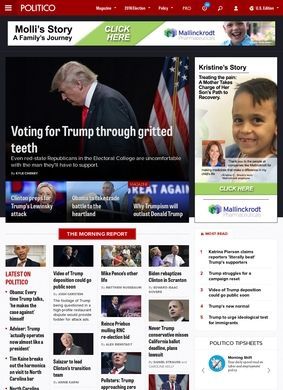
Most readers know Politico for the morning Playbook newsletter that lands in Washington inboxes before the coffee is poured, and that single product tells you a lot about who the whole operation is built for. This is journalism aimed squarely at the people who run, cover, and lobby the federal government, written on the assumption that the reader already follows a markup in committee or a whip count without needing the basics explained. The publication started in 2007 out of Arlington, Virginia, and the focus has stayed narrow on purpose: Congress, the White House, elections, and the machinery of federal policy.
Free coverage of federal politics
The free side covers the daily churn of national politics. There are dedicated streams for Congress, elections, and the West Wing, and the reporting tends to be granular in a way general-interest outlets skip. A bill stalling in conference, a staffer leaving a member's office, a procedural fight over a rule: this is the level of detail Politico chases. Most articles are open without a paywall, which makes it an easy stop for anyone who wants the day's federal news without a subscription in the way. That open-access posture is part of how Politico built its audience, since a reporter or staffer can cite a piece in the morning without forcing colleagues past a gate to read it.
Policy verticals with dedicated reporters
Policy is where the site fans out widest. Separate verticals track health care, defense, energy, finance, agriculture, technology, and education, each with reporters who cover that beat full time. Federal policy does not move as one block, and a person following a Medicare rulemaking has different needs from someone watching a defense appropriations cycle. The coverage reflects that division, and for a reader who works inside a single corner of government, it is a clear reason to make Politico a regular stop.
The elections coverage is where a lot of readers first arrive at Politico. The site tracks primaries, general races, candidate movements, and the polling and money that surround them, with the same procedural eye it brings to legislation. For a presidential cycle, that means candidate strategy alongside the down-ballot races that decide control of Congress.
Politico Pro serves institutions
A lot of the answer is Politico Pro, the subscription intelligence service that sits behind the free news and does much of the financial heavy lifting. Pro is sold to institutions: lobbying shops, government affairs teams inside corporations, trade associations, and advocacy groups that need to track legislation and regulation in close to real time. It bundles legislative alerts, regulatory analysis, bill and amendment tracking, and proprietary data tools that go well past what the public site shows.
This is the part of Politico that most readers never touch and never need to. Pro exists for the professional who treats missing a regulatory deadline as a fireable problem, and the depth of tracking reflects those stakes. The free news and the paid intelligence service feed the same beats, so the journalism anyone can read and the data only licensees see come from a newsroom pointed in one direction.
The pricing model is institutional licensing, not a consumer subscription. A congressional staffer's office or a K Street firm will find the cost justifiable because missing a committee schedule change can cost a client real money. A casual reader will never see this tier, and that is by design. Pro is the engine; the free site is the storefront and the credibility that makes the engine worth licensing.
That two-track structure also shapes how to read the public coverage. The newsroom discipline that lets Pro promise reliable tracking shows up in the free reporting as a preference for specific, sourced detail over hot takes. It is not always exciting, but it is rarely vague, and on a day when a cloture vote hangs on a single senator, that is exactly what the audience needs.
Beyond the daily wire and Pro, Politico runs a magazine arm that handles the longer work. Politico Magazine publishes long-form features, profiles, and argued essays in both digital and print, and it is where the site slows down to do narrative reporting and ideas pieces that do not fit a breaking-news rhythm. If the front page is the firehose, the magazine is the considered counterweight.
Tracking newsletters and audio formats
The newsletter franchise extends well beyond Playbook. Playbook remains the flagship, aimed at setting the morning agenda for official Washington, but there are topic-specific newsletters across the policy beats so readers can subscribe narrowly to the verticals they care about. For many people, the newsletters are the actual front door to Politico.
There is an audio side too. Politico Dispatch and other podcasts put the reporting in spoken form, short and tied to the news cycle, aimed at the commuter who wants the day's federal story without reading it. The podcasts repackage the same beats for a different moment in the day, which suits a publication whose readers are often moving between meetings.
One detail that separates Politico from most American political outlets is its European operation. Politico Europe covers EU institutions and Brussels policymaking with the same insider orientation applied to a different capital. For a reader following transatlantic policy, or trying to understand how Brussels works at the committee-and-corridor level, that parallel newsroom is an uncommon asset. Few U.S.-rooted publications maintain a staffed presence covering EU mechanics on their own terms.
It is worth being clear-eyed about the texture of all this. The breadth can feel like a lot, and a first-time visitor who only wants a headline summary of national politics may find the policy depth and the insider framing more than they bargained for. Politico rewards a reader who already knows roughly how Washington operates and wants more resolution. Someone looking for an explainer-first outlet that walks through fundamentals will get less out of it, because Politico mostly assumes that groundwork is already in place.
The reporting also leans heavily toward process and the inside game: who has the votes, who is maneuvering, which staffer is up or down. That focus is a strength for the professional audience and occasionally a limitation for a reader who cares more about the substance of a policy than the horse race around it. Politico knows its lane and stays in it, and that discipline is part of why the professional class trusts the daily product enough to pay for the Pro version. That trust is the asset the whole company rests on, and Politico has spent close to two decades building it one accurately reported committee fight at a time.
Pulled together, the picture is coherent: a free national news site doing detailed federal reporting, policy verticals with full-time beat reporters, an institutional intelligence product in Pro that funds the ambition, a long-form magazine, a newsletter slate anchored by Playbook, a podcast lineup, and a separate European edition. Each piece addresses the same core audience of people whose work touches government, and the parts reinforce one another. Politico is not a casual destination, and it does not pretend to be one. The daily record of accurate, granular reporting has earned it a permanent place on the desktop of anyone who tracks how federal decisions get made.