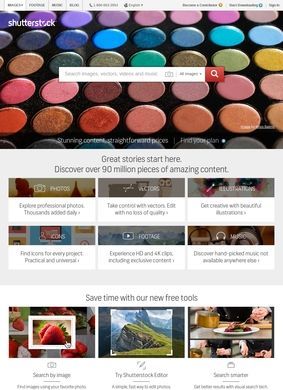
A Shutterstock account renews on a subscription basis, and one longtime user describes having kept one for twenty years. That detail says something about the service before any feature list does: this is a licensing relationship people hold onto, a paid pipeline to stock media they return to, not a single purchase made once and forgotten. Shutterstock is a global stock-content marketplace, and the account, not the lone download, is the unit it sells.
The product underneath is a large library of stock media, described across review and comparison sites as a massive collection spanning photography, video, and music-style assets. Creators, marketers, and video producers pull from it under subscription and licensing plans. One reviewer on a business-software site mentions using Shutterstock to boost video productions, which is the sort of job it is built around: a marketer or editor who needs a clip or an image now and does not have the budget or time to shoot it from scratch.
A library like this competes on breadth and on the promise that whatever a brief calls for, a usable version of it already exists and can be licensed in minutes.
The stock-media library and how it is sold
The core of Shutterstock is scale. A creator's argument for a marketplace like this is that the one clip, photo, or track a project needs is somewhere in the catalog, and a library measured in the millions is the selling point that keeps it in the conversation against smaller rivals.
Direct confirmation of the exact category breakdown was not possible this session, since the site itself would not load and no phone line or address surfaced in the material that could be reached, so the picture here comes from how reviewers and comparison platforms describe it rather than from the pages themselves.
What stays consistent across every description is a pitch built on coverage: a single destination deep enough that a searcher rarely has to look elsewhere, which is also what makes a lapsed subscription feel costly to a professional who has built a workflow around it.
The consistent thread across those descriptions is the shape of the deal. Shutterstock sells access, not ownership: a customer licenses the right to use an asset under plan terms, and the account renews to keep that right alive. The reviewer who cited twenty years on the platform is describing exactly that kind of standing arrangement, which is how a stock library builds a base of customers who treat it as infrastructure they pay for month after month.
A subscription and licensing model
The account model is worth understanding up front, before the first charge hits a card. Shutterstock runs on subscription and licensing plans, which means the cost recurs and the terms of use are governed by the license, not by the download itself. That structure works cleanly for a studio or agency with steady, ongoing needs, where a monthly allotment of Shutterstock assets gets used every cycle and nothing goes to waste.
It works far less well for someone who wants a single image one time, and a share of the complaints against the service trace back to exactly that mismatch: users who felt locked into renewals or tangled in licensing terms they had not expected when they signed up. Licensing is the fine print that decides whether an asset can be used in an ad, resold in a template, or dropped into a client deliverable, and misreading it is easy when the plan hides the details a layer down.
Who reaches for it
The audience is professional more than casual. Marketers assembling campaigns, video editors filling out a production, and content creators working to a deadline are the people these plans are priced for. The TrustRadius reviewer using Shutterstock to strengthen video work is representative: the value shows up when a project needs a competent asset fast and shooting or commissioning one is not practical.
For a hobbyist grabbing one picture, the subscription framing is a poor fit, and I suspect a fair number of the angriest reviews come from exactly that kind of buyer, someone who arrived expecting a simple checkout and met a recurring plan.
What reviewers report
The consumer verdict is harsh, and it is consistent enough to take seriously. On Trustpilot, Shutterstock carries about 2,760 reviews averaging roughly 1.2 out of 5. Sitejabber shows 1.1 stars across 533 reviews; SmartCustomer lands at 1.4 stars from 532. Three separate platforms, thousands of reviews between them, and all three sit near the bottom of the scale. That much agreement across independent sources is a real signal, whatever allowance one makes for the fact that unhappy customers tend to write reviews more readily than satisfied ones.
Business-software sites tell a softer story. G2 and TrustRadius, where professional users rate the product on pricing, features, and use cases, carry mixed sentiment with no single damning aggregate score, which suggests the tool does its job for the studios and agencies it was built for even as individual Shutterstock subscribers rebel against the billing.
The recurring complaints are specific and worth knowing before buying: subscription and licensing headaches, and customer service that reviewers found hard to deal with once those problems came up. That gap between how the platform reviews as a tool and how it reviews as a company to transact with is the throughline across almost every source, and it is the single most useful thing a prospective buyer can take from the ratings.
The employer side
Employee opinion sits somewhere in between. On Glassdoor, Shutterstock draws 673 reviews, with 49 percent of employees willing to recommend working there, a 3.9 out of 5 mark for work-life balance, and 3.0 for culture. Those numbers come from an employer-review source, so they speak to what working at Shutterstock is like, a separate question from whether its licensing is a fair deal for a buyer. Those are middling figures, healthier than the consumer ratings and well short of the enthusiasm a strong workplace posts.
A near-even split on whether staff would recommend the place leaves the internal read more balanced than the one paying customers paint from the outside.