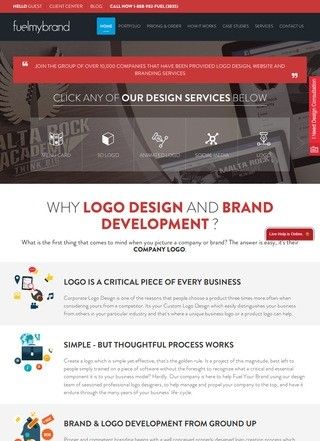
A logo shop in Austin lives or dies on its portfolio, and the portfolio is the one thing FuelMyBrand does not put in front of you when the site itself refuses to load. Both attempts to open the homepage returned server errors, which leaves a review of this operation resting on what other places record about it. That gap matters, because the company sells first impressions for a living, and a broken first impression is exactly what a prospective client meets.
The work on offer is custom logo design paired with broader corporate identity, the full visual package a young company reaches for when it wants a mark, a color scheme, and something that holds together across a card, a sign, and a screen. The stated audience is small and medium businesses, the sort of client who cannot keep an in-house design team and wants one shop to handle the whole look. On paper FuelMyBrand is built to be that one shop.
There is a testimonial page hanging off the domain, at testimonial.php, collecting client remarks about how the design process went and what the finished marks looked like. Testimonial pages are curated by the business, so they tell you what FuelMyBrand wants to lead with, not what a neutral customer walked away thinking. It is a useful window into the company's self-image and a poor substitute for independent proof. What FuelMyBrand chooses to highlight there and what strangers say elsewhere are two different stories.
What the branding work covers
Strip away the marketing and the service list is short and clear. FuelMyBrand draws logos to order and builds the surrounding identity, meaning the palette, the typographic choices, and the consistent application of a mark that a small firm needs before it prints anything. That is a real and useful bundle, and plenty of successful studios do exactly this and nothing more.
Because the live pages could not be reached, the details that would let a buyer compare shops are missing. Pricing tiers, turnaround, and the range of the portfolio are all unconfirmed. A prospective client cannot see finished logos, cannot read a package price, and cannot gauge how many revisions come with a job. For a design service, an inaccessible portfolio is close to a fatal flaw, since the sample work is the sales pitch. Whatever FuelMyBrand has produced over the years, none of it is visible at the moment a buyer goes looking.
The corporate identity side is where a shop earns repeat business. A logo alone is one deliverable; a system that governs how the logo behaves next to type, on a dark background, or shrunk to a favicon is the harder craft, and it is the part FuelMyBrand puts front and center in how it describes itself. Confirming that the execution matches the promise is impossible without the samples, which brings the review back to the same wall every time.
The clients it aims for
The target is the small operator: a new restaurant, a trades business, a local service company that needs a professional mark without a corporate budget. That focus is sensible, because these clients rarely have a designer on staff and want a single point of contact for the whole visual identity. Whether FuelMyBrand serves them well is a separate question from whether it aims at them, and the aim is at least coherent.
Small clients are also the least forgiving audience when something goes wrong, since a bad logo costs them signage, printing, and a rebrand they cannot afford. That raises the stakes on the reviews FuelMyBrand has accumulated, because this exact customer reads them closely before spending.
Where the record turns uncomfortable
The reputation trail is where a reader should slow down. Trustpilot carries a 1.7 out of 5 score across 21 reviews, which is a poor showing for any service business and a heavy weight against a shop whose product is trust in your brand. Yelp lists only 2 reviews for the Austin listing, just two reviews on file, which says the firm has not gathered much independent feedback either way.
One Trustpilot review praised a logo outcome. FuelMyBrand replied to that review disputing that the person had ever been a client, which is an odd exchange to leave in public: the business publicly rejecting a positive notice raises questions about how it tracks its own customers. Several recap sites republish a mix of takes, some glowing about design quality and value, others far less kind. The spread is wide enough that no single number captures it.
The most serious of those complaints, raised separately on Yelp and on an outside recap site by different people, is that the company declined a project stating it does not serve LGBT-owned businesses. That is a discrimination allegation, and while a review cannot adjudicate it, a buyer deciding where to spend money is entitled to know the claim exists and that it surfaced in more than one place.
Reading the trail from the outside
Because the homepage was down, everything about how FuelMyBrand presents itself has to be inferred from third parties, and those third parties disagree with each other. That disagreement is itself the finding.
What the listings confirm about reaching them
The contact side is easier to pin down than the reviews. Third-party listings on Yelp and Yahoo Local put the business at a Manor Road address in Austin, Texas, and Yelp's profile carries a phone number. So a determined customer can find a way to make contact. What cannot be checked is whether the actual homepage surfaces that address and number cleanly, since the page would not open, and a design firm that cannot keep its own site running sends an unfortunate signal to anyone judging it on craft.
The Better Business Bureau holds a profile for the company under a Web Design heading in Austin, and lists it as not accredited, with no rating or complaint tally visible in what could be seen. Non-accreditation is common and not damning on its own, though paired with the Trustpilot score it does nothing to steady the picture. It is also worth noting the BBB files FuelMyBrand under web design, a slightly different label than the logo and identity work the company leads with elsewhere, a small mismatch a thorough buyer might want cleared up.
Put the pieces together and FuelMyBrand reads as a real Austin shop with a defined service, a physical address, a phone line, and a genuinely troubled set of outside reviews. The service is legitimate on paper. The 1.7 Trustpilot average, the public spat over a favorable review, and the repeated discrimination complaint are the parts a careful buyer would want answered before handing over a deposit, and none of them can be waved off as a single disgruntled voice.
A shop with two Yelp reviews and a low Trustpilot score has not built the kind of track record that quiets those concerns.
Anyone weighing FuelMyBrand should treat the unreachable site and the low third-party score as the two facts that travel together. A logo maker whose own storefront returns a server error, and whose independent rating sits near the bottom of the scale, is asking a client to take the quality of the work on faith, and the testimonial page is the only place that faith is encouraged.
The fairest thing to say is that FuelMyBrand sells a service people genuinely need and that at least some past clients came away happy, going by the warmer reviews scattered across the recap sites. Set against that are the harder facts: a homepage nobody can open, a discrimination allegation that appears in two places, and a rating most buyers would read as a warning.
A client who reaches FuelMyBrand by phone would be right to ask for a live portfolio link and a direct answer on that complaint, and to weigh the silence on either against the Trustpilot score already on record. The Manor Road address and the Yelp phone number are there for anyone who wants to put those questions directly.