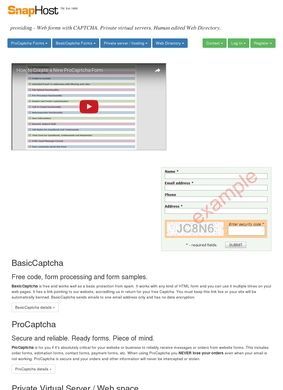
BasicCaptcha is free and ProCaptcha costs money, and the line between them is the first thing worth understanding about SnapHost. BasicCaptcha is no-cost form protection on the condition that you keep a link attribution back to the company; ProCaptcha is aimed at forms where a flood of junk submissions actually costs money: order pages, payment forms, anything tied to a transaction. That tiering is sensible. Spam bots do not care whether your form is a hobby newsletter signup or a checkout, but the consequences differ enormously, and pricing the protection to match where the risk sits is a reasonable way to run the product.
BasicCaptcha versus ProCaptcha
What makes the operation slightly unusual is that the spam-blocking forms are only one of three things SnapHost does. It has been around since 1998, which is a long run for a small shop, and over that time the company settled into three lanes: the CAPTCHA forms, web hosting, and a small curated web directory. The forms come pre-designed and ready to embed, so the appeal is partly that you drop in working markup instead of wiring up bot detection yourself.
For a small site owner who wants the spam to stop and does not want to read documentation, that convenience is the whole pitch from SnapHost, and it is an honest one. The attribution requirement on the free tier is also worth naming plainly: BasicCaptcha costs nothing because you carry a visible link back, which is a fair exchange if you are running a personal site and a non-starter if you would rather not advertise a vendor on your own pages. ProCaptcha exists precisely for that second group, and the line between the two is drawn where most people would draw it.
Web hosting and virtual servers
The hosting side of SnapHost is more conventional. It offers semi-dedicated shared space at the lower end and private virtual servers with dedicated resources further up, with the private servers starting at $195 a month and full admin support folded in. That is not a budget figure, and it positions the hosting toward customers who want hands-on help rather than the cheapest possible slot on an oversold machine. The bundled admin support is the more interesting half of that, because a managed server with someone actually watching it is a different product from a bare VPS you are expected to babysit alone. Whether $195 is fair depends entirely on how much of that management you would otherwise pay a sysadmin to do.
Admin support in managed servers
The third lane is the one that keeps inviting a second look. SnapHost also runs a human-edited, human-reviewed directory of sites, and instead of fixing rankings it re-sorts the listings randomly each day so every site rotates onto the first page in turn. The stated logic is fairness: no single listing camps permanently at the top while everyone else languishes on page nine. As a piece of design thinking it is genuinely thoughtful, because the usual complaint about directories is that early or paying entries ossify into position and the rest become invisible.
Human-edited directory with daily rotation
The flip side is that randomization cuts against how people actually use a directory. If the order changes daily, a listing's placement says nothing about quality or relevance, and a visitor cannot return tomorrow and find the same thing where they left it. SnapHost says it reviews and adds sites on an ongoing basis, and the human-edited part is a real point in its favor given how much of the web's directory space is automated junk. Still, the daily shuffle is a trade, and reasonable people will land on different sides of it.
Trade-offs in randomized listings
Across all three services, SnapHost states that universities and businesses are among its customers for the form protection and hosting. That is a claim made on its own pages, not something independently confirmed elsewhere, so it amounts to self-description and nothing firmer. It is plausible. Form spam and managed hosting are exactly the sort of unglamorous needs that institutions quietly pay for, but a reader should file it as the company's own account.
Customer base and public visibility
Among outside sources, the picture is sparse but not unfavorable. ScamAdviser assesses SnapHost as legitimate and safe, drawn from a small pool of fourteen recorded rating views, so the verdict is positive but lightly sampled. A thread on Web Hosting Talk, one of the larger hosting community forums, raised the company's name but produced no real user experiences, which tells you the SnapHost customer base is either quiet or modest. ZoomInfo carries the company in its business database, which confirms it is a real, catalogued firm. Nothing surfaced on Google, Trustpilot, Yelp, the BBB, or Glassdoor. For a firm that has operated since the late 1990s, that quietness is the most striking data point: longevity without a visible review trail usually means a small, steady clientele that renews rather than a stream of new buyers leaving feedback.
Contact methods and availability
The contact setup is the soft spot. There is no phone number and no physical address anywhere on the main site or the individual service pages. SnapHost routes everything through online contact forms, one each for the CAPTCHA service, the hosting and server side, and the directory, reachable from the respective sections. The forms are at least scoped sensibly, so a hosting question does not land in the same inbox as a directory query, and SnapHost clearly put some thought into keeping those streams apart.
What limits this service?
But for a hosting customer about to commit to a $195-a-month managed server, the absence of a phone line or a postal address is a real gap. When a server goes down at an awkward hour, a contact form is a poor substitute, and the lack of any callable number is the kind of thing that should give a prospective buyer pause.
Evaluating the overall operation
Taken together, SnapHost reads as a small, long-lived operator that does several modest things competently and asks you to take a fair amount on trust. The CAPTCHA tiering is smart, the managed hosting is positioned for people who value support over price, and the directory's daily reshuffle is an idea with a clear rationale and a clear cost. No major review platform has weighed in on SnapHost, which is neither a warning sign nor a clean bill of health; it is simply a gap in the public record. The concrete sticking point is the form-only contact: a managed server at $195 a month is a real commitment, and being restricted to a web form when something breaks is a real limitation that the published record does not explain away.