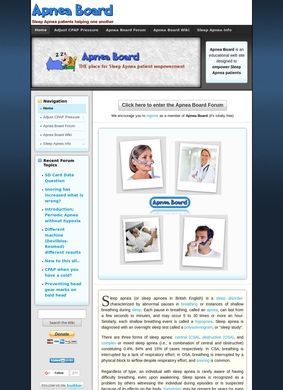
A banner at the top of Apnea Board calls it "the world's largest and most helpful CPAP and Sleep Apnea forum," which is a bold claim to lead with. Whether it is literally the largest is beside the point; the community behind Apnea Board has clearly put in enough years to say it without flinching. The site runs as an educational, donation-supported resource built by members, not a company selling machines or subscriptions.
That distinction shapes how the whole board reads. Nobody here is trying to move product. The people answering questions are, by and large, other patients who have already been through the confusion of a new diagnosis, a machine they do not understand, and a pile of nightly data that means nothing until someone shows them how to read it.
What a new CPAP user finds here
The core of Apnea Board is a general discussion board where users post their situations and get answers. Around that sit a few more specific resources worth knowing about before you sign up.
Apnea Board carries a CPAP Machine Reviews sub-forum, and it comes with a small catch: it is restricted to established members, so a brand-new account cannot walk straight in and read every candid opinion. That is a mild friction if you are researching a purchase on day one. It also cuts down on drive-by nonsense and keeps the reviews coming from people who have stuck around, which is a reasonable trade.
Beyond the boards, the site hosts setup manuals for CPAP machines, the kind of documentation that manufacturers often bury or gate behind a clinician. Alongside those manuals is practical guidance on interpreting your own therapy data and adjusting pressure settings. That last part is the sort of thing plenty of sleep clinics prefer patients leave alone, so anyone using it is taking on responsibility for their own tinkering. The information is here for people who want it.
The wiki and the reading behind the boards
Separate from the message boards, there is an associated Apnea Board Wiki, a standalone reference site that collects longer articles. The topics run into genuinely specific territory: optimizing CPAP therapy, telling palatal prolapse apart from ordinary mouth-breathing patterns, and the Epworth Sleepiness Scale, which is a short self-assessment for gauging how much daytime sleepiness a person is dealing with.
Reference material like this is what separates a forum where people just vent from one where a newcomer can get properly educated. You read the wiki article, then you take a sharper question back to the board. The two halves feed each other.
OSCAR and the data question
One of the more useful things the community points toward is OSCAR, the Open Source CPAP Analysis Reporter. It is free third-party software for pulling apart the data your machine records each night, and it lives over at sleepfiles.com rather than on Apnea Board itself. The forum references and links to it.
This is where the whole ethos of the site becomes concrete. A patient who learns to load their own data into OSCAR and then brings the resulting graphs to the board for interpretation is doing something a lot of casual health forums never enable. It is hands-on, it is technical, and it assumes you are willing to do a little work. For the audience this serves, which is people diagnosed with or still investigating obstructive sleep apnea, current CPAP users, and the caregivers helping them, that assumption is usually correct.
Where the outside record gets complicated
Now the harder part. Outside opinion on Apnea Board amounts to one automated score and a single Reddit thread, and honesty requires laying that out plainly instead of smoothing it over.
Scam Detector, an automated site that scores domains against a checklist of factors, gives apneaboard.com a "medium trust score" and flags it as posing "a potential risk." That reads worse than it probably is. Those automated scans lean heavily on registration data, site age, and other mechanical checks, and they routinely ding legitimate hobbyist and community sites that do not look like polished commercial operations. It is not a consumer rating and should not be read as one.
There is also a Reddit thread on r/SleepApnea titled "Can we talk about apneaboard.com?" with a couple dozen votes and a busier comment section, which points to real discussion and some criticism inside the sleep apnea community. That is a conversation, not a verdict, and without reading every comment it would be wrong to summarize which way it leans.
What is missing tells its own story. No Google rating, no Trustpilot, no Yelp, no Facebook count, nothing from the usual aggregators turned up. For a site this established that absence is a little surprising, though it fits a nonprofit community forum that has never courted that kind of listing. People who use these boards tend to find them through search or word of mouth.
What to weigh before joining
There is a wrinkle worth naming: the site would not load for direct inspection during research, returning access errors to automated tools. So the description of features above rests on how the community describes itself and on secondary sources, not on a walk through the live pages. Take that as the honest boundary of what can be said here.
Set the pieces side by side and the reading comes out fairly clear. Apnea Board is a peer-support and education hub for a specific, fairly technical medical need, run on donations by members with real experience, and it leans on solid adjacent tools like OSCAR and its own wiki. The medium trust score from an automated scanner and a critical Reddit thread are both worth reading, and neither one outweighs what Apnea Board itself offers to a CPAP user willing to read a few threads and judge the tone firsthand.
The peer advice carries the usual caveat that other patients are not your doctor, and the pressure-adjustment guidance in particular is something to approach with care. The most candid reviews on Apnea Board sit behind a membership wall, so a new account gets the general boards and the wiki first and has to earn its way to the rest.