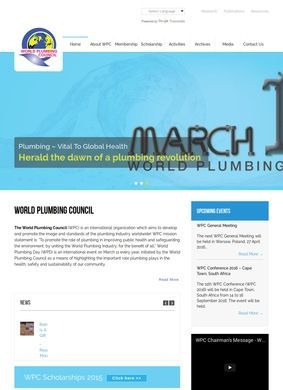
A national plumbing association in a country still building its standards wants two things at once: to link up with its counterparts abroad, and to pull its own trade toward a benchmark the rest of the world already recognizes. That is the exact gap the World Plumbing Council sets out to close. It is an international body whose stated aim is the best possible plumbing for the world through the growth and development of the plumbing industries, and its whole structure reads as an attempt to turn a scattered global trade into something that talks to itself.
The audience is broader than the name might suggest. Working plumbers and industry professionals are part of it, but the primary members are national plumbing organizations and associations, and a third strand reaches ordinary people who care about water, sanitation and public health. Plumbing sits directly on top of those last three, which is the quiet argument running under everything the site does. Clean water in and waste water out is the whole of public sanitation, and the trade that installs and maintains those systems is treated here as a health profession, not a commodity service.
How the council turns a global trade into a network
The machinery of the World Plumbing Council is membership, and the site treats that as the front door. Countries and organizations register and renew through it, a downloadable brochure lays out the terms, and a directory then lists affiliate and member organizations country by country. That directory is the payoff of membership: it is what lets an association in one place find the equivalent body in another and start comparing notes. Everything else on the site hangs off this spine.
Three things build on that spine, and each is worth walking through in turn: the membership directory itself, the scholarships and awards that develop individual plumbers, and the events and publications that keep the network in contact between conferences.
Membership and the country directory
Registration is pitched at institutions, not individuals, which fits an umbrella group. A member joins as a national body, renews on a cycle, and in return lands in a searchable roster of peers organized by country. For an association trying to raise local practice, that roster is the useful part, because it converts a vague sense that other countries do this better into a specific list of who to contact and learn from.
The World Plumbing Council is essentially a switchboard here, and the directory is the board. The brochure that lays out the terms does its job without overselling, spelling out what a member country gets and what it commits to, so a national body can weigh the decision with the terms already on the table.
Scholarships and the awards program
Money and recognition are the two levers the council pulls to develop the people inside the trade. The scholarship program funds education for individuals in plumbing and water fields, and the site publishes reports and testimonials from past recipients, so a prospective applicant can read what earlier scholars did with the support before applying.
That transparency about outcomes is the part that gives the program credibility. Published testimonials are easy to fake and easy to inflate, so the more useful items are the reports, which describe concrete work a scholarship paid for. For a young tradesperson in a country where formal plumbing training is scarce, a World Plumbing Council scholarship is one of the few international routes into that education, and the site treats it with appropriate seriousness.
Alongside it runs an awards program, including a Distinguished Service Award that recognizes individuals for their contribution to the industry. Between the two, the World Plumbing Council covers both ends of a career: seed funding for someone coming up, and public acknowledgment for someone who has already put decades in. The scholarship side is the more substantive of the two, since it moves resources rather than just conferring status.
Events, publications and the WPC Review
The calendar is where the network becomes visible. Annual General Meetings run on a regular schedule, and the flagship gathering is the World Plumbing Conference, set for Birmingham in the United Kingdom, a multi-day event that pulls members into one room. There is also World Plumbing Day, an annual observance the World Plumbing Council uses to push the link between plumbing and public health out to a wider audience.
That observance is the one piece of the calendar aimed past the membership at the general public, and it doubles as the group's clearest statement of purpose: plumbing framed as a health issue, not a trade nicety.
Between events, the resources hold the reader's attention. The site keeps publications and research materials, an industry news archive, and the WPC Review newsletter, which together form a running record of what the membership is working on.
The World Plumbing Council treats these less as marketing and more as a reference shelf, and the news archive in particular is the sort of thing a member returns to rather than reads once. Research materials sitting beside a news feed sitting beside a newsletter give the site a longer half-life than an events calendar alone would, since a visitor has a reason to come back when nothing is happening on the schedule. The publications carry the technical detail, and the WPC Review handles the lighter, more regular updates.
What ties the whole operation together is the through-line from the technical to the humanitarian. A conference session on standards and a World Plumbing Day message about sanitation are pointed at the same target, which is decent plumbing reaching more of the world. The World Plumbing Council does not treat those as separate causes, and the site is consistent about tying its industry-development work back to water and public health at every turn.
There is a fair question about how much of this reaches a working plumber versus a national committee. The membership model, the conference and the awards are institutional by design, so a solo tradesperson browsing in from outside will find plenty to read but fewer obvious ways to take part directly. The scholarship program is the clearest exception, since it is aimed squarely at individuals and publishes real results.
It would be easy for the World Plumbing Council to feel remote to the person actually holding the wrench, and the site does not fully solve that, though the news archive and the WPC Review at least give a curious tradesperson a reason to keep coming back between the big set-piece events.
The member directory lists affiliate organizations country by country, the World Plumbing Conference anchors the calendar in Birmingham, and the WPC Review newsletter and the news archive sit beside them as the standing paper trail of what the membership is doing.