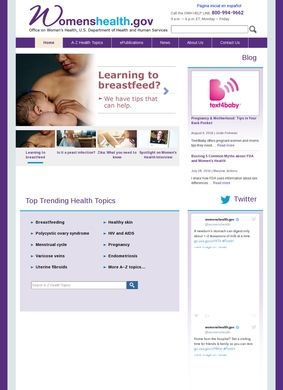
Every page here has a full Spanish-language counterpart, a complete parallel site instead of a handful of translated leaflets. That choice says something about the reach behind The National Women's Health Information Center, which the Office on Women's Health runs inside the U.S. Department of Health and Human Services. The information is evidence-based and government-vetted, aimed at people who want a plain answer before they need to sit in a clinic waiting room.
From reproductive health to disease reference
The Reproductive Health section is where the site is densest. It walks through pregnancy, breastfeeding, menopause, the menstrual cycle, and birth control, treating each as a standalone topic with room to breathe. Someone tracking one specific concern can land on it directly and stay there, which is how most people actually use a health site.
Alongside that sits a Diseases and Conditions library covering cancer, heart disease, HIV/AIDS, lupus, and a long list beyond those four. A separate Health and Wellness area handles mental health, fitness, nutrition, and relationships. The split is sensible: clinical conditions live in one place and everyday wellbeing in another, so a reader is not forced to wade through both at once to find the one that fits. It is a lot of ground for a single site, and The National Women's Health Information Center covers it without feeling scattered or thrown together.
Patient materials and the topic library
The Patient Materials collection is the part most visitors will take away with them. It gathers fact sheets, infographics, guides, videos, and recorded webinars, all organized by topic. This is where The National Women's Health Information Center is at its most practical, because the material is downloadable, plainly written, and built for someone who is never going to open a medical journal.
The mix of formats is a small, practical touch. A printable fact sheet and a three-minute video answer the same question for two different people, and having both on hand means the site does not force one style of learning on everyone who lands there looking for help.
Tools and the helpline
Two features push the site past being a reading library. The first is an Ovulation Calculator, a small interactive tool for anyone tracking fertility or a cycle. It is modest, but it is the kind of thing people search for and rarely find on an official source.
The second is the OWH Helpline, a phone line staffed to field health questions and point callers toward resources. The site is careful about what the line is: an informational service, not a route to diagnosis or treatment. That candor is worth noting. It sets a realistic expectation about what a caller will actually get, and nobody should mistake The National Women's Health Information Center for a stand-in for seeing a doctor. The site does not pretend otherwise, and the restraint reads as trustworthy instead of limiting.
Who it is built for
The audience is wider than a first glance suggests. Women and girls are the obvious readers, and most of the site speaks to them in direct, unhurried language, whether the topic is a first period or a menopause symptom nobody warned them about.
Caregivers and family members show up too, since a fair share of the content is written for someone helping a mother, a daughter, or a partner make sense of a diagnosis. The National Women's Health Information Center does not draw a hard line between the person with the condition and the person sitting next to her in the waiting room.
All of them are handed the same underlying promise, which is that the material has been reviewed and carries a federal agency's name behind it. That single fact separates The National Women's Health Information Center from the pile of general search results, where sourcing is anyone's guess.
The professional education angle
Underneath the consumer material runs a second track built for healthcare professionals. The National Women's Health Information Center hosts accredited CME and CE continuing education courses, which turns a public reference into something a clinician can use for actual credit. A blog and news section keeps a stream of shorter updates moving, and an About Us area lays out the organization, its leadership, and its job openings.
That professional layer is easy to miss if you arrive looking only for a fact sheet on menopause, yet it is a real part of what the site does and it widens the value considerably. A resource that serves both the patient and the person treating the patient is doing more work than its front page lets on.
As a first stop for vetted, readable women's health information, The National Women's Health Information Center does its job well, and the Spanish mirror plus the accredited courses give it more depth than most public health portals bother with. What it will not do is go as deep on any single condition as a specialist reference would, and the informational-only framing means a reader still has to take the next step with a clinician. For a trustworthy starting point it holds up cleanly.
As a complete answer to one specific medical question it comes up short, which is roughly what a broad government reference should be honest enough to admit about itself.