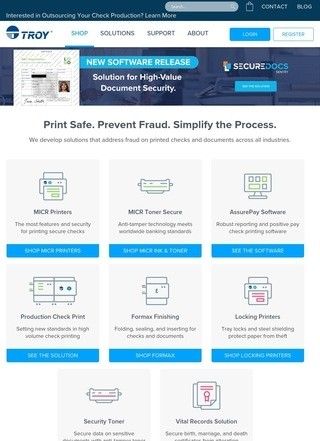
What does a printing company built around one narrow technology still sell six decades in? For Troy Group, the answer starts with MICR, the magnetic ink character recognition font printed along the bottom of every paper check so a machine can read the routing and account numbers without a human squinting at them. Around that single specialty sits a whole catalog: MICR printers, MICR toner cartridges, security check paper, and the inks and accessories meant to keep a printed check from being altered once it leaves the tray.
That magnetic font is the reason a bank's sorting machines can process millions of checks a day without a person reading each one, and it is part of why an altered check gets flagged.
That focus is unusual. Most printing suppliers chase color and speed; Troy Group has spent its history on documents whose entire value is that they cannot be faked. It describes the work as sixty years of MICR innovation, a self description worth the usual pinch of salt around a tidy anniversary number, though the depth of the product line does back the broader idea that this is no newcomer to the field. The claim reads as brand history, verifiable only in outline, but the range of products beneath it is real enough to check.
Beyond checks, the hardware widens out. Troy Group lists production digital presses for heavier print runs and UV curable flatbed printers, the type that lay ink straight onto rigid material. There is also a standalone industrial line of custom inks for security, packaging, and product coding, so the ink knowledge gets sold on its own terms, a product in its own right and not something buried inside a machine.
The security print catalog up close
Troy Group splits ordering off into a separate online storefront, where the toner, paper, and accessories can be bought directly. A promotion running there gives free ground shipping on orders above 150 dollars, the kind of quiet incentive pitched at an office reordering supplies, not at a first time buyer weighing a whole platform. It is a sensible split. The people who reorder toner every few weeks want a fast checkout, and the people evaluating a banking system want a salesperson.
The bigger systems carry no posted price, which is normal for equipment sold through quotes and service contracts. Troy Group expects a conversation before a sale on that side, and that does put a little friction between browsing and buying. A purchasing manager will need to make contact to get real figures, and the site does not pretend otherwise. That is standard for security hardware, where configuration, service terms, and order volume all move the number, though it does leave the shop and the sales process feeling like two different companies stitched together.
Software that runs beside the printers
Troy Group sells software as much as hardware. The list covers AssurePay Check and Teller software, the TellerCentral banking platform, SecureDocs for document handling, SecureRx for prescription printing, and a payment product called TROY Pay. The prescription piece is a telling inclusion. A printed prescription carries many of the same forgery risks as a check, so the same anti alteration thinking slides straight across into healthcare, and the whole spread starts to read as coherent instead of scattershot.
TellerCentral and AssurePay aim the same technology at the teller window and the back office, where a bank actually moves payments, and SecureDocs stretches it to general document handling. This is a company that has picked a problem, secure printed documents, and built outward from it toward institutions with genuine compliance exposure, not toward a home office.
Standards, partners, and who buys it
The buyer list is wide. Troy Group serves banking and finance, healthcare, insurance, auto dealerships, law firms, manufacturing, government, retail, education, and even casinos, and it claims a presence in more than a hundred countries. It points to partnerships with HP and Pitney Bowes, products made in the USA with domestic support, and compliance with ABA and ANSI banking rules, CPA guidance, and HIPAA on the healthcare side. Those are the correct acronyms for this line of work. For a bank or a hospital, they weigh more than any tagline could.
One caution runs through all of it. The partnerships, the country count, and the anniversary figure are Troy Group describing itself. They are plausible given the catalog, but they are self reported, and a careful buyer reads them as claims to confirm, not as settled fact. The compliance references are the easiest to check and the most worth checking, since they are the reason a regulated buyer would pick a specialist in the first place.
Contact is where the site turns a little coy. The landing page steers visitors toward a contact page instead of putting a phone number or address in plain sight, so reaching a person takes one extra click. The page does exist, and for a vendor this established the omission is minor, yet a number up top would suit anyone who wants to talk to sales before typing into a form.
Outside opinion is harder to read, mostly because most of what surfaces concerns Troy Group the employer, not the supplier. Glassdoor sits near 3.3 out of 5, with roughly a third of reviewers saying they would recommend the place to work; CareerBliss shows a rosier 4.6, though from only two reviews, and Comparably lands mid pack on workplace culture.
None of that tells a purchaser whether the check paper is any good. On the customer facing side there is not much to go on: Smart.Reviews lists the site at about 3.3 out of 5, and that is roughly the extent of it. For a business-to-business supplier that scarcity is not unusual, since corporate buyers rarely leave public star ratings the way consumers do, yet it does leave a prospective customer with little independent signal to lean on.
There is a four star Trustpilot page for a similarly named Troy Business Group, but it sits on a different domain and looks like a separate company, so pinning Troy Group's reputation on those reviews would be a mistake worth avoiding.
A bank operations lead, a hospital records office, or a dealership finance desk that prints sensitive paper in volume is the natural customer, and for that reader the narrow focus of Troy Group is the whole selling point. A shopper after a cheap all purpose office printer should look elsewhere. The shop is the place to price the consumables first, and the contact page is where Troy Group can be asked to match a specific MICR printer and software bundle to a buyer's own compliance requirements.
Specialization like this cuts both ways: real depth for the buyer who needs it, and almost nothing for the one who does not.