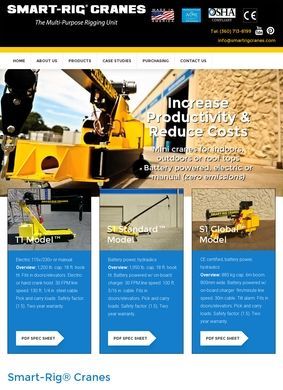
The M1 Global lifts 2,000 pounds, rolls through a standard doorway, and needs no operator license to run. That flagship model is the clearest statement of what Smart-Rig Mini Cranes is about: heavy lifting in places a full-size crane can never reach. The machine runs on either 24-volt battery power or 115-volt electric with hydraulics, reaches a hook height of 20 feet 3 inches (25 feet with the jib accessory), moves the line at 35 feet per minute, and carries up to 160 feet of cable, all backed by a two-year warranty.
Smart-Rig Mini Cranes is listed in this business directory as a mini-crane and lifting-equipment manufacturer. Before going further, one thing has to be stated plainly, because the website itself has moved on from the name.
The domain now presents under the "Microcranes" trademark in place of the Smart-Rig branding, and third-party listings on Yelp and MapQuest confirm they are one and the same business, filed under the combined name "Microcranes, Smart-Rig Cranes." The company distributes both Smart-Rig and Microcrane brand mini cranes, so a buyer arriving from an older listing for Smart-Rig Mini Cranes should not be thrown when the header reads Microcranes instead. It is the same equipment and the same phone line, under a newer name.
The M1 Global and where it fits
Specs that matter on a jobsite
The specification sheet is where Smart-Rig Mini Cranes makes its case, and the numbers are concrete enough to check against a real job. Two thousand pounds of capacity from a unit that fits through a doorway and into a standard elevator is the whole selling point, because it means material can be lifted on an upper floor without craning it up the outside of a building. The dual power option matters as much as the tonnage: battery for indoor work where fumes are a problem, mains electric where a socket is handy.
The reach figures are honest about their limits. A 20-foot hook height, extendable to 25 with the jib, is modest next to a truck crane, but truck cranes do not fit inside a mechanical room. That trade is the entire premise. No operator license, a two-year warranty, and a line that pays out to 160 feet fill in the practical detail a site manager would ask about before hiring or buying one. On paper, at least, Smart-Rig Mini Cranes gives a buyer enough hard numbers to model a real lift before making a call.
Confined spaces and the industries it serves
The equipment is aimed squarely at confined and awkward work, and the list of industries Smart-Rig Mini Cranes names is long and specific. Glazing and glass handling, aircraft and aerospace maintenance, oil and gas, steel erection, HVAC, warehousing, high-rise construction, marine, military, utilities, energy, water treatment, and manufacturing all appear, along with the newer job of installing EV charging stations.
That spread is telling. A portable hoist that clears a doorway solves the same problem in a glass shop, an aircraft hangar, and a rooftop mechanical room: getting real weight into a tight space without tearing out a wall or renting a machine that will not fit. The Green Energy angle and the EV-charging mention suggest the company is chasing newer installation work as well as the traditional trades, which is a sensible read of where confined-space lifting demand is heading.
What Smart-Rig Mini Cranes is really selling across all those sectors is access, not raw power. Plenty of machines lift more than 2,000 pounds; almost none of them do it after riding up in a passenger elevator. That single constraint, fitting where a bigger crane cannot, is the thread that ties glazing to aerospace to warehouse work, and it is why the M1 Global's doorway-friendly footprint gets as much billing on the site as its tonnage does.
Contact routes and the sparse review record
Reaching the company is straightforward. A phone number sits in the header on every page, and a Contact link rides in the main navigation throughout, so a prospective buyer is never more than a click from starting a conversation. The site sections are laid out the way a serious equipment maker lays them out: Home, About, Products, Specs, Case Studies, Common Questions, Green Energy, Accessories, and Contact.
Case Studies and a Common Questions page are the right things to publish for gear this specialised; a buyer spending real money wants proof the machine works on an actual jobsite, beyond what a spec sheet alone can show. On the transparency of how to get in touch, Smart-Rig Mini Cranes does better than many small manufacturers.
What the landing page does not put in the open is an email address or a street address, though third-party listings on BBB and Yelp place the business in Vancouver, Washington. For a manufacturer selling to trades who will phone anyway, a header phone number and a nav Contact link cover what a phone-first buyer actually needs, so the absence of an on-page address is a minor point, not a real gap. Contact, in short, is one of the stronger parts of how Smart-Rig Mini Cranes presents itself.
The reputation record is the weak spot here, and it deserves an honest accounting. The Better Business Bureau gives Smart-Rig Mini Cranes an A+ rating but notes it is not BBB-accredited, files it under "Iron Works," and shows no customer reviews at all, with the page inviting someone to "be the first to review." MapQuest lists three reviews without a visible star average. The Yelp listing exists, carries photos, and shows no review count or rating in what is visible.
Put together, that is close to no independent customer feedback, which means the case for Smart-Rig Mini Cranes rests almost entirely on the specs and the company's own word.
An A+ from the BBB reads well until you notice it comes without accreditation and without a single posted review to back it, which makes it a weaker signal than the letter grade suggests. The specifications on the M1 Global are detailed and verifiable, the contact route is clear, and the industry list is credible, but a buyer cannot yet point to a wall of satisfied customers to confirm any of it. For a purchase this size, that gap is worth weighing rather than waving away.
The offering itself holds up on its merits. Smart-Rig Mini Cranes has a clear flagship with real numbers, a coherent pitch built around confined-space lifting, and a rebrand to Microcranes that is easy to trace once you know to look for it. The missing piece is social proof, and only time and actual customers will fill that in.
A buyer sizing this up should weigh it against the two obvious alternatives. One is renting a conventional mobile crane for the job, cheaper for a one-off lift but useless the moment the load has to go indoors or up an elevator.
The other is a spider crane from an established maker such as Maeda, a direct competitor in the compact-lifting space with a longer track record and a deeper pool of published reviews. Against a full-size rental, Smart-Rig Mini Cranes wins on access and gives up little working indoors; against a Maeda, it competes on specs and price but has far more reputation still to earn.
Business address
Smart-Rig Cranes
PO Box 874023,
Vancouver,
WA
98687
United States
Contact details
Phone: 360-713-8199