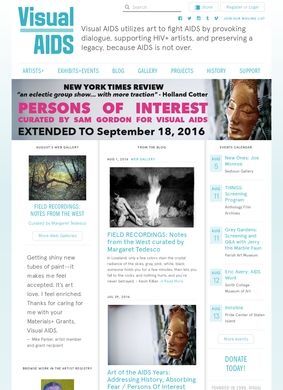
Visual AIDS is a nonprofit arts organisation founded in 1988 and based in New York that puts visual art to work in the fight against AIDS. The mission has three plain parts: provoke dialogue, support artists living with HIV, and preserve the artistic record of an epidemic that killed a generation of them. It is a narrow remit, held for more than three decades, and the whole site is organised around keeping it.
The reach is wider than any single gallery. Visual AIDS runs programs for artists, mounts exhibitions for the public, and maintains an archive for the researchers who will come after. Those three audiences pull the work in different directions, and part of what makes the organisation worth a closer look is how it tries to serve all of them at once out of one small New York office. Few nonprofits this size attempt that spread; fewer still sustain it for as long as this one has.
Contact is not the obstacle it can be with arts nonprofits. A street address in Chelsea, a phone number, and an email are all published plainly, and for a group that also asks the public for donations, that openness is the baseline of trust it needs to clear. Visual AIDS clears it without fuss, which is a small thing that quietly matters when money changes hands.
Founded in 1988, at the height of the crisis, the organisation has a claim few of its peers can match: it was there when the emergency was at its worst, and it is still here. That continuity is part of what it offers a visitor. The registry, the archive, and the Journal are not recent additions bolted onto a passing cause; they are the accumulated work of decades, and the weight of that history is real before you assess any single program on its merits.
How the mission reaches artists, the public, and the record
The clearest way to judge Visual AIDS is by what it does for each of the people it claims to serve, and the site conveniently splits along those lines. There is a registry and a support structure for artists, a program of shows and writing for the public, and an archive for anyone studying the history. Each holds up differently under scrutiny, and each deserves its own look.
A registry, fellowships, and research for HIV-positive artists
At the centre sits a registry of HIV-positive artists, and it is the feature that gives Visual AIDS its spine. A registry is a commitment, not a gesture. It means maintaining records, keeping them current, and building everything else on that foundation. Around it the organisation runs fellowships and research programs, which push past mere visibility into the harder work of funding and sustaining artists rather than simply naming them.
That distinction is a bigger deal than it looks at first glance. Plenty of causes offer a platform; far fewer offer money and structured support. By pairing a registry with fellowships, Visual AIDS does both, and the combination is what separates an archive-with-good-intentions from a working support organisation. Whether the funding runs deep or thin is not something the site quantifies, and any artist thinking of applying would want to ask exactly how far the support reaches before counting on it.
Exhibits, web galleries, and the Journal
The public-facing side is the busiest part of the operation. Visual AIDS mounts physical exhibitions, hosts web galleries for the many people who will never make it to New York, and runs public programming, the events and conversations that keep the subject in front of an audience that might otherwise let it slip from view. Alongside the shows, a Journal publishes writing on HIV and AIDS, giving the organisation an editorial voice to sit beside its curatorial one.
Two channels, gallery and Journal, doing related but distinct jobs. The exhibitions put the art in front of you; the Journal argues about what it means. An online store selling art-related merchandise sits beside them, a modest revenue stream and a way for supporters to carry a piece of the cause home with them. None of it is flashy, and the range is genuinely broad for an organisation working at this scale.
For the general public, the web galleries are the easiest way in. Someone who will never stand in the Chelsea space can still meet the artists and the work through a browser, and for a group whose whole premise is provoking dialogue, that open access is doing exactly the job it sets out to do. The physical shows reach the people who can get to New York; the galleries reach everyone else, which for a subject the wider culture would rather forget is the more important half of the audience.
The archive and what it holds
The quietest program may be the most important of all. Visual AIDS keeps an archive documenting AIDS-related artistic contributions, and for scholars that archive is the entire reason to visit. Memory is fragile, and the AIDS crisis took so many of its artists that a great deal of their work risked vanishing along with them. An organisation that treats preservation as a core function, not an afterthought bolted on later, is doing something a museum's temporary show never can.
For a researcher, the value is obvious: a focused, curated body of material gathered in one place, held by people who understand its context and its stakes. The open question is depth and access, how complete the holdings really are and how easy they are for an outsider to use, and none of that is answerable from the front page alone. It is the sort of thing you would have to test by actually asking.
Independent reputation comes down to one real data point and not much else. A Facebook page for Visual AIDS in New York shows a 92 percent recommendation drawn from 83 reviews, a warm number and, more usefully, a specific one tied to this exact organisation rather than a soundalike.
Beyond that, the major review platforms stay quiet; searches surfaced an unrelated eye clinic in Delhi and an audiovisual-equipment company sharing pieces of the name, neither of which has anything to do with this group. So the sentiment that exists is positive, but it rests on a single platform and a modest count.
The Support section, where donations are gathered, is the engine that keeps all of this running, and it is worth understanding that Visual AIDS is not a self-funding commercial venture. It depends on the public choosing to give, which is both a vulnerability and arguably the point: an organisation sustained by the community it exists to serve. The published address, phone, and email matter more in that light, because a donor is entitled to know precisely who is receiving the money before parting with it.
Set the pieces side by side and Visual AIDS reads as a serious, unusually durable organisation: a specific mission, a registry it has kept for decades, real support flowing to artists, a public program with genuine range, and an archive that earns its keep. The transparency on contact is a point in its favour, and the founding date alone tells you it has outlasted most of its contemporaries in a field where nonprofits fold quickly.
And yet the one thing you cannot see from the outside is whether the machine still runs at full strength. A mission held since 1988 can stay vital or it can coast on its own history, and a single Facebook score plus a tidy set of program pages will not tell you which. Nobody sensible doubts that Visual AIDS matters. The harder question, for a donor or an artist weighing the registry, is how much of the current program is living work and how much is legacy kept carefully warm, and nothing on the surface settles it.